


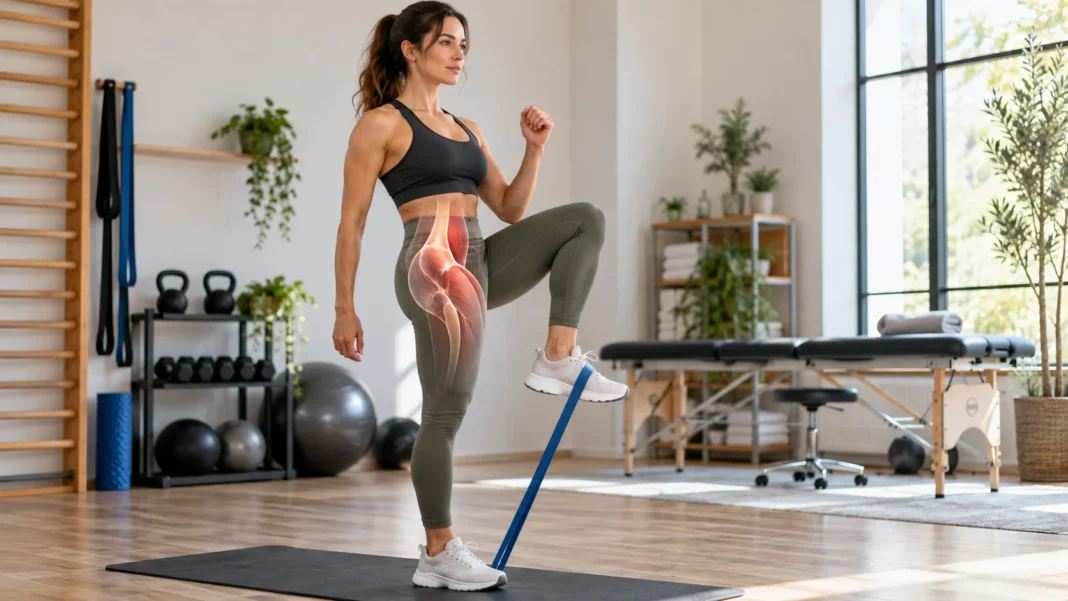
Strong hip flexors help support many everyday movements, from walking and climbing stairs to running, lifting the knees, and getting up from a chair. These muscles work closely with the hips, pelvis, core, and lower back, which means weakness can influence movement quality and overall stability. Learning how to strengthen hip flexors can therefore support better control during both daily activities and exercise.
Many people focus mainly on stretching their hip flexors because tightness is common after long periods of sitting. However, tight muscles are not always strong muscles, and some people benefit from improving strength alongside mobility. The goal is not simply to make the hip flexors work harder but to train them gradually with controlled movements that match your current ability.
This guide explains what strengthening the hip flexors means, why these muscles matter, signs they may need more strength, and practical exercises you can use. It also covers common mistakes, training frequency, mobility considerations, and ways to build a balanced routine without overworking the front of the hips.
What Does It Mean to Strengthen Hip Flexors?
Strengthening the hip flexors means training the muscles that help bring your thigh toward your torso and control movement around the front of the hip. Important muscles involved include the iliopsoas, rectus femoris, sartorius, and other supporting muscles. These structures work together whenever you lift your knee, step forward, climb stairs, or perform many athletic movements.
A strengthening exercise creates controlled resistance that challenges these muscles to produce force. Resistance can come from gravity, resistance bands, ankle weights, cables, or simply the weight of your leg. Over time, gradually increasing the challenge can improve muscular endurance, coordination, and the ability to manage movement during activities that repeatedly involve hip flexion.
Strength training is different from stretching because the goal is to improve force production rather than simply increase range of motion. Many people benefit from using both approaches because a muscle can feel stiff while still lacking strength or control. A balanced routine should consider mobility, strength, posture, and movement habits instead of treating every hip problem as simple tightness.
Why Strong Hip Flexors Are Important
Hip flexors help move your legs forward during walking, jogging, sprinting, and climbing stairs. Every time you raise your knee, these muscles contribute to the motion and help position your leg for the next step. Stronger hip flexors may make these repeated movements feel more controlled, especially during activities that require frequent or powerful knee lifting.
These muscles also interact with the pelvis and trunk during movement. When you walk or exercise, your hips do not work independently from your abdominal muscles, glutes, and lower back. Improving hip flexor strength while also training nearby muscle groups can support coordinated movement instead of allowing one area to compensate excessively for weakness somewhere else.
Athletes often train hip flexion because it contributes to activities such as running, cycling, kicking, and changing direction. However, hip flexor strength is also useful for non-athletes who simply want to move comfortably in daily life. Standing from low positions, stepping over obstacles, getting into vehicles, and climbing stairs all involve some degree of controlled hip flexion.
Signs Your Hip Flexors May Need Strengthening
Difficulty lifting your knees against resistance can sometimes suggest that your hip flexors are not producing much force. You may notice this during marching exercises, climbing steep stairs, or raising one leg while seated. However, weakness should not be diagnosed from one movement alone because pain, mobility restrictions, fatigue, balance, or other muscle groups can also affect performance.
Another possible sign is excessive compensation during leg-lifting exercises. For example, you might lean your torso backward, rotate your pelvis, or use momentum because maintaining a controlled hip-flexion movement feels difficult. These compensations do not automatically mean something is wrong, but they can indicate that the exercise is currently too challenging for your strength or movement control.
Fatigue at the front of the hips during repeated knee lifts may also highlight limited endurance. If you experience sharp pain, numbness, persistent weakness, or significant difficulty walking, exercise may not be the appropriate first step. In those situations, getting an assessment from a qualified healthcare professional can help identify what is contributing to the problem.
Best Exercises to Strengthen Hip Flexors
Seated knee lifts are one of the simplest ways to begin strengthening the hip flexors. Sit upright near the edge of a stable chair, keep your torso tall, and slowly raise one knee a few inches before lowering it with control. Avoid leaning backward or swinging the leg because slower movement makes it easier to keep the hip flexors working throughout the exercise.
Standing marches provide another accessible option while also challenging balance. Stand tall near a wall or sturdy surface for support, then lift one knee toward your chest without allowing your body to lean. Pause briefly, lower the foot slowly, and switch sides while focusing on smooth movement rather than trying to raise your knee as high as possible.
Straight-leg raises can provide a greater challenge for some people. Lie on your back with one knee bent and the other leg straight, tighten the front of the thigh, and lift the straight leg gradually. Keep the lower back comfortable and stop if the movement creates pinching or pain around the hip instead of normal muscular effort.
How to Strengthen Hip Flexors With Resistance Bands
Resistance bands make it easier to progressively challenge the hip flexors without using heavy equipment. Secure a band safely behind you and place the other end around your ankle, then stand tall while holding onto something stable if needed. Bring your knee forward against the band’s resistance while keeping the movement controlled through both the lifting and lowering phases.
Start with lighter resistance because hip-flexion exercises can become difficult quickly when a band is added. The goal is to feel steady muscular work without needing to swing your leg, twist your hips, or lean backward. When you can complete your planned repetitions with good control, you can gradually increase resistance or add repetitions instead of rushing to a much stronger band.
Bands can also be used for seated resisted marches. Place a loop band around your feet and lift one knee while keeping the other foot relatively stable. This variation allows you to train hip flexion in a supported position, which can be useful if standing balance makes traditional band exercises difficult or distracts you from focusing on the target muscles.
Strengthening Hip Flexors Without Overworking Them
More exercise does not automatically produce better results. Hip flexors are already active during walking, running, stair climbing, cycling, and many abdominal exercises, so adding large amounts of direct training may create unnecessary fatigue. Begin with a manageable amount of work and increase the challenge gradually based on how your muscles respond during and after each session.
Training should generally produce muscular effort rather than sharp or persistent pain. Mild temporary soreness can occur when introducing unfamiliar exercises, but discomfort around the groin or front of the hip that repeatedly worsens deserves attention. Reducing resistance, improving technique, or temporarily changing the exercise may be more useful than continuing through increasing symptoms.
Recovery also matters because muscles need time to adapt after resistance training. Alternating harder hip-flexor sessions with lighter movement or rest can help you avoid repeatedly stressing the same tissues. A well-rounded routine should also include exercises for the glutes, hamstrings, core, and other hip muscles so the front of the hips is not trained in isolation.
Should You Stretch and Strengthen Hip Flexors Together?
Stretching and strengthening can complement one another when they address different needs. Stretching may help improve comfortable movement when hip flexors feel restricted, while strengthening can improve force production and control. Rather than assuming that every sensation of tightness requires more stretching, consider how the muscles perform during movement and whether weakness or fatigue may also be contributing.
A simple routine might include gentle dynamic movement before training and comfortable static stretching afterward. For example, controlled leg swings or walking may prepare the hips before resistance exercises, while a mild hip-flexor stretch can be used later if it feels helpful. None of these movements should require forcing your hip into an uncomfortable range.
People who spend long hours sitting may especially benefit from combining movement breaks, strength exercises, and mobility work. Sitting does not automatically damage the hip flexors, but staying in one position for extended periods can make the area feel stiff. Regular movement throughout the day can often be more useful than relying entirely on one long stretching session.
How Hip Flexors Work With the Core and Pelvis
The hip flexors attach around structures that interact closely with the pelvis and spine, which is why hip movement can influence how the trunk feels during exercise. Strong abdominal and pelvic muscles help provide a stable base while the legs move. Training hip flexion with good trunk control can therefore improve exercise quality more effectively than simply lifting the leg as high as possible.
During exercises such as marching or resisted knee drives, try to keep your pelvis relatively steady. Excessive arching of the lower back or leaning backward can shift the movement away from the intended pattern. Lightly engaging your abdominal muscles and moving through a comfortable range can help maintain better control while the hip flexors generate force.
Pelvic health involves more than just hip strength, and symptoms in this region can have many different causes. For example, issues such as frequent nighttime urination are not problems that should automatically be attributed to weak hip flexors. Looking at symptoms individually helps avoid assuming that every concern around the pelvis has the same muscular explanation.
How Often Should You Strengthen Hip Flexors?
For many beginners, direct hip-flexor strengthening does not need to happen every day. Two or three sessions per week can provide enough practice while allowing recovery between harder workouts. The exact frequency depends on your exercise intensity, current fitness level, other activities, and whether your hip flexors are already heavily involved in sports or training.
A beginner might start with one or two exercises and complete two sets of controlled repetitions on each side. Focus on maintaining good form rather than reaching a specific repetition target at any cost. Once the exercise feels easy and your technique remains consistent, progression can come from additional repetitions, slightly more resistance, longer holds, or a more challenging variation.
Pay attention to how you feel during the following day as well as during the workout itself. If your hip flexors remain excessively sore or your normal movement becomes uncomfortable, reduce the training volume. Strength develops through consistent exposure over time, so sustainable progress is generally more useful than completing difficult sessions that require long periods of recovery.
Common Mistakes When Strengthening Hip Flexors
Using momentum is one of the most common mistakes during hip-flexor exercises. Swinging the leg may allow you to complete more repetitions, but it reduces control and can make it difficult to judge whether the target muscles are actually handling the resistance. Slow lifting and lowering usually provides a better training stimulus while making compensations easier to notice.
Another mistake is adding too much resistance before learning the movement. Heavy bands or ankle weights may cause you to lean, twist, or shorten the movement because your body is trying to complete a task that is too difficult. Starting lighter allows you to establish control first and creates a clearer path for gradual progression later.
Ignoring other hip muscles can also create an unbalanced program. Hip flexors are only one part of the system that controls the pelvis and legs, so strengthening glutes, abductors, adductors, hamstrings, and core muscles is also valuable. A broader strength routine can support better movement than repeatedly targeting only the muscles at the front of the hip.
How to Progress Hip Flexor Exercises Safely
Progression should happen when your current exercise becomes manageable without losing control. If you can complete your repetitions smoothly, maintain stable posture, and recover comfortably afterward, you may be ready for a small increase in difficulty. Adding one variable at a time makes it easier to understand how your body responds to the new challenge.
You can progress by increasing repetitions, adding another set, using slightly stronger resistance, or choosing a more demanding position. For example, someone who begins with seated marches might eventually move to standing banded knee drives. Progress does not always mean using heavier resistance because better control, slower lowering, or a longer pause can also make an exercise harder.
Avoid comparing your progression directly with someone else’s because hip strength varies with training history, activity level, injuries, and overall conditioning. The most useful benchmark is whether your own movement is becoming stronger and more controlled over time. If an exercise causes recurring pain or symptoms worsen as resistance increases, professional guidance can help you adjust the program appropriately.
When Hip Flexor Pain Needs More Attention
Muscle fatigue during exercise is different from sharp, sudden, or persistent pain. If you feel pinching deep in the front of the hip, significant groin pain, or discomfort that changes the way you walk, continuing to load the area may not be appropriate. Reduce or stop the aggravating exercise rather than assuming that more strengthening will automatically solve the problem.
Hip pain can have many potential sources, including muscles, tendons, joints, nerves, or nearby structures. Because symptoms can overlap, it is difficult to determine the cause based only on where you feel discomfort. Persistent symptoms, noticeable weakness, swelling, numbness, or pain following an injury are reasonable reasons to seek assessment from a qualified healthcare professional.
Strengthening can be valuable when weakness or reduced capacity is part of the problem, but exercise should match the underlying situation. Some people need gradual strengthening, while others may require temporary activity modification, mobility work, rehabilitation, or medical evaluation. Paying attention to symptoms helps you choose exercises based on your actual needs rather than following a generic routine blindly.
Conclusion
Learning how to strengthen hip flexors can help improve knee lifting, walking, stair climbing, running, and many other movements involving the hips and legs. Effective training usually involves controlled exercises such as seated marches, standing knee lifts, straight-leg raises, and resistance-band movements. The emphasis should remain on quality, gradual progression, and comfortable movement.
Strong hip flexors work best as part of a balanced lower-body program. Training the glutes, hamstrings, core, and surrounding hip muscles can support better control across the entire pelvis rather than placing excessive attention on one muscle group. Combining appropriate strengthening with mobility and regular movement can also help address stiffness associated with long periods of sitting.
Start with exercises that match your current ability and increase the difficulty gradually as your control improves. Normal muscular effort is expected, but persistent pain, sudden weakness, or significant movement problems deserve professional attention. Consistency matters more than intensity, and steady training over time is usually the most practical way to build stronger, more capable hip flexors.
FAQs
What is the best exercise to strengthen hip flexors?
Seated marches and controlled standing knee raises are good starting options because they directly train hip flexion. Resistance bands can be added later when basic movements become easy.
Can weak hip flexors cause problems when walking?
Weakness may make repeated knee lifting or stepping feel more difficult, but walking problems can have many causes. Persistent weakness, pain, or changes in gait should be evaluated appropriately.
Should I strengthen my hip flexors every day?
Daily direct strengthening is usually unnecessary for most beginners. Two or three weekly sessions often provide enough training while allowing the muscles time to recover between harder workouts.
How long does it take to strengthen hip flexors?
Improvement varies depending on your starting strength, training consistency, resistance, and overall activity level. Gradual progress over several weeks is more realistic than expecting major changes after only a few workouts.
Is stretching enough for tight hip flexors?
Not always. A muscle can feel tight while also lacking strength or control, so some people benefit from combining mobility work with progressive strengthening rather than relying entirely on stretching.