


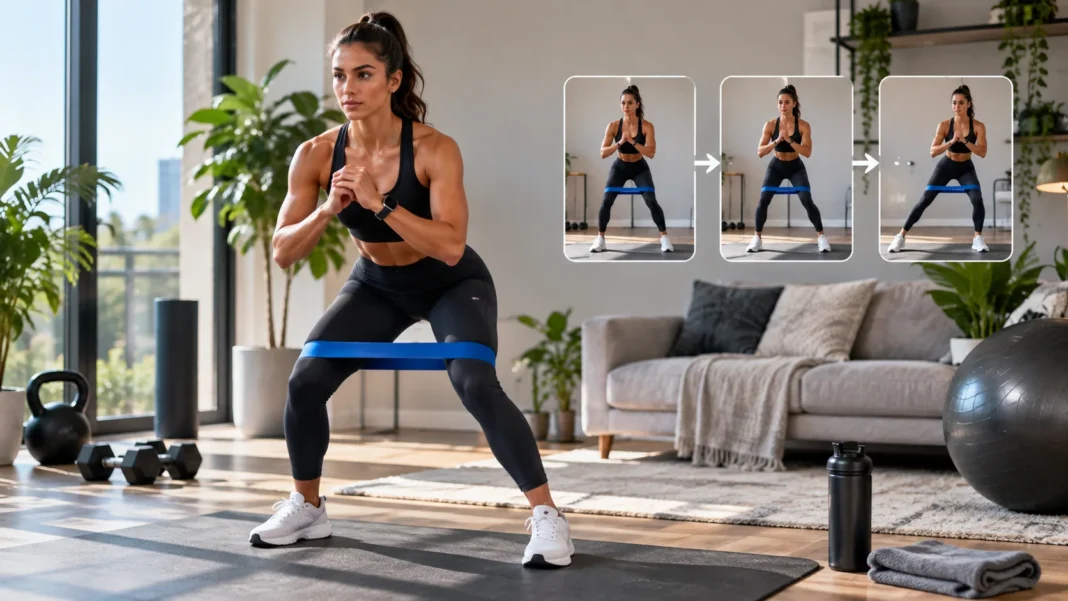
What Is the Monster Walk Exercise?
The monster walk exercise is a resistance-band movement that strengthens the hips, glutes, and surrounding stabilizing muscles. It involves stepping forward, backward, or diagonally while maintaining tension on a loop band placed around the legs. The exercise is commonly used in strength training, warm-ups, rehabilitation programs, and athletic conditioning because it challenges lower-body control without requiring heavy weights.
Unlike regular walking, monster walks require you to stay in a partial squat while keeping your knees aligned and the resistance band stretched. This position forces the hip muscles to remain active throughout the movement. The exercise may look simple, but maintaining proper posture, controlled steps, and constant band tension makes it surprisingly demanding when performed correctly.
Monster walks are especially useful for people who want to improve hip stability, strengthen the glute muscles, or prepare their lower body for squats, running, jumping, and other exercises. They can be performed almost anywhere with a small resistance band. Learning the correct technique is important because poor form can reduce muscle engagement and place unnecessary stress on the knees or lower back.
What Muscles Do Monster Walks Work?
Monster walks primarily target the gluteus medius and gluteus maximus, two important muscles around the hips and buttocks. The gluteus medius helps stabilize the pelvis and control the position of the legs during walking, running, and single-leg movements. The gluteus maximus contributes to hip extension and helps generate force during activities such as squats, climbing stairs, and jumping.
The exercise also engages smaller hip stabilizers that help keep the knees and pelvis aligned while you move. The quadriceps and hamstrings assist because you remain in a partially bent-knee position throughout each step. Your core muscles also work to maintain an upright torso and prevent unnecessary twisting as you move against the resistance of the band.
Because monster walks involve several lower-body muscles working together, they are often used as an activation exercise before more demanding strength movements. They are not meant to replace heavy compound exercises, but they can complement them effectively. Stronger hip muscles may also improve control during lunges, deadlifts, squats, and other movements that require stable knees and hips.
Benefits of Adding Monster Walks to Your Workout
One major benefit of monster walks is improved hip strength and stability. Strong hip muscles help control how the knees, pelvis, and legs move during exercise and everyday activities. This can be particularly valuable for runners, athletes, and people performing lower-body strength training because good hip control helps maintain efficient movement patterns when the body becomes tired.
Monster walks can also improve glute activation before a workout. Some people have difficulty feeling their glutes working during squats or lunges, especially when they spend long periods sitting during the day. Performing controlled band walks during a warm-up can increase awareness of these muscles and help prepare the hips for more challenging exercises later in the session.
Another advantage is convenience. A resistance band is inexpensive, portable, and easy to use at home, in a gym, or while traveling. Monster walks require very little space and can be adjusted by changing band resistance, step size, or exercise duration, making them suitable for beginners and experienced exercisers who want an effective lower-body accessory movement.
How to Do Monster Walks Correctly
Start by placing a loop resistance band around your legs and standing with your feet about hip-width apart. Slightly bend your knees and push your hips back as if beginning a shallow squat. Keep your chest lifted, core engaged, and weight balanced through your feet while maintaining enough distance between your legs to create constant tension in the band.
Take a controlled diagonal step forward with one foot, then follow with the opposite foot without allowing your feet to come completely together. Continue alternating sides so your walking pattern moves forward while maintaining the same squat position. Keep the knees tracking in line with the toes and avoid allowing the band to pull your legs inward between steps.
After completing the desired number of forward steps, you can reverse the movement and walk backward using the same controlled diagonal pattern. Move slowly enough to maintain balance and muscular tension rather than rushing through repetitions. The goal is not to cover distance quickly but to keep the glutes active and maintain consistent alignment throughout every step.
Where Should You Place the Resistance Band?
Placing the resistance band above the knees is often the easiest option for beginners. This position provides resistance while allowing you to focus on proper knee tracking, hip position, and stepping technique. It can also be useful when learning the exercise because the band creates less leverage than positions farther down the legs, making the movement easier to control.
Placing the band around the ankles increases the challenge because the resistance acts farther from the hips. This position requires stronger hip abductor activation and greater control during each step. You must keep your feet separated and avoid dragging them inward, which makes ankle-level monster walks suitable for people who already understand the movement and can maintain good alignment.
Some exercisers place the band around the forefoot for an even greater challenge, but this version requires good ankle and hip control. The best band position depends on your strength, experience, and training goals. Choose a position that allows smooth steps and stable knees rather than using the hardest variation if it causes your technique to break down.
Common Monster Walk Mistakes to Avoid
One common mistake is allowing the knees to collapse inward while stepping. This usually happens when the resistance band is too strong or when the hips become fatigued. Keep gentle outward pressure against the band and make sure each knee continues pointing in roughly the same direction as the toes rather than drifting toward the center.
Another mistake is standing too upright. Monster walks are more effective when you maintain a small amount of knee and hip flexion, creating a stable athletic position throughout the exercise. Standing tall between steps reduces continuous muscle tension, while squatting excessively can turn the movement into a tiring leg exercise that makes controlled stepping unnecessarily difficult.
Taking steps that are too large can also reduce control and encourage the body to rock from side to side. Use moderate steps that allow your pelvis to remain relatively level and your torso stable. Avoid bouncing, rushing, or letting the trailing foot snap inward because the goal is controlled tension rather than simply completing as many steps as possible.
Monster Walks vs Other Lower-Body Exercises
Monster walks mainly train hip stability and controlled movement rather than maximum lower-body strength. Exercises such as squats, deadlifts, and lunges allow you to use heavier resistance and train larger muscle groups through greater ranges of motion. Monster walks work well as an accessory exercise because they emphasize smaller stabilizing muscles that may receive less focused attention during traditional strength training.
For example, wide-stance squat variations place substantial demand on the glutes, thighs, and inner-leg muscles while allowing progressive resistance. If you are comparing exercises, learning about the sumo squat muscles worked can help you understand how different lower-body movements target the hips and legs. Combining compound strength exercises with band work can create a more balanced routine.
Lateral band walks are another similar exercise, but the movement direction is different. Lateral walks involve stepping directly sideways, while monster walks usually use diagonal forward and backward steps. Both exercises can strengthen hip abductors and glutes, so many training programs use them interchangeably or rotate between them depending on the athlete’s needs and movement goals.
How to Add Monster Walks to Your Workout
Monster walks work well during a warm-up before lower-body training. You can perform them after general movement such as light cycling or walking and before heavier exercises like squats, lunges, or deadlifts. Using a light or moderate resistance band allows you to activate the hips without creating excessive fatigue before the main strength portion of your workout begins.
They can also be performed near the end of a workout as an accessory exercise. In this situation, you may use slightly more resistance or complete longer sets because preserving energy for heavy lifting is no longer as important. Focus on maintaining good form even when your muscles feel tired, since technique often starts deteriorating during the final repetitions.
Monster walks can also fit into home workouts, mobility routines, or athletic training sessions. Pair them with exercises such as glute bridges, step-ups, split squats, or bodyweight squats for a simple lower-body circuit. The exercise is flexible enough to use several times per week, provided your hips recover comfortably and you are not experiencing pain or excessive soreness.
How Many Monster Walks Should You Do?
Beginners can start with two or three sets of approximately eight to twelve steps in each direction. Focus on slow, controlled movement rather than trying to complete a large number of repetitions. If maintaining band tension becomes difficult or your knees begin collapsing inward, stop the set because continuing with poor technique is unlikely to provide additional benefit.
As your hip strength improves, gradually increase the number of steps, sets, or resistance. You might progress toward twelve to twenty controlled steps in each direction depending on your goals and fitness level. Increasing only one variable at a time makes it easier to determine whether you are becoming stronger without adding unnecessary fatigue or compromising movement quality.
There is no perfect number of repetitions for everyone. Athletes using monster walks during a warm-up may perform fewer repetitions, while someone using them as a strengthening exercise may complete longer sets. Choose a volume that creates noticeable muscle effort in the hips and glutes while still allowing you to maintain consistent posture and controlled movement from start to finish.
How to Make Monster Walks Easier or Harder
To make monster walks easier, choose a lighter resistance band and place it above your knees. Use shorter steps and a slightly higher body position until you become comfortable maintaining knee alignment. You can also reduce the number of repetitions and focus on mastering the stepping pattern before increasing resistance or moving the band farther down your legs.
To make the exercise harder, use a stronger band or move it from above the knees toward the ankles. You can increase the number of steps, move more slowly, or maintain a slightly deeper athletic stance. These changes increase the amount of time your hip muscles remain under tension without requiring additional gym equipment or complicated exercise variations.
Advanced exercisers can include monster walks in supersets or circuits with squats, lunges, hip thrusts, or step-ups. However, difficulty should never come at the expense of technique. If stronger resistance causes your knees to collapse, your torso to sway, or your feet to drag inward, return to an easier variation until you can control the movement properly.
When Should You Be Careful With Monster Walks?
Monster walks should generally feel like muscular work around the hips and glutes rather than sharp pain in the knees, hips, ankles, or lower back. Mild muscle fatigue or burning can occur during resistance-band exercises, but joint pain is different. Stop the movement if you experience sharp, worsening, or unusual discomfort instead of forcing yourself to complete the planned repetitions.
People recovering from hip, knee, ankle, or lower-back injuries may need individual guidance before adding resistance-band walking exercises. The appropriate band position, resistance, and movement range can vary depending on the injury and stage of recovery. A qualified physical therapist or healthcare professional can help determine whether monster walks are appropriate within a rehabilitation or return-to-exercise program.
Good form matters more than resistance level. Start with an easier band and gradually progress as your strength and coordination improve, especially if you are new to lower-body resistance training. If the exercise consistently causes discomfort despite reducing resistance and correcting technique, choose another hip-strengthening movement rather than repeatedly training through pain.
Conclusion
The monster walk exercise is a simple but effective way to strengthen the glutes, improve hip stability, and prepare the lower body for more demanding movements. All you need is a resistance band and enough space to take several controlled steps. Proper technique makes the exercise more useful than simply choosing the strongest band available.
Keep your knees slightly bent, maintain tension on the band, and take controlled diagonal steps without allowing your legs to collapse inward. Focus on keeping your torso stable and your hips level while moving. Starting with a lighter band allows you to learn the technique before progressing to harder resistance, longer sets, or more challenging band positions.
Monster walks can work well in warm-ups, strength workouts, home routines, and athletic training programs. They are most effective when combined with other lower-body exercises rather than treated as a complete leg workout on their own. Use consistent form, progress gradually, and stop if you experience joint pain instead of normal muscular fatigue.
FAQs
Are monster walks good for glutes?
Yes. Monster walks primarily challenge the glute muscles and hip stabilizers, especially when you maintain constant band tension. They work well as an activation or accessory exercise alongside squats, lunges, and other lower-body movements.
Where should I feel monster walks?
You should mainly feel muscular effort around your outer hips and glutes. Some thigh involvement is normal, but sharp discomfort in your knees, hips, ankles, or lower back is a reason to stop and check your technique.
Should the band go above or below the knees?
Beginners often find it easier to place the band above the knees. Moving it toward the ankles increases leverage and difficulty, so lower band positions are usually better once you can maintain good control and alignment.
Can I do monster walks every day?
Daily monster walks may not be necessary for most people. Two or three sessions per week can provide useful practice and strengthening, although frequency depends on resistance, training volume, recovery, and the rest of your workout program.
Are monster walks good before squats?
Yes. Light monster walks can be used before squats to activate the hips and glutes without creating excessive fatigue. Keep the resistance moderate and the set relatively short when using them as part of your warm-up.