


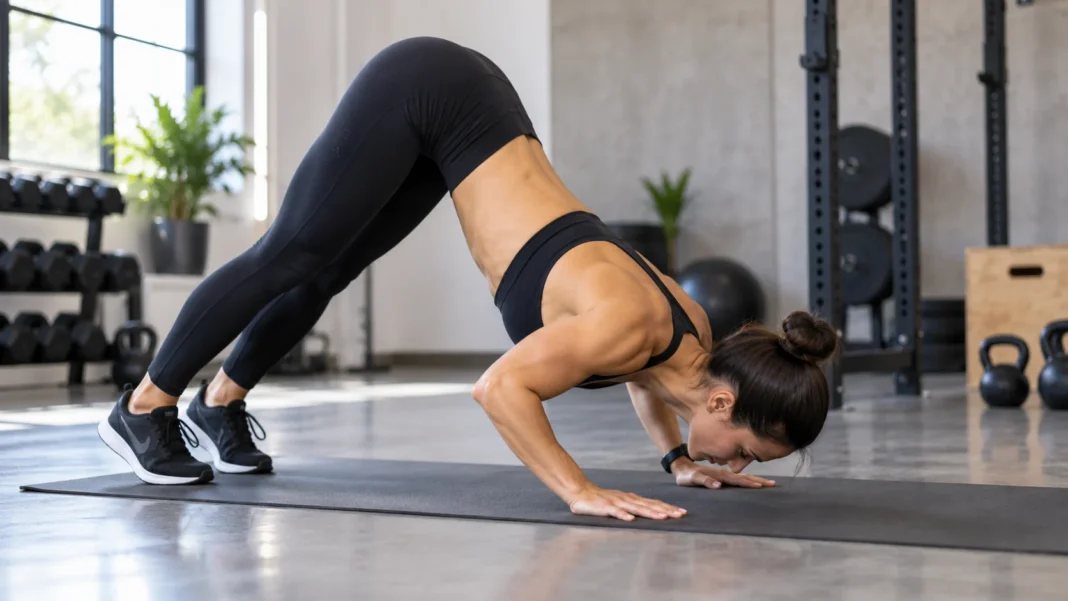
Pike push ups are a challenging bodyweight exercise that place more emphasis on the shoulders than a traditional push up. By raising your hips and shifting more body weight toward your upper body, you create a movement that resembles an overhead press without needing dumbbells or gym machines. They can help develop shoulder strength, triceps control, upper-body stability, and confidence for more advanced bodyweight exercises.
Although the movement looks simple, good technique matters. Poor hand placement, a collapsed upper back, limited shoulder mobility, or lowering your head in the wrong direction can make the exercise uncomfortable and reduce its effectiveness. Learning the correct setup, range of motion, and progression can help you perform pike push ups more safely and get more from every repetition.
What Are Pike Push Ups?
Pike push ups are a bodyweight pressing exercise performed with the hips raised toward the ceiling and the torso angled toward the floor. Unlike a standard push up, where your body stays relatively straight, the pike position shifts more resistance toward the shoulders. This makes the movement useful for developing overhead pressing strength without traditional gym equipment.
The exercise primarily targets the deltoids, triceps, and upper chest while also requiring the core, upper back, and stabilizing muscles to stay active. Your hands remain on the floor while your hips form the highest point of the body. As you bend your elbows, your head moves toward the floor before you press back to the starting position.
Pike push ups are often used as a progression toward more advanced movements such as elevated pike push ups and handstand push ups. They can also be useful as a standalone shoulder exercise in home workouts. Because difficulty can be adjusted through body position, the movement works well for many intermediate bodyweight training programs.
Muscles Worked During Pike Push Ups
The front and side portions of the shoulders do much of the work during a pike push up. As your body lowers, the deltoids control the movement before helping press your upper body away from the floor. Raising the hips higher generally shifts even more body weight toward the shoulders, increasing the challenge.
Your triceps also play an important role by extending the elbows as you push yourself upward. The upper chest contributes to the pressing movement, particularly when your torso is less vertical. At the same time, the muscles around your shoulder blades help maintain stability so your shoulders can move smoothly throughout each repetition.
The core, hips, and upper back work mainly as stabilizers rather than primary movers. Keeping tension through these areas helps prevent your body from collapsing or shifting unpredictably during the exercise. Although pike push ups are mainly considered an upper-body movement, good performance depends on coordinated control throughout much of the body.
How to Do Pike Push Ups Correctly
Begin in a high plank position with your hands around shoulder-width apart and your fingers spread comfortably. Walk your feet slightly toward your hands while lifting your hips toward the ceiling until your body forms an inverted V shape. Keep your arms straight at the start, brace your core, and allow your heels to remain lifted if hamstring flexibility is limited.
Bend your elbows and lower your head toward the floor slightly in front of your hands rather than dropping straight between them. Your elbows should remain controlled instead of flaring dramatically outward. Continue lowering only as far as you can maintain good shoulder control, then pause briefly before pressing firmly through your palms.
Straighten your elbows while pushing the floor away and return to the starting pike position. Keep your hips elevated rather than allowing your body to turn into a regular push up. Move slowly enough to control each repetition, especially when learning the exercise, and focus on consistent technique instead of trying to complete as many repetitions as possible.
Common Pike Push Up Mistakes
One common mistake is allowing the hips to drop as fatigue develops. When this happens, the exercise gradually becomes closer to a standard push up and reduces the amount of work performed by the shoulders. Maintaining the inverted V position helps preserve the intended pressing angle and keeps the movement focused on overhead strength.
Another mistake is lowering the head directly between the hands. Ideally, the head should travel slightly forward as you descend, creating a small triangular relationship between your head and hands near the bottom. This movement pattern can help produce a more natural pressing path and better prepare you for advanced vertical pushing exercises.
Excessive elbow flaring can also make the movement less controlled. Your elbows do not need to remain completely tucked against your body, but they should not point directly sideways either. Using a comfortable angle, keeping your palms firmly planted, and controlling the descent can improve stability while helping you avoid unnecessary stress around the shoulders and wrists.
How Deep Should You Go?
Your ideal pike push up depth depends on shoulder strength, mobility, experience, and comfort. Beginners do not need to touch their head to the floor on every repetition. A shorter range of motion performed with good control is often more useful than forcing a deeper position that causes the shoulders, neck, or wrists to feel uncomfortable.
As you become stronger, gradually increase the range until your head moves closer to the floor while the rest of your position remains stable. The deepest repetition is not automatically the best repetition if your hips collapse or your elbows lose control. Progress should come from improving both strength and movement quality rather than chasing depth alone.
You can also place a cushion or yoga block beneath your head as a reference point. This provides a consistent target while helping you monitor your range over time. Once you can comfortably reach that target for several controlled repetitions, you can lower the target or progress to a more difficult pike push up variation.
Pike Push Ups for Beginners
Beginners can start with a reduced range of motion to learn the pressing pattern without placing excessive demand on the shoulders. Set up in the normal pike position but lower only a few inches before pressing back upward. Focus on keeping the hips high, elbows controlled, and hands firmly connected with the floor throughout the movement.
Another option is performing pike push ups with your hands elevated on a sturdy bench, box, or countertop. Elevating the hands reduces the percentage of body weight your upper body must move, making the exercise easier. As strength improves, gradually use a lower surface until you can perform controlled repetitions with your hands on the floor.
Do not rush directly into advanced variations simply because the beginner version feels manageable for a few repetitions. Build enough strength to perform consistent sets without losing your position. For many people, completing several sets of controlled pike push ups provides a stronger foundation than attempting difficult handstand movements before the shoulders are adequately prepared.
How to Make Pike Push Ups Harder
Elevating your feet is one of the most effective ways to increase pike push up difficulty. Place your feet on a stable bench, box, or step while keeping your hands on the floor. This creates a more vertical torso position and moves a greater percentage of your body weight toward the shoulders, making each repetition significantly more demanding.
You can also slow down the lowering phase. Taking three or four seconds to descend increases time under tension and makes the shoulders work harder without adding external weight. Pausing near the bottom before pressing upward can further increase difficulty while encouraging better control through the most challenging portion of the exercise.
Eventually, elevated pike push ups can help prepare you for wall-supported handstand push ups. However, progression should remain gradual because vertical pressing places substantial demand on the shoulders, elbows, and wrists. Mastering each stage before advancing makes it easier to develop strength without relying on momentum or compensating with poor technique.
Wrist, Shoulder, and Lower-Body Positioning
Your wrists support a large amount of body weight during pike push ups, so hand placement should feel stable. Spread your fingers and press through the whole hand rather than allowing your weight to collapse toward the outer edge of the palm. A gentle wrist warm-up can also make the position more comfortable before harder pressing sessions.
Shoulder position should remain strong rather than allowing your upper body to collapse between your arms. Think about pushing the floor away at the top while maintaining space between your shoulders and ears. If you experience sharp shoulder discomfort, reduce the range, adjust your setup, or stop the movement until you understand what is causing the problem.
Your legs do not need to remain perfectly straight if hamstring flexibility is limited. A slight bend in the knees can help you maintain a better torso position while keeping the hips high. If lower-body movements are also uncomfortable, understanding issues such as knee pain when squatting can help you separate upper-body exercise limitations from unrelated knee symptoms.
Pike Push Ups vs Regular Push Ups
Regular push ups primarily emphasize the chest, triceps, and front of the shoulders while keeping the body in a relatively straight plank position. Pike push ups shift the torso angle and transfer more body weight toward the shoulders. This makes them better suited for building the vertical pressing strength required for overhead and handstand-style movements.
The two exercises should not necessarily replace one another because they train different pressing angles. Regular push ups remain valuable for horizontal pushing strength, while pike push ups provide a stronger shoulder-focused challenge. Including both movements in a balanced program can help develop more complete upper-body pressing strength without requiring gym equipment.
Your choice should depend on your goals and current ability. If you want stronger shoulders or eventually hope to perform handstand push ups, pike variations deserve more attention. If general chest strength and basic pushing ability are your priorities, traditional push ups may remain the foundation while pike push ups are added as a secondary exercise.
How Many Pike Push Ups Should You Do?
Beginners may start with two or three sets of five to eight controlled repetitions. The exact number matters less than maintaining good technique throughout each set. Stop the set when your hips begin dropping, your elbows become difficult to control, or you can no longer lower yourself through a consistent range.
Intermediate exercisers may perform three or four sets of eight to twelve repetitions, depending on their strength and training goals. Once twelve repetitions feel easy with clean form, increasing difficulty may be more useful than continuing to add repetitions. Foot elevation, slower tempos, or deeper ranges can provide progressive overload without turning the exercise into an endurance challenge.
Allow enough recovery between shoulder-focused workouts, particularly if you also perform overhead presses, handstands, dips, or other demanding upper-body exercises. Training frequency depends on your total program, but many people do well practicing pike push ups two or three times per week. Recovery gives the muscles and connective tissues time to adapt to increasing training demands.
How to Add Pike Push Ups to Your Workout
Pike push ups can be performed early in an upper-body session when shoulder strength is a major priority. After warming up, complete your most difficult pike variation before easier pushing exercises. Training the movement while fresh makes it easier to maintain good technique and produce enough force during each repetition.
You can pair pike push ups with pulling exercises such as rows or pull ups to create a balanced upper-body session. For example, alternate one set of pike push ups with one set of bodyweight rows, resting as needed between exercises. This approach trains both pushing and pulling muscles without overloading the same movement pattern repeatedly.
They can also be included in full-body routines alongside squats, lunges, hip hinges, core exercises, and pulling movements. Avoid adding too many similar pressing exercises in the same workout if your shoulders are not accustomed to the volume. A simple program with gradual progression usually produces better results than constantly adding more exercises.
When Pike Push Ups May Not Be Right for You
Pike push ups may not be appropriate if you currently have significant shoulder, elbow, wrist, or neck pain. The exercise places substantial body weight through the upper extremities and requires enough mobility to reach the pike position comfortably. Continuing through sharp or worsening pain is unlikely to improve technique and may aggravate an already sensitive area.
People returning from an upper-body injury may need easier pressing variations first. Wall push ups, incline push ups, or rehabilitation exercises recommended by a qualified professional may provide a more suitable starting point. Your ability to perform standard push ups comfortably does not automatically mean your shoulders are ready for the increased loading of pike push ups.
Seek professional advice if pain persists, weakness develops suddenly, or you experience numbness, significant swelling, or loss of normal movement. A physical therapist or other qualified healthcare professional can help identify the source of symptoms. Once the problem is understood, they can also help determine whether modified pike push ups can safely return to your program.
Conclusion
Pike push ups are an effective bodyweight exercise for building shoulder strength, triceps control, and upper-body stability. The key is maintaining high hips, controlled elbows, a stable hand position, and a smooth lowering path. Starting with a manageable range gives you time to develop strength before moving toward harder variations.
Progress does not need to happen quickly. Hand elevation can make the movement easier, while foot elevation, slower repetitions, and deeper ranges can increase the challenge as your strength improves. Focusing on clean repetitions instead of simply chasing higher numbers helps ensure that the intended muscles continue doing the work.
Whether your goal is stronger shoulders, better bodyweight fitness, or eventually performing handstand push ups, pike push ups can provide a valuable stepping stone. Practice consistently, increase difficulty gradually, and pay attention to how your shoulders and wrists respond. Good technique combined with steady progression will usually provide more benefit than attempting advanced variations too soon.
FAQs
Are pike push ups good for shoulders?
Yes, pike push ups place substantial emphasis on the shoulders, particularly the front deltoids. They also train the triceps, upper chest, core, and stabilizing muscles around the shoulder blades.
Are pike push ups harder than regular push ups?
They can be harder on the shoulders because more body weight shifts toward the upper body. Difficulty also depends on hip height, range of motion, foot elevation, strength, and individual body proportions.
Can beginners do pike push ups?
Yes, beginners can start with a shorter range of motion or elevate their hands on a sturdy surface. Gradually lowering the surface helps build enough shoulder strength for the standard floor version.
Do pike push ups help with handstand push ups?
Yes, they can help develop the vertical pressing strength and movement pattern needed for handstand push ups. Elevated pike push ups provide an especially useful progression before moving to wall-supported handstand variations.
How often should I do pike push ups?
Two or three sessions per week may work well for many people, depending on their overall training program. Allow adequate recovery, especially if you also perform other demanding shoulder or overhead pressing exercises.