


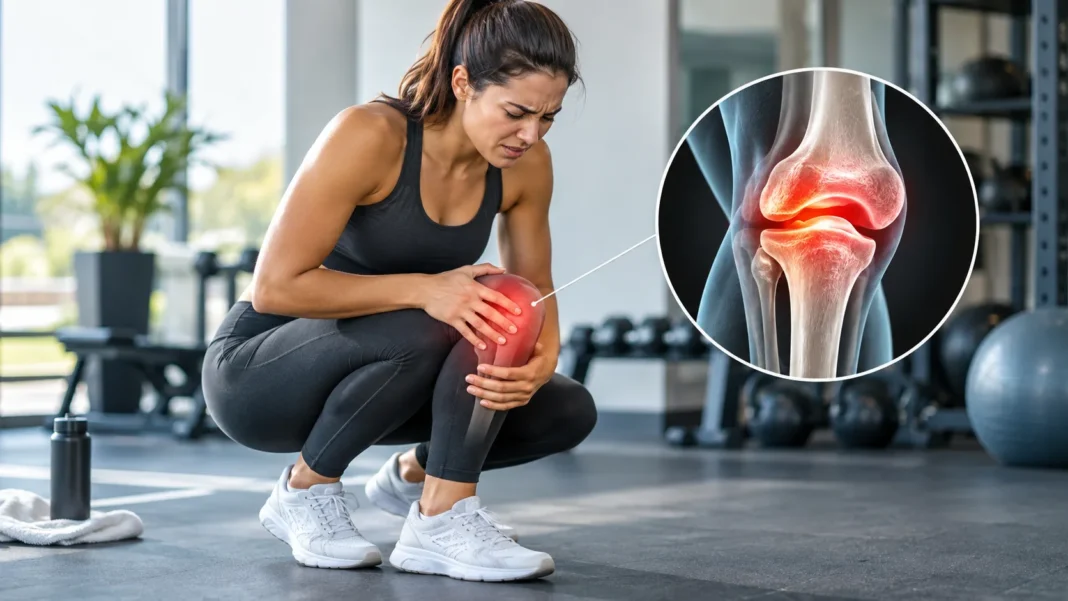
Knee pain during squats can be frustrating, especially when the movement is part of your workout, job, or everyday routine. Squatting places significant demand on the knees, hips, ankles, and surrounding muscles, so discomfort can develop when one part of that movement system is overloaded, irritated, weak, or not moving efficiently.
Sometimes the cause is relatively simple, such as doing too much training too quickly or using a squat depth your body is not ready for. In other situations, pain may be connected with tendon irritation, kneecap sensitivity, arthritis, or an existing injury. Understanding where the pain occurs and what movements trigger it can help you decide what to do next.
Why Do My Knees Hurt When I Squat?
Squatting naturally increases pressure through the knee joint as the knees bend and the muscles work to control your body weight. This pressure is not automatically harmful, and healthy knees are designed to tolerate it. Pain may develop, however, when the amount of stress exceeds what your muscles, tendons, or joints are currently prepared to handle.
A sudden increase in squat volume, heavier weights, deeper repetitions, running, jumping, or other lower-body training can increase knee sensitivity. Your knees may also become irritated when you repeatedly perform movements without enough recovery between workouts. This is why someone can squat comfortably for months and suddenly notice discomfort after changing their training routine.
The location and type of pain can provide useful clues. Pain around or behind the kneecap may feel different from tenderness below the kneecap, discomfort along the joint line, or stiffness throughout the entire knee. Paying attention to swelling, clicking, instability, and how long symptoms last can help determine whether simple training modifications are enough.
Patellofemoral Pain and Kneecap Irritation
Pain around the front of the knee is commonly associated with irritation around the kneecap and the joint beneath it. You may notice discomfort while squatting, climbing stairs, running downhill, or sitting with your knees bent for long periods. The symptoms can range from a dull ache to a sharper sensation during deeper knee bending.
The kneecap moves through a groove in the thigh bone whenever you bend and straighten your knee. Muscle strength, training load, hip control, and movement habits can influence how much stress you feel in this area. Pain does not necessarily mean the joint is damaged, but persistent sensitivity usually deserves attention rather than repeatedly pushing through it.
Reducing painful squat depth temporarily can sometimes make training more comfortable while you rebuild tolerance. Strengthening the quadriceps, hips, and surrounding muscles can also help the knee manage gradually increasing loads. The goal is usually not to avoid knee movement forever but to find a manageable level of activity and progressively build from there.
Squat Form and Training Load Can Affect Knee Pain
There is no single perfect squat technique that works for every body. Limb length, ankle mobility, hip structure, stance width, training goals, and previous injuries can all influence how someone naturally squats. Problems are more likely when a technique forces you into positions you cannot comfortably control or when load increases faster than your body can adapt.
Allowing the knees to travel forward during a squat is not automatically dangerous. However, if you suddenly increase depth, weight, repetitions, or frequency, the additional demand may irritate a sensitive knee. Improving control and adjusting training variables can often be more useful than trying to keep your knees behind your toes during every repetition.
Squats also involve the hips, trunk, and pelvic region rather than working the knees in isolation. If your discomfort is actually located around the pelvis instead of the knee, learning more about pelvic floor pain may help you distinguish between different symptoms. Correctly identifying where the pain originates is important before changing your exercises.
Limited Ankle or Hip Mobility May Change Your Squat
Ankle mobility plays an important role in how comfortably you can lower into a squat. If your ankles have limited ability to move forward over your feet, your body may compensate by lifting the heels, turning the feet excessively outward, leaning forward, or changing knee position. These adjustments can make the movement feel less stable or comfortable.
Hip mobility can influence squat depth and stance in a similar way. Some people naturally squat better with a slightly wider stance or more toe rotation, while others feel comfortable with their feet closer together. Trying to copy another person’s exact squat position may create unnecessary discomfort if your anatomy and mobility are different.
Improving mobility should focus on areas that are actually limited rather than stretching everything aggressively. Controlled ankle movements, calf stretches, hip mobility drills, and gradual exposure to comfortable squat depths can be useful. If one side feels dramatically different from the other, a qualified rehabilitation professional can help identify whether mobility restrictions are contributing to your symptoms.
Weakness and Poor Muscular Control Can Increase Stress
Your quadriceps are heavily involved in controlling the knee during squatting. If they are not prepared for the demands of your workouts, the movement may become uncomfortable as fatigue increases. Weakness does not mean you should avoid squatting completely, but it may mean starting with lighter resistance and building capacity more gradually.
The gluteal muscles also help control the hips and thighs as you lower and rise from a squat. Poor hip control may cause the knees or pelvis to move in ways that feel unstable, particularly during single-leg exercises. Strengthening the hips can therefore be useful as part of a broader lower-body program rather than treating the knee completely in isolation.
Muscular endurance matters as much as maximum strength. Your first few squats may look controlled, while later repetitions become less stable as the muscles fatigue. Using appropriate weights, stopping before technique breaks down significantly, and progressing volume gradually can help your muscles become better prepared for repeated squatting without overwhelming sensitive tissues.
Tendons, Meniscus, and Arthritis Can Also Cause Symptoms
The patellar tendon runs between the kneecap and shin and can become irritated with repeated jumping, running, or heavy lower-body training. Tendon discomfort is often felt just below the kneecap and may be more noticeable during loaded squats. Symptoms can develop when activity increases more quickly than the tendon can adapt to the additional demand.
The meniscus is cartilage inside the knee that helps distribute forces through the joint. Some meniscus problems can cause pain along the inside or outside joint line, particularly during bending or twisting movements. Clicking alone does not always mean something serious, but pain combined with swelling, locking, or difficulty straightening the knee deserves professional assessment.
Arthritis can also make deep knee bending uncomfortable, particularly when stiffness, reduced mobility, or swelling is present. However, having arthritis does not automatically mean you must stop strength training. Appropriate exercise is often still possible, but the depth, resistance, frequency, and type of movement may need to be adjusted according to your symptoms and abilities.
How to Modify Squats When Your Knees Hurt
Start by finding a squat depth that does not significantly increase your symptoms. Instead of forcing yourself into a deep squat, use a box, bench, or chair as a target and gradually lower the height as your comfort improves. This allows you to continue practicing the movement while controlling how much knee bending occurs.
Reducing resistance can also help determine whether training load is contributing to the problem. Try bodyweight squats or lighter weights before returning to heavy barbell training. Slower repetitions may improve control, but they can also increase muscular effort, so use a pace that feels manageable rather than automatically making every repetition extremely slow.
You can also adjust stance width, foot angle, or exercise variation to find a more comfortable position. Goblet squats, box squats, supported squats, and sit-to-stand movements may feel different from traditional back squats. A modification is useful when it allows you to train productively without causing symptoms that become noticeably worse during or after the session.
Exercises That May Help Build Stronger Knees
Simple sit-to-stand exercises can be a good starting point if full squats are painful. Sit on a stable chair and stand using controlled movement, then slowly lower yourself back down. As strength improves, you can use a lower chair, add repetitions, or introduce external resistance while keeping symptoms within a manageable range.
Step-ups and controlled split squats can help strengthen the quadriceps and glutes while allowing you to work each leg individually. Start with a low step or shallow movement range before increasing difficulty. These exercises can reveal strength differences between sides and provide an alternative when traditional squats do not currently feel comfortable.
Calf raises, bridges, and hip-strengthening exercises can complement knee-focused training by improving support throughout the lower body. Progression should happen gradually rather than adding several difficult exercises at once. If an exercise consistently causes sharp pain, significant swelling, or symptoms that remain worse afterward, reduce the difficulty and consider getting professional guidance.
When Should You Get Knee Pain Checked?
Mild soreness after an unfamiliar workout may settle as your body recovers, particularly when there is no swelling or loss of function. Pain that repeatedly returns every time you squat deserves more attention. Persistent symptoms can indicate that your current training load, technique, mobility, or underlying knee condition needs to be assessed more carefully.
Seek medical attention sooner if the knee becomes significantly swollen, gives way, locks, or cannot fully bend or straighten. You should also get evaluated after a significant fall, twisting injury, direct impact, or sudden popping sensation followed by pain. Being unable to comfortably bear weight on the leg is another reason not to simply continue training through the symptoms.
A physical therapist, sports medicine clinician, or other qualified healthcare professional can examine your movement, strength, mobility, and symptoms. They can also help distinguish between training-related irritation and problems that require additional investigation. Getting an assessment does not automatically mean you will need imaging or surgery; many causes of squat-related knee pain can be managed conservatively.
Conclusion
If your knees hurt when you squat, the cause may involve training load, kneecap irritation, mobility restrictions, muscle weakness, tendon sensitivity, arthritis, or another knee problem. The pain does not necessarily mean squatting is permanently unsafe for you. In many cases, adjusting depth, resistance, exercise selection, and progression can make the movement more manageable.
Avoid assuming that one technique correction will solve every type of knee pain. Bodies differ, and the best squat position depends on your anatomy, mobility, strength, goals, and symptoms. Building strength gradually and paying attention to how your knees respond during and after exercise is often more useful than chasing a supposedly perfect squat.
Most importantly, do not repeatedly force your way through sharp, worsening, or persistent pain. Modify the movement while monitoring your symptoms and seek professional evaluation when swelling, instability, locking, trauma, or ongoing pain is present. With the right approach, many people can continue strengthening their legs while finding a squat variation that feels more comfortable.
FAQs
Should I stop squatting if my knees hurt?
You may not need to stop completely. Reducing the depth, resistance, or training volume can sometimes make squats manageable, but sharp or persistent pain should be assessed before you continue increasing the load.
Is it bad if my knees go over my toes when squatting?
Not necessarily. Forward knee movement is a normal part of many squatting patterns. What matters more is whether you can control the movement comfortably and tolerate the amount of load placed on your knees.
Why does the front of my knee hurt during squats?
Front-of-knee pain may be related to kneecap sensitivity, tendon irritation, training overload, or other causes. The exact reason depends on where the pain occurs, when it appears, and whether other symptoms are present.
Can weak glutes cause knee pain when squatting?
Weak or poorly controlled hip muscles can influence lower-body movement and may contribute to some people’s symptoms. However, knee pain can have several causes, so glute weakness should not automatically be assumed to be the only problem.
When should I see a doctor for knee pain from squatting?
Seek assessment if pain persists, repeatedly worsens, or occurs with significant swelling, instability, locking, inability to bear weight, or a recent injury. Sudden severe symptoms should be evaluated promptly.