


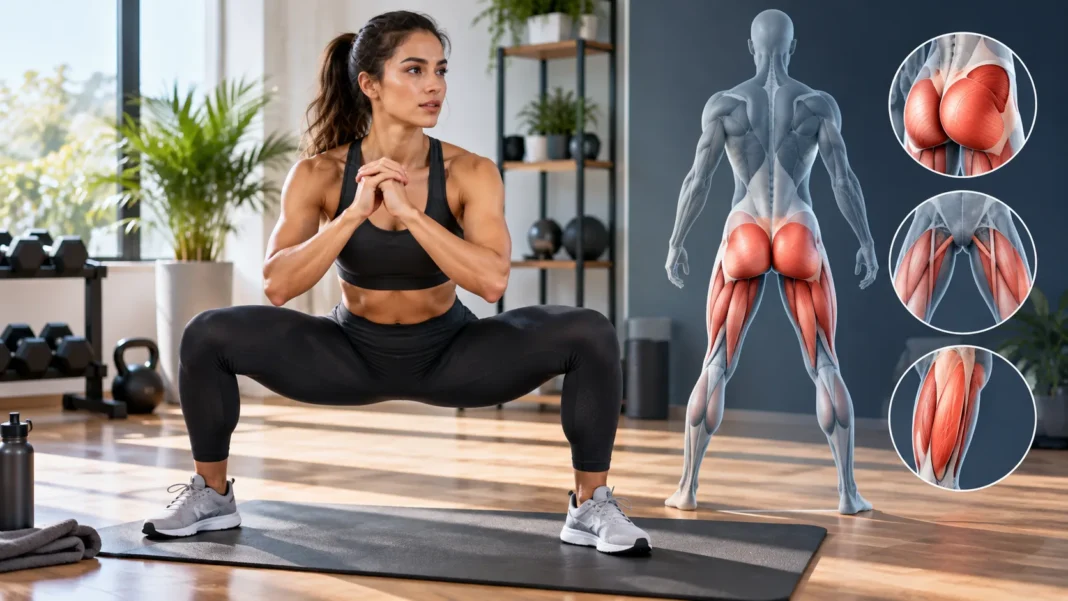
Sumo squats are a popular lower-body exercise that use a wider stance than traditional squats. This stance changes how your hips, knees, and surrounding muscles contribute to the movement, placing noticeable emphasis on the glutes, quadriceps, and inner thighs. The exercise can be performed with body weight or resistance, making it suitable for many different fitness levels.
Understanding the sumo squat muscles worked can help you decide where the exercise fits within your leg workout. Although people often think of sumo squats as an inner-thigh movement, several major muscle groups work together during every repetition. Your core, hamstrings, calves, and hip stabilizers also contribute to balance and control.
Good technique is important because a wider stance can become uncomfortable if you force your hips or knees beyond their natural range. The goal is not to stand as wide as possible, but to find a stable position where you can squat smoothly. When performed correctly, sumo squats can support lower-body strength, mobility, and muscular development.
What Is a Sumo Squat?
A sumo squat is a squat variation performed with the feet positioned wider than shoulder width and the toes turned outward. The wider stance changes the position of the hips compared with a conventional squat. As you lower yourself, your knees track outward while the hips move down and slightly back before you return to standing.
The name comes from the wide stance associated with sumo wrestlers, although the exercise itself is used across strength training, bodybuilding, mobility, and general fitness programs. You can perform it using only your body weight or add resistance with a dumbbell, kettlebell, barbell, or other equipment. The basic movement pattern remains similar regardless of the loading method.
Your ideal stance width depends on hip structure, mobility, limb length, and comfort. Some people can squat comfortably with a very wide stance, while others need a more moderate position. A successful sumo squat should allow your feet to stay planted, your knees to track smoothly, and your hips to move without pinching or sharp discomfort.
Primary Muscles Worked During Sumo Squats
The gluteus maximus is one of the main muscles involved in a sumo squat. It helps extend your hips as you rise from the bottom of the movement and return to standing. The wider stance can increase the involvement of several muscles surrounding the hips, especially when you maintain controlled depth and drive upward without letting the knees collapse inward.
Your quadriceps also perform significant work during every repetition. These muscles on the front of your thighs help straighten the knees as you stand and control knee flexion while you lower. Although sumo squats are often described as glute-focused, the quadriceps remain essential because both the hip and knee joints must extend to complete the movement.
The adductors, commonly called the inner-thigh muscles, are another major group involved in sumo squats. The wide stance places them in a position where they help stabilize and control the hips, while the adductor magnus can also assist with hip extension. This increased inner-thigh involvement is one of the main differences people notice compared with narrower squat variations.
Secondary Muscles Worked During Sumo Squats
The hamstrings contribute to hip control and stability during the movement, even though they are not usually the primary driving muscles. They work alongside the glutes and surrounding tissues as your hips move through flexion and extension. Their exact contribution depends on squat depth, stance, resistance, and individual body mechanics.
Your calves and muscles around the ankles also help maintain a stable base. The feet need to remain planted while your body lowers and rises, which requires control through the lower legs. Limited ankle mobility may be less noticeable in a wider squat for some people, but the calves still contribute to balance and lower-body stability.
Core muscles provide another important layer of support. Your abdominal muscles, obliques, and spinal stabilizers help keep your torso controlled while force travels between your upper and lower body. This becomes even more important when holding a heavy dumbbell, kettlebell, or barbell because your trunk must resist unwanted movement throughout the repetition.
Sumo Squats vs Regular Squats: Muscle Differences
Both sumo and regular squats train the glutes, quadriceps, and several supporting lower-body muscles. The key difference is stance width and hip position. Regular squats typically use a stance around shoulder width, while sumo squats place the feet farther apart and usually involve greater outward rotation through the hips.
Because of this wider position, sumo squats often involve the adductors more noticeably. Many people feel a stronger inner-thigh stretch and muscular effort compared with conventional squats. However, this does not mean the quadriceps stop working, nor does it mean sumo squats completely isolate the glutes or inner thighs.
Regular squats may feel better for people who prefer a narrower stance, while sumo squats can provide useful variation for those who tolerate wider hip positions comfortably. Neither version is automatically superior. Including both may help expose your lower body to different movement patterns while developing strength through slightly different hip and knee positions.
Key Benefits of Sumo Squats
One major benefit of sumo squats is that they train several lower-body muscles in one exercise. The movement works the glutes, quadriceps, adductors, and supporting muscles without requiring complicated equipment. This makes it useful for home workouts, gym sessions, strength programs, and routines designed to improve general lower-body fitness.
Sumo squats can also increase the training demand placed on the inner thighs. Strong adductors support hip stability and contribute to movements such as walking, running, changing direction, and controlling the legs during exercise. Training them alongside the glutes and quadriceps can help create a more balanced approach to lower-body strength development.
Another benefit is exercise flexibility. Beginners can start with bodyweight repetitions, while more experienced lifters can increase difficulty using dumbbells, kettlebells, resistance bands, or barbells. You can also manipulate tempo, pause at the bottom, or increase range of motion when appropriate, allowing the exercise to progress with your strength and experience.
How to Do a Sumo Squat Correctly
Stand with your feet wider than shoulder width and turn your toes outward at a comfortable angle. Keep your weight distributed across your feet rather than shifting completely onto your heels or toes. Brace your core gently, keep your chest controlled, and choose a stance where your hips feel free to move without pinching.
Bend your knees and hips together as you lower your body toward the floor. Allow your knees to follow roughly the same direction as your toes while maintaining full-foot contact. Descend only as far as you can maintain balance, a stable torso, and comfortable hip and knee alignment rather than forcing yourself toward an arbitrary depth.
From the bottom position, push through your feet and extend your knees and hips together. Finish standing tall without leaning backward or aggressively thrusting your pelvis forward. Keep the movement controlled from beginning to end, particularly when using weights, because rushing can make it harder to maintain consistent knee and hip positioning.
Common Sumo Squat Mistakes
Using an excessively wide stance is a common mistake. People sometimes assume a wider position automatically creates greater inner-thigh or glute activation, but forcing the feet too far apart can make the hips, groin, or knees uncomfortable. Start moderately wide and adjust gradually until you find a position that allows smooth movement.
Allowing the knees to collapse inward is another problem. Your knees should generally track in the direction of your toes while you squat and stand. You do not need to force them outward aggressively, but maintaining control helps distribute load more effectively through the hips, thighs, knees, and feet.
Another mistake is sacrificing form to squat deeper or lift more weight. If your heels lift, lower back rounds excessively, or hips shift noticeably to one side, reduce the depth or resistance. Controlled repetitions performed through a comfortable range are more useful than forcing a larger range while losing stability and creating unnecessary joint stress.
How to Progress Sumo Squats With Weights
Bodyweight sumo squats are a good starting point because they allow you to learn the movement without managing extra resistance. Once you can maintain consistent stance, knee tracking, balance, and depth, you can add a light dumbbell or kettlebell. Holding the weight in front of your body is an accessible progression for many beginners.
Increase resistance gradually rather than making large jumps. Your target weight should allow the final repetitions to feel challenging without causing your technique to deteriorate. If you begin bouncing out of the bottom, leaning excessively, or allowing the knees to collapse inward, the load may be too heavy for your current ability.
Advanced lifters may use heavier dumbbells, kettlebells, or barbell variations to continue building strength. Tempo can also increase difficulty without adding much weight, such as lowering for three seconds before standing. Pauses near the bottom can further increase muscular demand and help improve control through positions where you might otherwise rush.
Sumo Squats, Hip Comfort, and Injury Prevention
A sumo squat should create muscular effort, but it should not produce sharp hip, groin, or knee pain. If the wider stance feels uncomfortable, bring your feet slightly closer together or reduce the depth. Hip structure varies between individuals, so copying someone else’s exact stance may not be appropriate for your body.
Runners and active people sometimes add sumo squats to strengthen the hips and inner thighs, but exercise should still be introduced gradually. If you already experience recurring hip pain from running, adding more lower-body load without understanding the problem may worsen symptoms. Consider how your current training volume and existing discomfort affect exercise selection.
Strength training can support overall physical capacity, but no single squat variation guarantees injury prevention. Recovery, running volume, sleep, mobility, technique, and overall programming also matter. Persistent pain, weakness, swelling, or symptoms that affect walking and daily activity should be assessed rather than repeatedly trained through.
How Many Sumo Squats Should You Do?
Beginners can often start with two or three sets of around 8 to 15 controlled repetitions using body weight. This range provides enough practice to learn the movement without encouraging excessive fatigue. Stop the set when your form begins to change noticeably instead of completing extra repetitions with poor knee or hip control.
For muscle development, you can gradually add resistance and work within a repetition range that becomes challenging near the end of each set. Some workouts may use moderate repetitions, while strength-focused sessions can use fewer repetitions with heavier weights. The correct approach depends on your experience, equipment, recovery, and broader training program.
You do not need to perform sumo squats every day to benefit from them. One to three sessions per week may fit many lower-body programs, depending on the other exercises you perform. Give your muscles enough time to recover, especially when you also include lunges, deadlifts, conventional squats, step-ups, or other demanding leg exercises.
Conclusion
Sumo squats work several major lower-body muscles, with the glutes, quadriceps, and adductors doing much of the work. Hamstrings, calves, core muscles, and hip stabilizers also contribute by controlling movement and maintaining balance. The wider stance makes the exercise particularly useful for adding variety and increasing inner-thigh involvement within a lower-body program.
Good technique matters more than achieving the widest possible stance or lifting the heaviest weight. Keep your feet stable, allow the knees to follow the toes, and squat only as deeply as you can control comfortably. Start with body weight before adding resistance and progress gradually as your strength and coordination improve.
Sumo squats can support strength, muscle development, hip control, and overall lower-body fitness when used appropriately. They work best as one part of a balanced training program rather than the only leg exercise you perform. If the movement repeatedly causes hip, groin, or knee pain, modify it and seek professional guidance when symptoms persist.
FAQs
What muscles do sumo squats work the most?
Sumo squats primarily work the glutes, quadriceps, and inner-thigh adductors. Your hamstrings, calves, core, and other hip-stabilizing muscles also assist with balance and control throughout the movement.
Are sumo squats better for glutes than regular squats?
Sumo squats can strongly involve the glutes, but they are not automatically better than regular squats. Stance, depth, resistance, anatomy, and technique all influence how much the glutes contribute.
Do sumo squats work the inner thighs?
Yes. The wide stance increases the involvement of the adductor muscles along the inner thighs. These muscles help stabilize the hips and contribute to hip extension during parts of the movement.
Can beginners do sumo squats?
Yes. Beginners can start with bodyweight sumo squats using a comfortable stance and range of motion. Resistance should only be added after the movement can be performed consistently without pain or loss of balance.
How often should I do sumo squats?
Many people can include sumo squats one to three times per week depending on training volume and recovery. Allow enough time between demanding leg sessions, especially when using heavier resistance.