


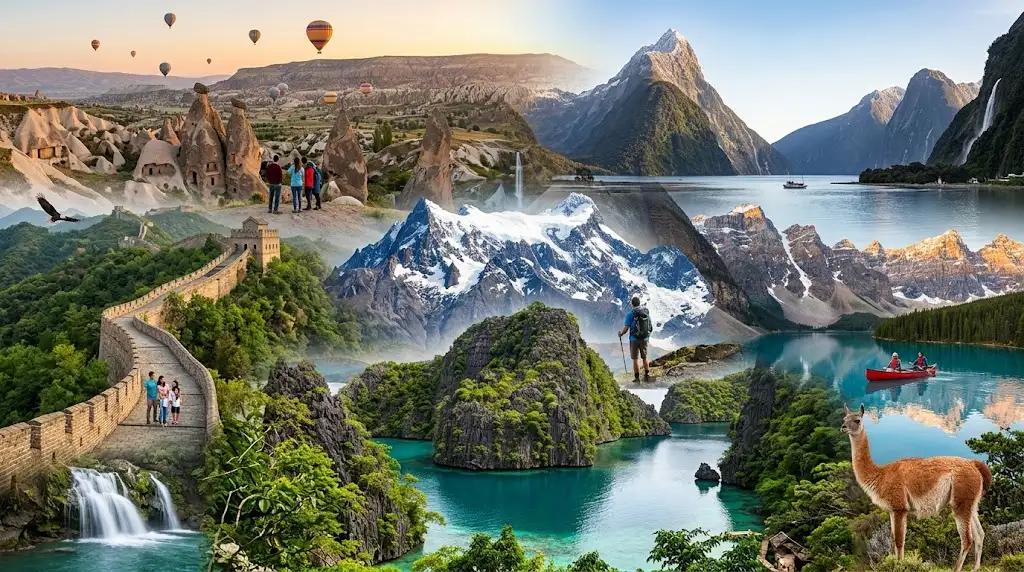
Most Beautiful Places to Visit Once in Your Life
Some destinations are impressive in photographs but become almost overwhelming when you finally stand in front of them. Towering mountains, ancient cities, turquoise reefs, enormous waterfalls, desert landscapes, wildlife-filled plains, and remote islands can make travel feel less like sightseeing and more like experiencing something genuinely extraordinary. The most beautiful places to visit once in your life are not necessarily beautiful for the same reasons. Some combine remarkable natural scenery with human history, while others remain powerful because nature still dominates almost completely. National Geographic’s 2026 travel selections similarly span Alpine landscapes, coastlines, cultural regions, and less-visited natural environments rather than defining beauty through one style of destination.
A once-in-a-lifetime destination also does not need to mean a place you will literally visit only once. The phrase is better understood as somewhere extraordinary enough to justify building a major trip around it at least once. Machu Picchu offers archaeology surrounded by dramatic Andean scenery, Petra blends monumental architecture with desert cliffs, and the Great Barrier Reef reveals an entire landscape beneath the ocean. The Serengeti can turn a wildlife trip into one of nature’s greatest spectacles, while destinations such as Patagonia, Santorini, Banff, and the Dolomites create unforgettable experiences through mountains, water, and changing light. This guide explores places worth putting on a serious travel bucket list while helping you decide which ones fit your interests, budget, timing, and preferred travel style.
1. Machu Picchu, Peru
Machu Picchu is one of those destinations where landscape and human achievement are almost impossible to separate. The fifteenth-century Inca site sits high in the mountains where the Peruvian Andes meet the Amazon Basin, surrounded by steep green peaks, clouds, terraces, and deep valleys. UNESCO describes the sanctuary as both an outstanding cultural and natural property, containing approximately 200 structures within a dramatic mountain environment. Walking into the site for the first time can feel very different from simply seeing its famous postcard view. The scale of the mountains makes the carefully constructed stone terraces and buildings feel even more remarkable.
The archaeological importance is a major reason to visit, but Machu Picchu is equally memorable for its atmosphere. Mist can move through the surrounding mountains within minutes, temporarily hiding sections of the landscape before revealing them again. Early light can create an almost theatrical effect as the ruins gradually emerge from shadow. Travelers who enjoy photography may find themselves looking at the same viewpoint repeatedly because weather and light continually change it. Yet the experience is most meaningful when you also pay attention to the terraces, ceremonial spaces, water channels, and construction details rather than viewing the citadel only as a backdrop.
Reaching Machu Picchu can become part of the adventure. Some travelers arrive by train followed by a bus, while others build the journey around one of the trekking routes through the Andes. Walking demands more time and physical preparation, but it creates a gradual approach rather than an immediate arrival. Travelers with limited time can still have an extraordinary experience without completing a multi-day trek. The best approach depends on fitness, budget, altitude tolerance, and how much of the surrounding landscape you want to explore. There is no requirement to choose the hardest route for the visit to feel meaningful.
Altitude should be taken seriously when planning the broader trip. Many travelers spend time in Cusco or the Sacred Valley before visiting Machu Picchu, and building enough time into the itinerary can make the experience more comfortable. Avoid designing a rushed schedule that involves arriving at altitude and immediately attempting strenuous activity. Hydration, sensible pacing, and professional medical advice when necessary matter more than maintaining an ambitious itinerary. You have traveled a long way to see an extraordinary place, so giving your body enough time to enjoy it is worthwhile. A slower trip can also create opportunities to explore more of the Sacred Valley.
Machu Picchu deserves its reputation because it offers several experiences at once. It is an archaeological site, a mountain destination, a cultural journey, and a place where weather and geography contribute almost as much as architecture. The surrounding sanctuary extends far beyond the famous ruins, encompassing mountain slopes, valleys, and diverse ecological environments. Spend enough time in the region that Machu Picchu does not become a single rushed photograph between transportation connections. Its beauty becomes stronger when you understand the landscape in which the Inca city was built.
2. Petra, Jordan
Petra delivers one of the most dramatic approaches of any ancient city. Visitors typically walk through the Siq, a narrow gorge framed by towering rock walls, before the façade of the Treasury suddenly becomes visible ahead. The effect is powerful partly because the architecture remains hidden until the final section of the passage. Petra was an important Nabataean caravan city located between the Red Sea and Dead Sea, connecting routes between Arabia, Egypt, and Syria-Phoenicia. UNESCO describes it as half-built and half-carved into the rock, surrounded by mountains, passages, and gorges. The setting makes the archaeological site feel inseparable from the desert itself.
The Treasury receives most of the photographs, but Petra is much larger than many first-time visitors expect. Tombs, temples, pathways, viewpoints, rock-cut façades, and the Monastery extend across an enormous archaeological landscape. This means a quick visit can reveal the headline attraction without capturing the scale of the ancient city. Travelers who can spend more than one day may appreciate the experience more because they have time to walk beyond the busiest areas. The climb toward the Monastery is physically demanding for some visitors, yet it also shows how dramatically structures are distributed across the terrain. Comfortable footwear is essential.
Petra’s beauty changes according to light. The sandstone contains reds, pinks, oranges, and softer tones that become particularly vivid at certain times of day. Rock faces can appear almost painted when sunlight reaches the narrow passages at different angles. This natural variation helps explain the term “Rose City,” although the landscape contains far more colors than one name suggests. Photographers may be drawn to façades, but some of the most memorable scenes involve empty desert paths and rock formations. The site becomes more compelling as you notice how architecture follows rather than overwhelms the surrounding geology.
Jordan can also turn a visit to Petra into a broader journey through extraordinary landscapes. Wadi Rum offers towering sandstone formations and desert scenery, while the Dead Sea provides a very different geographical experience. Combining these destinations creates a trip in which archaeology, desert adventure, and natural environments constantly contrast with one another. Avoid compressing everything into a few hurried days if your schedule allows. Long desert transfers and extensive walking can become exhausting when the itinerary is too dense. A slower journey gives each place enough space to feel distinct rather than blending into a checklist.
Petra belongs on a once-in-a-lifetime list because few destinations combine history and geology so effectively. The city developed as a major trade crossroads and incorporated sophisticated water-management systems despite its arid setting. That historical ingenuity adds depth to the visual experience. Visitors are not simply looking at monuments carved into attractive cliffs; they are walking through the remains of a complex city adapted to a difficult environment. When you understand both elements, the beauty becomes more than aesthetic. Petra feels like evidence of what humans can build when culture and landscape become deeply connected.
3. The Great Barrier Reef, Australia
The Great Barrier Reef offers a kind of beauty that cannot be fully appreciated from land. Much of the experience exists beneath the surface, where coral structures, fish, marine animals, changing depth, and filtered sunlight create an environment that can feel almost like another planet. UNESCO describes it as the world’s most extensive coral reef ecosystem, covering roughly 348,000 square kilometers and including about 2,500 individual reefs and more than 900 islands. Its scale is difficult to understand until you travel across part of it by boat or see the reef patterns from the air. Even then, any visitor experiences only a tiny fraction.
Snorkeling is enough to reveal extraordinary color and life in suitable locations. You do not need advanced diving qualifications to appreciate coral, tropical fish, and the structure of shallow reefs. Certified divers can explore deeper environments, while glass-bottom boats and semi-submersible experiences provide alternatives for travelers who prefer to remain dry. Choose an activity appropriate to your swimming confidence and comfort level. The goal is observing the ecosystem responsibly rather than pushing yourself into an experience that makes you anxious. Reputable operators should explain environmental practices, weather conditions, and safety before departure.
The reef is remarkable for its biodiversity as well as scenery. UNESCO records more than 1,500 species of fish, around 400 coral species, thousands of mollusk species, and a large variety of birds and other marine life within the World Heritage property. Seeing that diversity transforms snorkeling from simple recreation into something closer to wildlife observation. Slow down rather than swimming continuously. Some of the most interesting moments happen when you remain near one section of reef long enough to notice smaller fish, patterns, and movement you initially missed.
Choosing where to experience the reef is an important part of planning because the ecosystem stretches along a vast section of Australia’s northeast coast. Different departure points provide access to islands, outer reefs, beaches, and distinct types of excursions. Weather, sea conditions, coral health, and seasonal marine activity can affect individual experiences. Research current conditions rather than relying only on photographs from previous years. Responsible tourism matters particularly in fragile ecosystems. Avoid touching coral, feeding wildlife, standing on reef structures, or participating in activities that treat marine animals as props.
The Great Barrier Reef is a once-in-a-lifetime destination because it changes your understanding of what a landscape can be. Mountains and deserts are visually obvious from the moment you arrive, whereas the reef asks you to look beneath an apparently ordinary ocean surface. Only then does its complexity become visible. UNESCO considers its natural beauty exceptional both above and below the water, including islands, coral cays, and immense reef patterns. For travelers fascinated by oceans, wildlife, or photography, few places provide such a dramatic reminder that some of Earth’s most extraordinary environments remain largely hidden from everyday view.
4. Serengeti National Park, Tanzania
The Serengeti represents natural beauty on an enormous scale. Rather than one mountain, waterfall, or monument, the attraction is an entire living landscape of grasslands, rivers, woodlands, wildlife, changing skies, and seasonal movement. UNESCO describes Serengeti National Park as roughly 1.5 million hectares of savannah and identifies its annual migration as one of the world’s most impressive natural spectacles. Large herds of wildebeest, zebras, and gazelles move through the wider ecosystem while predators follow opportunities created by the migration. Experiencing this movement in person can make wildlife documentaries feel suddenly much more real.
The Great Migration often attracts the most attention, but the Serengeti is worth visiting beyond one specific event. Wildlife remains abundant across different regions and seasons, although the location of animals and migration stages changes throughout the year. Lions, cheetahs, elephants, giraffes, buffalo, birds, and numerous other species can transform an ordinary drive into hours of observation. The unpredictability is part of what makes a safari exciting. You do not know exactly what will appear around the next bend, and no two game drives are identical. Patience usually produces better experiences than constantly demanding the next major sighting.
Landscape matters as much as individual animals. The famous “endless plains” can stretch toward the horizon with very little human development interrupting the view. Rocky outcrops called kopjes rise from the grassland, while rivers and wooded sections introduce completely different environments within the ecosystem. UNESCO notes that the wider migration involves an immense circular movement spanning Tanzania and Kenya. Watching even a small part of that system helps visitors understand wildlife as something connected to rainfall, water, grazing, predation, and geography rather than isolated animals appearing conveniently beside safari vehicles.
Choosing the right season depends on what you hope to experience. Migration stages occur in different areas during different months, and weather influences roads, vegetation, wildlife concentration, and photography. Research recent seasonal information rather than assuming there is one universally perfect time. Some periods bring dramatic animal concentrations, while quieter seasons may offer fewer vehicles and lush landscapes. A reputable safari operator can help match itinerary and region to your priorities. Do not select solely by a photograph of a river crossing because wildlife movement follows nature rather than a guaranteed timetable.
The Serengeti belongs on a life list because it can change the way you think about scale, wilderness, and animal behavior. Seeing predators hunt or massive herds move through open country is extraordinary, but quiet moments can be just as powerful. Sunrise across an apparently empty plain or several giraffes walking in the distance may remain in memory longer than a frantic wildlife encounter. The park’s value lies in the ecosystem functioning as a whole. Visiting respectfully turns safari from animal collecting into observation of one of the planet’s great natural systems.
5. Patagonia, Argentina and Chile
Patagonia occupies the southern regions of Argentina and Chile and contains some of the most dramatic mountain and wilderness landscapes in the world. Sharp granite peaks, glaciers, turquoise lakes, windswept plains, forests, and enormous skies give the region a rawness that feels very different from heavily developed mountain resorts. Distances are large, communities can be widely separated, and weather is famously unpredictable. Those characteristics are part of the appeal for travelers who want landscapes to feel genuinely expansive. Patagonia rewards people who enjoy being outside for long periods and do not need every day to provide predictable weather.
Torres del Paine in Chile and the areas around El Chaltén and Los Glaciares National Park in Argentina are among the best-known bases for hiking and scenery. Trails range from shorter viewpoints to multi-day routes requiring more planning and equipment. You do not need to complete the hardest trek to appreciate Patagonia. Day hikes can bring travelers remarkably close to glaciers, lakes, and mountain formations. Choosing one or two bases and staying several nights often provides a better experience than moving quickly through the region. Weather delays become easier to handle when the itinerary has flexibility.
The wind can be as memorable as the mountains. Patagonia’s conditions may shift from sunshine to rain and strong gusts in a surprisingly short period, making layering and waterproof clothing essential. Hiking plans should remain flexible rather than tied rigidly to one particular date. Some days will be better suited to scenic drives, towns, or shorter walks. Travelers who become frustrated by changing conditions may find Patagonia challenging. Those who accept weather as part of the landscape often find the unpredictability adds character to the journey.
Glaciers provide another major reason to visit. Argentina’s Perito Moreno Glacier offers a dramatic example of moving ice visible from a network of viewpoints, while other areas provide boat trips, guided ice activities, and remote glacier scenery. Hearing large pieces of ice crack or break away can be more powerful than photographs suggest. Climate change also adds urgency to experiencing glacial landscapes responsibly. Travelers should choose established operators and follow all protected-area rules. Natural beauty becomes more meaningful when visitors understand that many environments are changing.
Patagonia is a once-in-a-lifetime destination for people who want travel to feel expansive rather than comfortable. The beauty comes partly from how small humans appear inside the landscape. A road disappearing toward distant mountains or a lone hiker beneath granite towers can communicate scale more effectively than any viewpoint platform. Give the region enough time. Long transfers are unavoidable, and rushing between destinations undermines the sense of wilderness. Patagonia deserves several days of simply allowing the weather and landscape to determine what happens next.
6. Santorini and the Greek Islands
Santorini is famous for whitewashed buildings, blue-domed churches, volcanic cliffs, and sunsets over the Aegean Sea, but its beauty becomes more interesting when you understand the island’s geography. Settlements sit high along the edge of a volcanic caldera, producing dramatic views across deep blue water and neighboring islands. The contrast between bright architecture, dark volcanic terrain, and the sea creates the visual identity that has made Santorini one of the world’s most recognizable island destinations. Popularity brings significant crowds, however, so thoughtful timing matters. A beautiful place can feel very different when experienced at sunrise rather than during the busiest sunset hour.
Oia attracts enormous attention, but Santorini offers more than one village and one famous viewpoint. Walking sections of the caldera, exploring smaller settlements, visiting volcanic beaches, and experiencing local food can create a more complete trip. Stay long enough that you can experience quieter mornings and evenings rather than arriving only as a day visitor. Ferry and cruise traffic can change the atmosphere considerably during peak daytime hours. Exploring early or later often reveals the island at its most appealing. Beauty becomes easier to appreciate when you are not competing constantly for space.
Santorini can also become a starting point for understanding the wider Greek islands. Different islands offer dramatically different experiences, from nightlife and beaches to mountain villages, archaeological sites, hiking, and quieter local communities. Travelers seeking less crowded scenery may prefer pairing Santorini with an island that receives fewer visitors. This creates contrast between an iconic destination and a slower one. Island hopping should remain manageable, however. Too many ferry connections can turn a relaxing trip into repeated packing and transportation.
Food is an important part of experiencing Greece rather than simply photographing it. Long meals, seafood, local produce, bakeries, and regional dishes give travelers reasons to move away from the busiest viewpoints. Restaurants with dramatic caldera views may charge significant premiums, while equally enjoyable food can be found in less famous locations. Plan one special scenic meal if that experience matters to you and eat more casually elsewhere. A sunset picnic or small local restaurant can be every bit as memorable. Beautiful destinations do not require every meal to have a luxury price.
Santorini deserves a place on many travel lists, but visiting intelligently matters because the island faces the pressures of extraordinary popularity. Travel outside the busiest summer weeks when possible, support local businesses, respect residential areas, and avoid treating private spaces as photography sets. The most meaningful experience comes from seeing the island as a living community as well as a famous landscape. Once crowds are managed, the combination of cliffside villages, volcanic geology, sea, and evening light becomes easy to understand. Santorini remains iconic because its visual character is genuinely distinctive.
7. Banff and the Canadian Rockies
Banff and the surrounding Canadian Rockies offer mountain scenery on a scale that makes ordinary road trips feel cinematic. Turquoise lakes, snow-covered peaks, glaciers, forests, wildlife, waterfalls, and long mountain roads create constant visual variety. Lake Louise and Moraine Lake are among the most photographed locations, but the wider region contains enough scenery to fill weeks rather than days. The challenge is not finding something beautiful to see. It is choosing how to experience the area without spending the entire trip moving between famous viewpoints.
Hiking reveals a different side of the Rockies than roadside sightseeing. Even moderate trails can move visitors away from the busiest parking areas and provide wider mountain perspectives. Choose routes suitable for weather, wildlife conditions, and personal fitness. Bears and other wildlife inhabit the region, making local safety guidance important. Carry appropriate supplies, understand recommended wildlife precautions, and never approach animals for photographs. The landscape may feel accessible because roads and facilities are excellent, but it remains a genuine mountain environment.
Lakes are a defining feature of the region. Their remarkable blue and turquoise colors are influenced by fine glacial sediment suspended in the water, creating an appearance that can seem digitally enhanced even when seen with your own eyes. Canoeing or walking along the shoreline provides a slower experience than simply taking a photograph from the busiest platform. Arrive early where access arrangements permit and understand current transportation systems before travel. Several famous locations have restrictions designed to manage congestion. Researching logistics beforehand prevents frustration.
Summer attracts hiking and road-trip travelers, while winter transforms the Rockies into a skiing, snowshoeing, and frozen-lake destination. The same mountains can feel completely different between seasons. Shoulder periods sometimes provide fewer visitors, though trail, road, and weather conditions may also become less predictable. Decide what you want most before choosing travel dates. Wildflowers, open hiking trails, snow scenery, skiing, or quieter roads cannot all be optimized during the same visit. Season is part of the experience rather than merely a booking detail.
The Canadian Rockies belong on a once-in-a-lifetime list because they make dramatic scenery unusually accessible without making it feel ordinary. You can drive through enormous valleys, hike toward glaciers, paddle beneath mountains, or simply sit beside a lake and watch changing clouds. The biggest mistake is rushing because each famous stop appears close on a map. Stay longer in fewer places and let weather influence the itinerary. Mountains look different from one hour to the next. The scenery rewards travelers who stop long enough to notice those changes.
8. The Dolomites, Italy
The Dolomites offer one of Europe’s most distinctive mountain landscapes. Their pale limestone towers rise sharply above green valleys, alpine meadows, forests, villages, and clear lakes, producing scenery that looks almost unreal during early or late light. National Geographic included Italy’s Dolomite Mountains among its 2026 Best of the World selections, highlighting their scenic appeal beyond the year’s major sporting events. The region attracts hikers, climbers, cyclists, road trippers, skiers, photographers, and travelers who simply enjoy beautiful mountain villages. This range of experiences makes the Dolomites easier to adapt to different travel styles than many people expect.
Summer provides extensive hiking and mountain-road opportunities. Cable cars can help travelers reach higher areas without requiring technical climbing, while well-developed huts create opportunities for memorable mountain meals and overnight stays. Day hikes vary enormously in difficulty, so beginners can still experience dramatic views. Choose trails according to elevation and conditions rather than distance alone. A relatively short route can feel demanding when it climbs steeply. Good footwear and weather layers remain essential even during warm months.
Road trips through the Dolomites are spectacular, but driving should not dominate the itinerary. Mountain passes provide extraordinary views, yet the region becomes much more rewarding when you stop for walks and longer stays in individual valleys. Choose one or two bases and explore from them rather than changing hotels every night. This reduces packing and gives you flexibility when weather changes. Smaller villages can also provide quieter evenings and a stronger sense of place than staying only in the busiest resort centers.
Food adds another dimension because the region sits at a cultural crossroads where Italian and Alpine traditions meet. Mountain huts may serve hearty dishes that feel especially satisfying after hiking, while valleys and towns offer their own culinary specialties. Allow time for meals rather than treating them as interruptions between viewpoints. A long lunch overlooking mountains can become one of the strongest memories of the trip. Travel beauty is not limited to scenery. The atmosphere created by villages, language, food, and landscape working together is part of why the Dolomites feel distinctive.
Winter brings an entirely different character through snow and skiing. Travelers uninterested in skiing can still enjoy snowy villages, winter walks, scenic lifts, and mountain restaurants, although access to certain trails changes. National Geographic’s 2026 recognition has increased attention around the region, making advance planning especially sensible during popular periods. Visit with enough time to move beyond headline viewpoints. The Dolomites are most impressive when experienced as a landscape you move through slowly rather than a collection of photographs you reproduce.
9. Choose Places That Match Your Own Definition of Beauty
There is no objective list of the world’s most beautiful places. A traveler fascinated by wildlife may be more moved by the Serengeti than Santorini, while someone passionate about history might place Petra or Machu Picchu above every beach on earth. Another person may value remote forests, deserts, small villages, or modern cities more than famous natural wonders. Contemporary travel publications increasingly reflect this variety, mixing iconic attractions with overlooked towns and less-visited natural landscapes. Condé Nast Traveler’s 2026 coverage, for example, highlights both globally recognized wonders and quieter natural places that remain compelling partly because they have avoided intense attention.
Think about which landscapes you remember most strongly from previous trips. If mountains constantly impress you, prioritize Patagonia, the Dolomites, the Himalayas, or the Canadian Rockies rather than forcing a tropical island onto your bucket list. If water is what you love, reefs, waterfalls, lakes, fjords, and remote beaches may provide stronger emotional experiences. History lovers can structure trips around archaeological landscapes and old cities. Wildlife enthusiasts may choose safari or marine environments. A personal life list should reflect curiosity rather than popularity.
Season changes beauty dramatically. A mountain covered in snow provides a different experience from the same place surrounded by summer wildflowers. Waterfalls may be more powerful during wetter months, while deserts can become unbearable during extreme heat. Wildlife follows seasonal patterns, and tropical destinations can experience monsoons or cyclones. Before deciding when to visit, research what actually happens during your chosen month. The “best time” should match the experience you value rather than simply the period with the highest average temperature.
Crowds also influence beauty. An extraordinary landscape experienced beside thousands of people can feel very different from the same place during a quiet morning. Visit famous attractions early, stay overnight instead of arriving only on day tours, or travel during shoulder seasons when conditions remain reasonable. Explore secondary trails and nearby communities rather than standing only at the most recognizable viewpoint. None of this guarantees solitude, especially at global icons, but thoughtful timing can improve the emotional quality of the experience significantly.
Finally, do not build a bucket list so long that travel becomes a race to complete it. Seeing twenty celebrated places rapidly may create less meaning than spending a week understanding one landscape. A once-in-a-lifetime trip deserves enough time to absorb where you are. Sit somewhere without photographing it, revisit a viewpoint under different light, talk with people who live nearby, and learn how the environment was shaped. Beauty becomes more memorable when it is connected to context. The strongest travel experiences usually involve attention rather than accumulation.
10. How to Plan a Once-in-a-Lifetime Trip
Start planning around the experience rather than the destination name. Decide whether you want trekking, wildlife, underwater exploration, cultural history, photography, relaxation, or several of these together. This helps determine how much time you need and what season makes sense. Machu Picchu requires different physical and logistical preparation from the Great Barrier Reef, while a Serengeti safari differs completely from exploring Santorini. A trip becomes expensive quickly when activities are added without priorities. Knowing what matters most protects both time and budget.
Budget for the entire journey. International airfare may be only one part of the cost, especially when remote destinations require domestic flights, trains, guides, park fees, boats, transfers, or specialized equipment. Research these elements before booking a cheap long-haul ticket. Set aside emergency funds for delays and schedule changes as well. Major trips often involve more moving parts than weekend travel. Financial flexibility prevents one unexpected problem from dominating the experience.
Do not schedule the itinerary too tightly. Weather can affect mountains, oceans, wildlife, flights, ferries, and hiking routes, making buffer days valuable at destinations where one major experience matters greatly. If seeing Machu Picchu, completing a glacier excursion, or joining a reef trip is the purpose of traveling thousands of kilometers, give yourself enough time for conditions to change. An extra day may feel unnecessary during planning and priceless once something is delayed. Flexibility protects the experiences you care about most.
Research current access rules before departure. Major attractions increasingly use timed tickets, visitor limits, shuttle systems, permits, or specific routes to manage crowds and protect environments. Information from an old guidebook can become outdated quickly. Check official tourism, heritage, national park, or transportation sources close to travel. Responsible access policies may occasionally feel inconvenient, but they help preserve destinations under enormous tourism pressure. Planning ahead prevents avoidable disappointment.
Most importantly, treat beautiful places as environments and communities rather than backgrounds. Follow trail rules, minimize waste, respect wildlife, avoid damaging archaeological sites, and behave thoughtfully in residential areas. Choose legitimate guides and businesses that support local communities where possible. The places travelers describe as “once in a lifetime” often face intense pressure precisely because millions of people want the same experience. Visiting responsibly helps ensure their beauty remains meaningful for people who arrive long after you leave.
Final Thoughts on the Most Beautiful Places to Visit
The most beautiful places to visit once in your life cover almost every type of landscape imaginable. Machu Picchu combines Andean scenery with one of the world’s greatest archaeological sites, while Petra turns desert geology into monumental architecture. The Great Barrier Reef reveals extraordinary beauty underwater, and the Serengeti offers wildlife and open plains on a scale difficult to comprehend until you experience them directly. Patagonia and the Canadian Rockies appeal to mountain lovers, Santorini brings dramatic volcanic island scenery, and the Dolomites combine spectacular peaks with villages and Alpine culture. Beauty becomes more interesting because these places are completely different from one another.
Some destinations earn their reputation through sheer scale. UNESCO’s descriptions of Machu Picchu, the Serengeti, the Great Barrier Reef, and Petra demonstrate that their global significance involves culture, ecosystems, biodiversity, archaeology, and landscape rather than appearance alone. Understanding that background can make a visit more meaningful. A beautiful photograph may inspire the trip, but learning what you are actually seeing creates the memory that lasts. Travel becomes richer when scenery and knowledge reinforce each other.
Do not assume every place on a famous bucket list belongs on yours. You may feel far more emotional watching wildlife on open plains than looking across a famous European coastline, or you may care more about ancient architecture than mountains. Build your priorities around genuine interests. Current travel writing increasingly celebrates both global icons and lesser-known towns, wilderness regions, and cultural landscapes, reminding travelers that extraordinary beauty is not confined to the destinations with the largest social-media presence. Sometimes the place that changes you most is one you barely knew before planning the trip.
Timing, pace, and preparation strongly affect whether a destination lives up to expectations. Travel during a season suited to your activities, allow enough days for weather changes, and avoid overloading the itinerary with too many distant places. Stay overnight near major attractions when possible so you can experience quieter mornings or evenings. Budget for the journey realistically and prioritize the activities you would most regret missing. Once-in-a-lifetime travel deserves more thought than simply purchasing the cheapest ticket to somewhere famous.
Ultimately, the world’s most beautiful places remind us how varied the planet is. Ancient cities can survive within desert cliffs, coral ecosystems can stretch for hundreds of thousands of square kilometers, wildlife can still migrate across immense plains, and mountains can make enormous human structures appear tiny. Travel gives you the chance to experience that scale directly rather than through a screen. You do not need to visit every famous place in the world. Choose the ones that make you most curious, experience them slowly and responsibly, and give yourself enough time to understand why they became unforgettable in the first place.
Frequently Asked Questions
What are the most beautiful places everyone should see once?
Machu Picchu, Petra, the Great Barrier Reef, the Serengeti, Patagonia, the Canadian Rockies, Santorini, and the Dolomites are strong choices because they combine exceptional scenery with distinctive cultural or natural experiences.
What is the most beautiful natural place to visit?
That depends on your interests. Ocean lovers may prefer the Great Barrier Reef, mountain travelers may choose Patagonia or the Canadian Rockies, while wildlife enthusiasts may find the Serengeti more impressive than any conventional scenic viewpoint.
Which beautiful places are best for adventure travelers?
Patagonia, the Dolomites, the Canadian Rockies, Machu Picchu and surrounding Andes, and parts of the Great Barrier Reef are particularly suitable for travelers who want hiking, diving, paddling, climbing, or other outdoor activities.
How should I choose a once-in-a-lifetime destination?
Consider the scenery you enjoy most, the activities you want to do, your physical comfort, available travel time, season, and total budget. Choose somewhere you genuinely want to experience rather than selecting a destination only because it appears on popular bucket lists.
How can I visit famous places without feeling overwhelmed by crowds?
Travel during shoulder seasons when appropriate, visit early or late in the day, stay locally instead of arriving only on day trips, and spend time exploring secondary areas beyond the most photographed viewpoint.