


Why Leg Strength Matters
Strong legs support nearly every movement you make throughout the day, from walking and climbing stairs to standing up from a chair. The quadriceps, hamstrings, glutes, calves, and smaller stabilizing muscles all work together to move and control the lower body. Building strength in these areas can make everyday tasks feel easier and more efficient.
Leg strengthening exercises also support balance, coordination, and joint stability. When the muscles around the hips, knees, and ankles are stronger, they can better control movement during walking, running, lifting, and sports. This does not guarantee that injuries will never happen, but greater strength can improve your ability to tolerate physical demands.
You do not need complicated gym equipment to build stronger legs. Bodyweight exercises, resistance bands, dumbbells, machines, and simple household setups can all be effective. The most important factors are good form, gradual progression, and choosing movements that challenge your muscles without causing sharp or worsening pain.
Squats for Overall Leg Strength
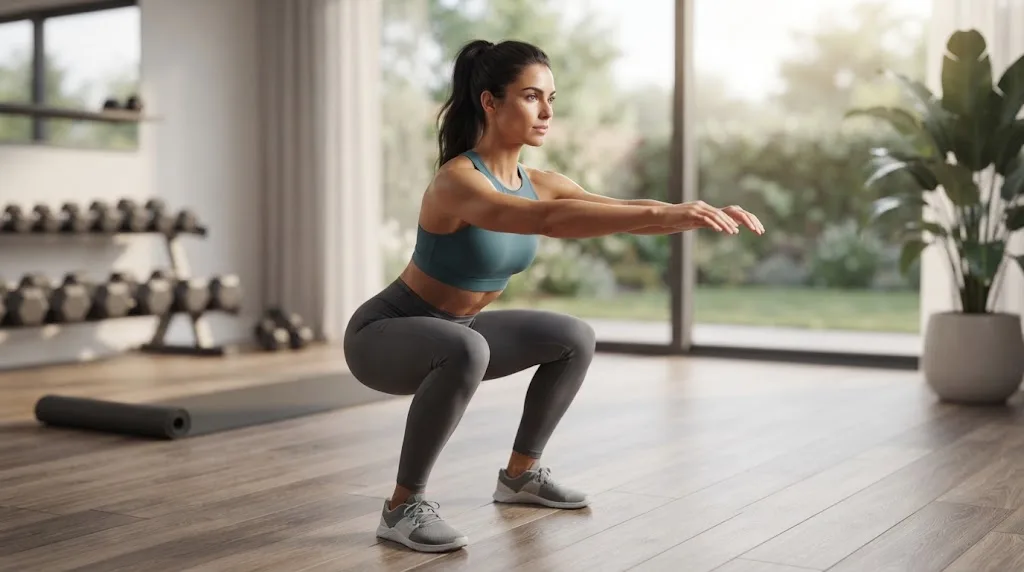
Squats are one of the most effective compound exercises for strengthening the lower body. They mainly work the quadriceps and glutes while also involving the hamstrings, calves, adductors, and core. Because the movement resembles sitting down and standing up, squat strength also transfers well to everyday activities.
To perform a basic squat, stand with your feet at a comfortable width and keep your weight balanced through the feet. Bend your hips and knees together as you lower, keeping the knees moving in the same general direction as the toes. Descend only as far as you can comfortably control.
Push through the floor to return to standing while extending your knees and hips together. Avoid allowing the knees to collapse inward or using momentum to bounce out of the bottom. Beginners can start with chair squats or supported squats before progressing to goblet squats, barbell squats, or other loaded variations.
Lunges for Single-Leg Strength
Lunges strengthen the quadriceps, glutes, hamstrings, and hip stabilizers while training each leg more independently. This makes them useful for improving side-to-side control and developing strength that carries over to walking, running, and climbing stairs. They also challenge balance more than many two-legged exercises.
For a forward lunge, step one foot ahead and lower your body by bending both knees. Keep your front foot flat and maintain a tall torso while moving through a comfortable range. Push through the front foot to return to the starting position, then repeat on the opposite side.
If forward lunges feel difficult, reverse lunges can be easier to control because you step backward instead. You can also hold onto a stable surface while learning the movement. Once your technique feels comfortable, add dumbbells or increase the depth gradually to make the exercise more challenging.
Glute Bridges for Hip Strength
Glute bridges strengthen the gluteus maximus and help improve hip extension strength. The hamstrings and core also contribute, making the movement useful for developing the muscles that support walking, running, lifting, and standing. Bridges are especially convenient because they require very little equipment and can be performed at home.
Lie on your back with your knees bent and feet flat on the floor. Gently engage your abdominal muscles, press through your feet, and lift your hips until your body forms a comfortable line from the shoulders toward the knees. Avoid forcing the hips so high that your lower back arches excessively.
Pause briefly at the top and squeeze the glutes before lowering slowly. As the exercise becomes easier, you can add a resistance band, place a weight across the hips, or progress to a single-leg variation. Keep each repetition controlled so the glutes remain the main muscles driving the movement.
Step-Ups for Functional Strength
Step-ups are a practical leg strengthening exercise because they closely resemble climbing stairs. They target the quadriceps, glutes, hamstrings, and calves while also challenging balance. The movement is useful for everyday function and can be adjusted easily by changing the height of the step or the resistance used.
Stand in front of a stable step or platform and place one foot firmly on top. Push through that foot to lift your body onto the step without using excessive momentum from the opposite leg. Stand tall at the top, then lower yourself back down slowly and under control.
Start with a relatively low step if balance or knee comfort is a concern. Hold onto a railing or sturdy support until the movement feels stable. Once basic step-ups become easy, increase step height gradually or hold dumbbells to create a greater strength challenge.
Romanian Deadlifts for Hamstrings
Romanian deadlifts, or RDLs, focus heavily on the hamstrings and glutes while also training the muscles along the back of the body. Unlike a squat, the movement emphasizes hinging at the hips rather than bending deeply through the knees. Learning this pattern can improve both strength and control during lifting tasks.
Stand tall with a pair of dumbbells or another manageable weight in front of your thighs. Keep a slight bend in the knees and push your hips backward while allowing the weights to travel down the front of your legs. Maintain a neutral spine and stop once you feel a comfortable stretch through the hamstrings.
Drive the hips forward to return to standing and squeeze the glutes at the top. Avoid rounding the back or reaching the weights toward the floor simply to increase range. The correct depth depends on your mobility and ability to maintain control throughout the movement.
Calf Raises for Lower-Leg Strength
Calf raises strengthen the gastrocnemius and soleus muscles at the back of the lower leg. These muscles help push the body forward during walking and running while supporting ankle stability and balance. Strong calves can also improve performance during stairs, jumping, hiking, and other activities involving repeated foot push-off.
Stand with your feet about hip-width apart and lightly hold a wall or chair if needed. Rise onto the balls of your feet by lifting the heels, pause briefly at the top, and then lower with control. Avoid bouncing or allowing the ankles to roll excessively outward.
Once two-legged calf raises become easy, you can progress to single-leg versions or hold additional weight. Performing them on a step can increase the available range of motion, but this should be introduced gradually. Stop if the movement creates sharp Achilles, ankle, or calf pain rather than ordinary muscle fatigue.
Side Steps and Hip Abduction
Lateral band walks and standing hip abduction strengthen muscles along the outside of the hips, particularly the gluteus medius. These muscles help stabilize the pelvis and control the position of the leg during walking, running, stairs, and single-leg activities. Strong hip stabilizers can complement larger leg exercises such as squats and lunges.
For lateral band walks, place a light loop band around the thighs or lower legs. Bend the knees slightly and take controlled steps sideways while keeping tension in the band. Avoid dragging the trailing foot or allowing your body to sway from side to side.
Standing hip abduction provides another simple option. Hold a stable surface and move one leg slowly out to the side while keeping your torso upright. A balanced lower-body routine can also benefit from mobility work, and these core stretches can complement strength training by supporting comfortable trunk and hip movement.
Wall Sits for Quadriceps Endurance
Wall sits are an isometric exercise that strengthens the quadriceps without repeated knee movement. They can be useful when you want to build muscular endurance or add variety to a lower-body routine. The glutes and core also contribute as you hold the body steady against the wall.
Stand with your back against a wall and step your feet forward. Slide down until your knees reach a comfortable angle, then hold the position while keeping your feet flat on the floor. You do not need to lower until the thighs are perfectly parallel if that depth causes discomfort.
Start with short holds and gradually increase the duration as strength improves. You can also make wall sits harder by holding a weight or extending one leg briefly. The exercise should create muscle fatigue, but sharp knee pain is a sign to reduce the depth or choose another movement.
How Often Should You Train Your Legs?
Many people can benefit from two or three lower-body strength sessions per week. This frequency provides enough practice and training stimulus while allowing time for recovery between harder workouts. The exact schedule depends on your fitness level, overall activity, exercise intensity, and whether you also participate in sports or endurance training.
You do not need to perform every leg exercise in one session. A simple routine could include squats, Romanian deadlifts, step-ups, calf raises, and hip work, while another session uses lunges, bridges, wall sits, and similar variations. Rotating exercises can provide variety while still training the same major muscle groups consistently.
Recovery is important because muscles become stronger between training sessions, not only during them. Sleep, nutrition, and rest days all influence how well you adapt. If your legs remain unusually sore, weak, or fatigued for several days, reduce training volume or intensity before adding more work.
How to Progress Leg Exercises Safely
Progressive overload means gradually making exercises more challenging as your body adapts. You can do this by adding weight, increasing repetitions, adding another set, or choosing a harder variation. Changing one variable at a time makes it easier to monitor how your muscles and joints respond.
Good form should remain consistent as difficulty increases. If adding weight causes you to shorten the movement dramatically, lose balance, or rely on momentum, the load may be too heavy. Staying with a slightly lighter weight while controlling every repetition is often more productive than lifting heavier with poor technique.
Pain should also guide progression. Normal muscle fatigue or temporary soreness can occur after training, but sharp joint pain or steadily worsening symptoms should not be ignored. Reduce the load, range, or exercise difficulty and seek professional evaluation if pain persists despite sensible modifications.
Common Leg Training Mistakes
One common mistake is training only the muscles you can see easily, such as the quadriceps. A balanced program should also include the glutes, hamstrings, calves, inner thighs, and hip stabilizers. Training several movement patterns helps distribute strength more evenly across the lower body.
Another mistake is progressing too quickly. Adding heavy weights, extra sets, and more workout days at the same time can create more fatigue than your body can recover from. Gradual increases are more sustainable and make it easier to identify exactly which change caused soreness or discomfort.
Skipping warm-ups can also make the first working sets feel stiff and uncoordinated. A few minutes of walking, cycling, bodyweight squats, or easy versions of the planned exercises can prepare the muscles and joints. A warm-up does not need to be long, but it should make you feel more ready to move.
Conclusion
Leg strengthening exercises can improve lower-body strength, balance, movement control, and everyday function. Squats, lunges, bridges, step-ups, Romanian deadlifts, calf raises, and hip exercises train the major muscles needed for walking, running, lifting, and climbing stairs. The best routine combines several movement patterns rather than relying on one exercise.
Focus on controlled form and gradual progression instead of chasing the heaviest possible weight. Start with bodyweight or light resistance, then increase difficulty as your strength improves. Training two or three times per week can provide a practical foundation for many people when combined with adequate recovery.
Listen to how your body responds as you build strength. Mild muscle fatigue is expected, but sharp pain or persistent joint discomfort should not be ignored. With consistent training, appropriate recovery, and sensible progression, stronger legs can support better mobility, performance, and confidence during everyday activities.
FAQs
What are the best exercises for strengthening legs?
Squats, lunges, Romanian deadlifts, step-ups, glute bridges, calf raises, and lateral band walks are all effective. Combining several exercises helps train the quadriceps, hamstrings, glutes, calves, and hip stabilizers.
How often should I do leg strengthening exercises?
Two or three lower-body strength sessions per week work well for many people. Frequency should match your fitness level, workout intensity, recovery, and any additional sports or endurance activities.
Can I strengthen my legs without weights?
Yes. Bodyweight squats, lunges, wall sits, step-ups, bridges, and calf raises can build strength, particularly for beginners. Resistance bands and harder variations can provide additional challenge later.
How long does it take to make your legs stronger?
Many people notice improvements in coordination and strength within several weeks of consistent training. More significant strength and muscle changes usually require longer periods of progressive exercise and adequate recovery.
Should leg strengthening exercises hurt?
Muscle effort and mild soreness can be normal, but sharp or increasing joint pain is not something to push through. Modify the exercise and seek professional advice if concerning symptoms continue.