


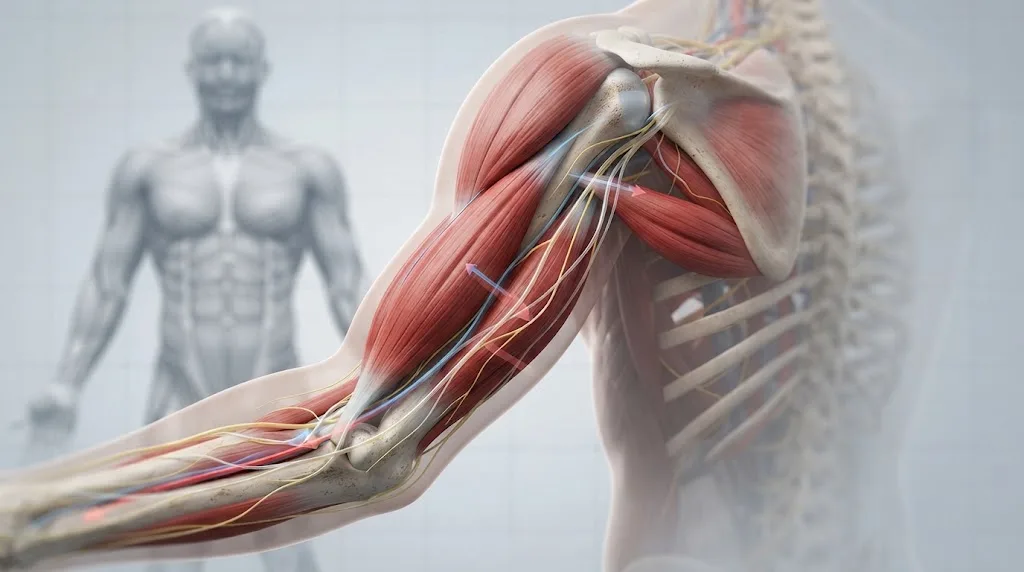
The biceps are among the most recognizable muscles in the human body, but their role goes far beyond making the upper arm look muscular. They help bend the elbow, rotate the forearm, and support several movements involving the shoulder. Understanding biceps anatomy can make exercise technique, injury prevention, and everyday arm movement easier to understand.
Although people commonly use the word “biceps” to describe the entire front of the upper arm, the main muscle is formally called the biceps brachii. It works closely with several surrounding muscles rather than functioning alone. Learning where it starts, where it attaches, and how it moves the arm provides a clearer picture of its importance.
What Are the Biceps?
The biceps brachii is a large muscle located on the front of the upper arm between the shoulder and elbow. Its name comes from the fact that it has two separate heads near the shoulder. These two portions eventually join together to form one muscular structure before attaching farther down the arm.
Most people associate the biceps primarily with elbow bending because the muscle becomes visibly shorter and more prominent during a curl. However, elbow flexion is only one part of its function. The biceps also plays an important role in turning the palm upward and assisting certain movements at the shoulder.
The muscle is active during many ordinary tasks, including carrying groceries, lifting objects, opening containers, pulling doors, and holding items close to the body. It also contributes heavily to exercises such as curls, chin-ups, and rowing movements. Because it crosses both the shoulder and elbow joints, its function changes depending on arm position.
Biceps Anatomy: Long Head and Short Head
The biceps brachii consists of two portions known as the long head and short head. Both heads originate near the shoulder blade but begin at different anatomical locations. They travel down the front of the upper arm and eventually combine into a shared muscle belly before continuing toward the elbow.
The long head runs along the outer portion of the biceps and begins from an area of the scapula above the shoulder socket. Its tendon travels through part of the shoulder region before entering the upper arm. Because of this pathway, the long-head tendon can sometimes become irritated during repetitive overhead or lifting activities.
The short head forms more of the inner portion of the upper arm and begins from the coracoid process of the scapula. It joins the long head farther down the arm. Although the two heads have slightly different origins, they work together during most movements involving elbow flexion and forearm supination.
Where Do the Biceps Attach?
At the upper end, both biceps heads attach to different areas of the scapula. The long head originates near the top of the shoulder socket, while the short head begins from the coracoid process. These attachments allow the muscle to cross the shoulder joint before continuing down toward the upper arm and elbow.
At the lower end, the biceps narrows into a strong distal tendon near the elbow. This tendon attaches to the radius, one of the two bones of the forearm. Because the attachment is on the radius rather than the ulna, the biceps can produce powerful rotation of the forearm in addition to bending the elbow.
Another structure called the bicipital aponeurosis spreads from the distal biceps tendon into connective tissue in the forearm. It helps distribute force and provides additional support around the elbow region. Together, these anatomical connections allow force generated by the biceps muscle to influence movement at both the elbow and forearm.
What Is the Main Function of the Biceps?
One of the primary functions of the biceps is elbow flexion, which means decreasing the angle between the upper arm and forearm. This movement happens whenever you bring your hand toward your shoulder. Carrying a box, lifting a cup, or performing a dumbbell curl all require some degree of elbow flexion.
The biceps is also a powerful forearm supinator. Supination turns the forearm so the palm faces upward or forward, depending on arm position. A simple example is turning a doorknob, using a screwdriver, or rotating your palm upward while holding an object in your hand.
Because the biceps crosses the shoulder, it can also assist with shoulder flexion, particularly when raising the arm forward. However, it is not the primary muscle responsible for most shoulder movement. Muscles such as the deltoid and rotator cuff play larger roles in positioning and stabilizing the shoulder during upper-body activity.
How the Biceps Bend the Elbow
When the biceps contracts, it creates tension through its distal tendon and pulls on the radius. This action brings the forearm closer toward the upper arm and produces elbow flexion. The amount of force the muscle can generate depends partly on joint position, forearm orientation, resistance, and how strongly other elbow flexors are working.
The biceps tends to contribute strongly when the forearm is supinated, meaning the palm faces upward during a curl. This is why traditional dumbbell curls are commonly associated with biceps training. Turning the palm downward changes the contribution of different elbow flexors and may place relatively more emphasis on muscles such as the brachialis and brachioradialis.
Elbow movement rarely depends on one muscle acting alone. The biceps works alongside the brachialis and brachioradialis to bend the elbow efficiently. These muscles share the workload in different ways depending on grip, arm position, movement speed, and the type of resistance being lifted.
How the Biceps Rotate the Forearm
Supination is one of the most important functions of the biceps and is sometimes overlooked in discussions about arm training. During this movement, the radius rotates relative to the ulna, turning the palm upward. The biceps can create substantial rotational force because of where its distal tendon attaches to the radius.
You can feel this function by bending your elbow to approximately 90 degrees and rotating your palm from downward to upward. The biceps often becomes more prominent as the palm turns upward. This demonstrates that the muscle is doing more than simply changing the angle of the elbow during everyday movement.
Forearm rotation is important for many practical activities, including carrying a bowl, turning keys, using tools, and handling objects with different grips. Athletes also rely on this function during pulling and climbing activities. Healthy biceps strength therefore supports both gym performance and common movements requiring controlled forearm rotation.
Biceps and Shoulder Movement
Because both heads of the biceps begin on the shoulder blade, the muscle crosses the shoulder joint before reaching the upper arm. This anatomical arrangement means the biceps can assist with movement at more than one joint. The muscle contributes modestly to lifting the arm forward and may help stabilize the shoulder during certain activities.
The long-head tendon is especially relevant to shoulder function because it travels through the shoulder region before continuing into the upper arm. Repetitive overhead movements, throwing, or heavy lifting can sometimes irritate this tendon. Pain related to the long head may be felt toward the front of the shoulder rather than directly in the middle of the biceps.
Shoulder position can also influence how the biceps feels during exercise. For example, curls performed with the arm behind the torso place the muscle in a different starting position than preacher curls or concentration curls. Understanding these differences can help explain why various exercises create different sensations even though all involve elbow flexion.
Biceps vs. Brachialis and Brachioradialis
The biceps is not the only muscle responsible for bending the elbow. The brachialis lies underneath the biceps and attaches from the humerus to the ulna. Because its function is focused primarily on elbow flexion, it contributes strongly during many pulling and curling movements regardless of whether the palm faces upward or downward.
The brachioradialis runs from the upper arm toward the thumb side of the forearm. It also helps bend the elbow and becomes particularly active when the forearm is in a neutral position. Hammer curls are a familiar example of an exercise that uses this grip and involves considerable brachioradialis participation.
Together, the biceps, brachialis, and brachioradialis create strong and controlled elbow movement. Training only one movement pattern may not challenge these muscles equally. Using different grips and pulling exercises can help develop the entire elbow-flexor group while supporting strength through a variety of everyday arm positions.
Everyday Movements That Use the Biceps
The biceps work frequently during activities that involve lifting or carrying objects toward the body. Picking up shopping bags, lifting a child, holding a box, or bringing food toward your mouth all involve elbow flexion. The amount of biceps activity changes according to the weight, grip, arm position, and speed of each movement.
Pulling movements also recruit the biceps significantly. Opening a heavy door, climbing, pulling an object across a surface, or performing a chin-up requires the elbow flexors to work alongside muscles of the back and shoulder. The biceps often assists larger pulling muscles rather than acting as the only source of movement.
Rotational tasks involve another important aspect of biceps function. Turning a screwdriver, rotating a handle, or turning the palm upward while carrying something can activate the muscle through supination. These examples show why maintaining healthy biceps function matters even for people who have no interest in bodybuilding or visibly larger arms.
Best Exercises for Strengthening the Biceps
Traditional curls are among the simplest exercises for directly strengthening the biceps. Dumbbells, resistance bands, cables, or barbells can all provide resistance while the elbow bends. Keeping the movement controlled and avoiding excessive body swinging generally places more consistent tension through the elbow flexors while reducing reliance on momentum.
Hammer curls use a neutral grip with the palms facing toward each other. This variation still trains the biceps but also places considerable demand on the brachialis and brachioradialis. Alternating traditional curls with neutral-grip movements can provide a more balanced approach to developing the muscles involved in elbow flexion.
Compound pulling exercises such as chin-ups and rows also train the biceps while involving larger muscles of the back. These exercises can build useful strength because the arms work as part of a coordinated movement rather than in isolation. Beginners should choose manageable resistance and increase training volume gradually as strength and technique improve.
Common Biceps Injuries and Pain
Biceps pain can develop from overuse, sudden overload, tendon irritation, or direct injury. Discomfort may appear near the shoulder, through the muscle belly, or close to the elbow depending on the structure involved. Repetitive lifting and sports requiring frequent throwing or pulling may place substantial stress on the biceps and its tendons.
Biceps strains involve overstretching or tearing muscle fibers and may cause tenderness, swelling, weakness, or pain during elbow movement. Tendon problems can occur near either end of the muscle, although the long-head tendon near the shoulder is a common source of irritation. Symptoms that persist should not automatically be treated as ordinary post-workout soreness.
A sudden tendon rupture can cause sharp pain, bruising, weakness, and sometimes a visible change in the shape of the upper arm. Significant injuries require medical assessment rather than simply resting and returning to training. Prompt evaluation is particularly important after sudden trauma or when normal elbow or shoulder function becomes noticeably impaired.
How to Keep Your Biceps Healthy
Progressive training is one of the simplest ways to protect the biceps from unnecessary overload. Increase resistance, repetitions, and overall training volume gradually rather than making large jumps between sessions. Muscles and tendons need time to adapt, even when cardiovascular fitness or motivation makes you feel ready to lift considerably more weight.
Good exercise technique also matters. Keep movements controlled and choose resistance that allows you to complete repetitions without excessive swinging, jerking, or uncomfortable joint positions. A proper warm-up using lighter movements can prepare the arms and shoulders before heavier pulling or curling exercises begin.
Recovery is equally important because stronger muscles develop between demanding training sessions rather than during every repetition. Adequate sleep, appropriate nutrition, and rest between hard workouts support adaptation. Persistent pain, unusual weakness, swelling, or reduced range of motion should be taken seriously instead of repeatedly training through symptoms that continue getting worse.
Conclusion
The biceps brachii is a two-headed muscle located along the front of the upper arm. Its long and short heads begin at different areas of the shoulder blade before joining and attaching to the radius near the elbow. This anatomy allows the muscle to influence movement at the elbow, forearm, and shoulder.
Its most important functions include bending the elbow and rotating the forearm so the palm faces upward. The biceps also assists with certain shoulder movements and works closely with muscles such as the brachialis and brachioradialis. These combined actions make the biceps important for lifting, carrying, pulling, gripping, and many ordinary daily activities.
Understanding biceps anatomy can improve the way you approach training and recognize potential problems. Controlled resistance exercise, varied pulling movements, gradual progression, and adequate recovery can help maintain healthy arm function. Persistent pain or sudden loss of strength should be professionally evaluated rather than treated as normal exercise soreness.
FAQs
What are the two parts of the biceps called?
The biceps brachii has two sections called the long head and short head. They begin from different parts of the scapula but join together as they travel down the upper arm.
What is the main function of the biceps?
The biceps primarily helps flex the elbow and supinate the forearm, turning the palm upward. It also provides some assistance during forward movement and stabilization of the shoulder.
Where do the biceps attach?
The two biceps heads originate from different areas of the scapula near the shoulder. At the lower end, the biceps tendon attaches to the radius bone in the forearm.
Are curls enough to strengthen the biceps?
Curls directly train the biceps, but compound pulling exercises such as rows and chin-ups also build useful arm strength. Different grips can additionally train the brachialis and brachioradialis alongside the biceps.
Why does my biceps hurt after exercise?
Mild soreness after unfamiliar exercise may result from normal muscle stress, while persistent or sharp pain can indicate strain or tendon irritation. Significant weakness, swelling, bruising, or sudden pain should be professionally assessed.