


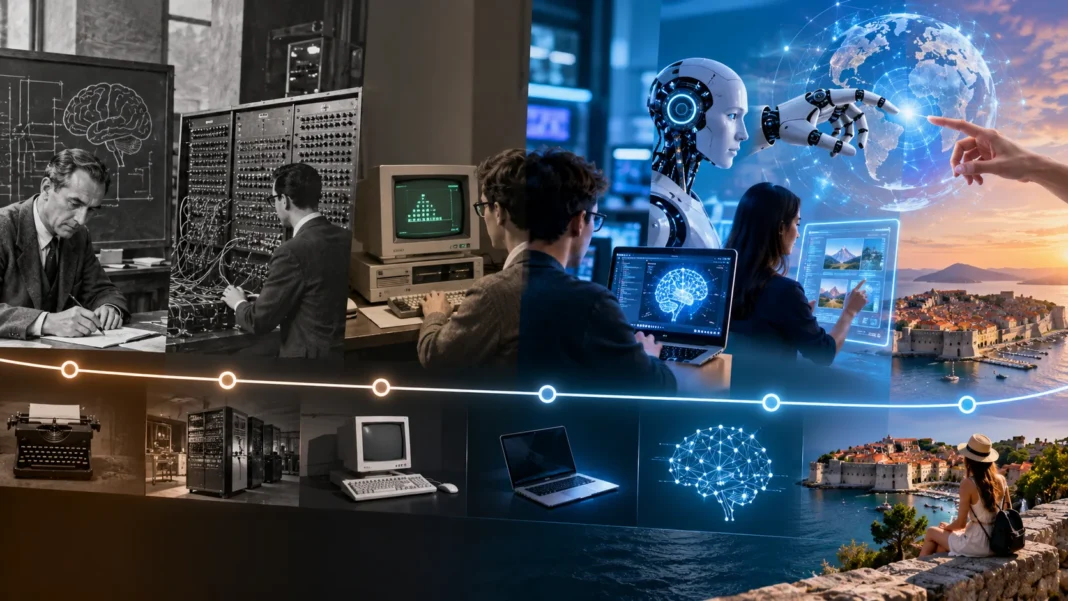
Artificial intelligence has moved from an ambitious academic idea to one of the most influential technologies in modern life. What began as theoretical questions about whether machines could think has developed into machine learning systems that write, analyze images, generate videos, assist programmers, support scientific discovery, and interact through natural language. Understanding this journey helps explain why today’s AI revolution did not happen overnight.
The artificial intelligence timeline includes periods of extraordinary optimism, disappointing setbacks, reduced funding, unexpected breakthroughs, and rapid commercial adoption. Researchers experimented with symbolic reasoning, neural networks, expert systems, statistical machine learning, deep learning, transformers, generative AI, and increasingly autonomous agents. Each generation built on earlier discoveries, even when those earlier approaches temporarily disappeared from public attention.
From Alan Turing’s influential ideas in 1950 to the generative and agentic AI systems shaping technology today, the history of AI contains several turning points worth understanding. This timeline explores the major milestones, researchers, technologies, and breakthroughs that transformed artificial intelligence. It also explains how these developments gradually produced the AI tools businesses and individuals now use every day.
1950: Alan Turing Asks Whether Machines Can Think
The modern history of artificial intelligence is often traced to 1950, when British mathematician Alan Turing published his influential paper, “Computing Machinery and Intelligence.” Instead of trying to define intelligence philosophically, Turing proposed evaluating whether a machine could communicate convincingly enough to appear human. His idea eventually became widely known as the Turing Test and remains an important reference in AI discussions.
Turing understood that digital computers could potentially perform far more than numerical calculations. He imagined machines capable of learning, adapting, playing games, communicating, and demonstrating behavior associated with intelligence. These ideas appeared at a time when computers were extremely expensive and limited, making his vision particularly remarkable compared with the technological capabilities available to researchers during the early 1950s.
The importance of Turing’s work goes beyond the famous test carrying his name. He helped transform the question of machine intelligence from science fiction into something researchers could investigate scientifically. Later AI researchers developed completely different methods for measuring machine capability, but Turing’s fundamental question—whether computers could demonstrate intelligent behavior—helped establish the intellectual foundation for artificial intelligence.
1956: The Dartmouth Conference Gives AI Its Name
A defining moment in the artificial intelligence timeline arrived in 1956 with the Dartmouth Summer Research Project on Artificial Intelligence. Researchers including John McCarthy, Marvin Minsky, Claude Shannon, and Nathaniel Rochester gathered to discuss how machines might simulate aspects of intelligence. McCarthy’s proposal helped establish “artificial intelligence” as the formal name for this emerging scientific field.
The researchers were highly optimistic about how quickly progress might occur. They believed aspects of learning, reasoning, language, creativity, and problem-solving could eventually be described precisely enough for machines to reproduce them. Early computer successes encouraged this confidence, although researchers dramatically underestimated the complexity of human intelligence and the computational resources required to replicate even apparently simple cognitive abilities.
Dartmouth remains historically important because it helped turn scattered experiments into a recognizable research discipline. Universities began establishing AI laboratories, researchers attracted funding, and computer scientists developed increasingly ambitious programs. The conference did not immediately create intelligent machines, but it provided artificial intelligence with a shared identity that allowed research communities, funding programs, and competing approaches to develop around it.
1957–1965: Perceptrons and Early Machine Learning Begin
Neural network research gained early momentum when psychologist Frank Rosenblatt developed the perceptron during the late 1950s. Inspired loosely by biological neurons, the perceptron could adjust internal weights based on examples and learn simple classification tasks. This represented an important change from programming every rule manually because machines could potentially improve their behavior by learning patterns directly from data.
The perceptron created considerable excitement because researchers imagined increasingly sophisticated networks eventually recognizing images, understanding language, and making intelligent decisions. Computers of the period lacked the processing power and data available to modern machine learning researchers, however. Early neural models were therefore extremely limited compared with today’s deep learning systems and struggled with problems requiring more complex representations.
At the same time, symbolic AI researchers developed programs capable of solving mathematical problems and demonstrating logical reasoning. Systems such as the Logic Theorist showed that computers could prove certain mathematical theorems, strengthening confidence that machine intelligence was achievable. These competing ideas—learning from examples versus manipulating explicit symbols—would repeatedly shape AI research during the following decades.
1966–1973: AI Tackles Language, Robotics, and Reasoning
During the late 1960s and early 1970s, researchers pushed artificial intelligence into increasingly ambitious areas. ELIZA, created by Joseph Weizenbaum, demonstrated how computers could simulate conversation by responding to user statements using carefully designed language patterns. Although ELIZA did not understand conversations in the modern sense, users sometimes reacted surprisingly strongly to the illusion that the software understood what they were saying.
Robotics also became an important research direction through projects such as Shakey the Robot. Shakey could perceive aspects of its surroundings, plan actions, and navigate a structured environment using a combination of computer vision and symbolic reasoning. The project illustrated how artificial intelligence might connect software reasoning with physical actions, anticipating later developments in autonomous vehicles, warehouse robotics, and intelligent machines.
Despite impressive demonstrations, the gap between controlled experiments and real-world intelligence remained enormous. Natural language programs failed when conversations moved beyond carefully designed patterns, while robots struggled in complex environments. Researchers began discovering that tasks humans perform effortlessly often require huge amounts of knowledge, perception, context, and common-sense reasoning when computers attempt to reproduce them.
1974–1980: The First AI Winter Slows Progress
Early AI researchers had made ambitious promises about how quickly machine intelligence might develop. When expected breakthroughs failed to arrive, governments and research organizations became increasingly skeptical about continuing large investments. Computing hardware remained limited, data was scarce, and many AI systems performed well only within carefully controlled situations, reducing confidence that broadly intelligent machines were approaching anytime soon.
This decline in enthusiasm became known as the first AI winter. Funding decreased across several research programs, and artificial intelligence temporarily lost some of the excitement that had surrounded it during the previous two decades. Neural network research was particularly affected because early models had significant mathematical and computational limitations that researchers could not easily overcome using available technology.
The AI winter did not mean artificial intelligence research stopped completely. Scientists continued working on knowledge representation, algorithms, computer vision, language processing, and specialized reasoning systems. Many concepts developed during quieter periods eventually became important later, demonstrating a recurring pattern in AI history: ideas sometimes appear decades before hardware, data, or algorithms become powerful enough to make them practical.
1980–1986: Expert Systems Bring AI Into Business
Artificial intelligence regained commercial attention during the early 1980s through the rise of expert systems. These programs attempted to capture the knowledge and decision-making processes of human specialists using collections of rules. Instead of trying to create general intelligence, developers focused on narrow professional problems where expert knowledge could be represented clearly and applied consistently by computers.
Businesses began using expert systems for applications such as medical support, equipment configuration, geological analysis, financial decisions, and industrial troubleshooting. One famous example was XCON, developed to assist with configuring computer systems. Successful applications demonstrated that AI could generate genuine commercial value when developers limited the problem carefully rather than attempting to reproduce every aspect of human intelligence.
The expert-system boom also encouraged companies to invest heavily in specialized AI software and hardware. Knowledge engineering became an important activity because specialists had to translate human expertise into explicit computer rules. However, maintaining thousands of interconnected rules became increasingly difficult, and systems frequently struggled when unusual situations appeared outside the scenarios their developers had anticipated.
1987–1993: The Second AI Winter Arrives
By the late 1980s, enthusiasm surrounding expert systems began declining as businesses encountered practical limitations. Developing and updating knowledge bases was expensive, specialized AI hardware faced competition from increasingly powerful conventional computers, and many systems failed to provide the flexibility companies expected. Investments decreased as the commercial promises surrounding AI once again exceeded what available technology could reliably deliver.
This downturn became known as the second AI winter. Companies associated heavily with artificial intelligence disappeared or changed direction, while investors became more cautious about using the AI label. Researchers continued making progress, but artificial intelligence temporarily received much less mainstream attention than it had during the expert-system boom of the early and middle 1980s.
The second winter taught researchers an important lesson about technological hype cycles. Artificial intelligence needed measurable performance and practical usefulness rather than ambitious predictions alone. During the following years, researchers increasingly adopted statistical techniques, probability, optimization, and machine learning approaches that allowed systems to learn patterns from data instead of relying entirely on enormous collections of manually written rules.
1997: Deep Blue Defeats World Chess Champion Garry Kasparov
Artificial intelligence returned to global headlines in 1997 when IBM’s Deep Blue defeated reigning world chess champion Garry Kasparov in a six-game match. Chess had long been viewed as an important demonstration of strategic intelligence, making the result culturally significant. A computer defeating one of history’s strongest chess players showed that machines could outperform humans in highly complex but clearly defined intellectual tasks.
Deep Blue was not intelligent in the same general sense as a human chess player. It relied heavily on enormous computational power, sophisticated evaluation methods, and the ability to examine huge numbers of possible positions. Nevertheless, the victory demonstrated that carefully designed algorithms combined with powerful computing could achieve performance that earlier generations of researchers had considered extremely difficult.
The match also changed public perceptions of machine intelligence. AI was no longer only a university research topic discussed by computer scientists; millions of people saw a machine outperform an elite human competitor. Deep Blue became an important historical bridge between symbolic, search-based artificial intelligence and the data-driven machine learning revolution that would accelerate during the following decade.
2000–2010: Big Data Changes Machine Learning
During the 2000s, artificial intelligence became increasingly connected with machine learning, statistics, and large datasets. The rapid growth of the internet created enormous quantities of digital information, while storage became cheaper and computing power increased substantially. Instead of manually programming every decision, developers could train algorithms using examples collected from search engines, websites, online transactions, images, and other digital sources.
Companies began applying machine learning to recommendation engines, fraud detection, search ranking, advertising, spam filtering, speech recognition, and customer behavior analysis. These applications often appeared quietly inside everyday digital products rather than being marketed dramatically as artificial intelligence. Their success demonstrated that practical AI could improve continuously when systems had access to larger datasets and measurable user feedback.
Visual analysis also became increasingly important as organizations attempted to understand complex datasets and model behavior. Techniques such as heat maps helped analysts represent patterns visually, making large amounts of information easier to interpret. The combination of better data, visualization, statistical learning, and growing computing resources created essential conditions for the deep learning breakthroughs that followed.
2011: IBM Watson Demonstrates Advanced Question Answering
Another widely watched AI milestone arrived in 2011 when IBM Watson competed against successful human champions on the television quiz show Jeopardy! The challenge required significantly more than searching a database because clues often involved wordplay, ambiguous language, cultural references, and indirect meanings. Watson processed possible interpretations, searched its knowledge resources, ranked answers, and determined how confident it was before responding.
Watson’s performance demonstrated the growing sophistication of natural language processing and information retrieval. Unlike earlier conversational systems based primarily on simple patterns, Watson combined multiple algorithms and large collections of structured and unstructured information. Its success encouraged organizations to explore how similar technologies might help people retrieve knowledge from complex databases, research collections, healthcare information, and corporate documents.
The project also reflected an important transition in AI development. Instead of relying on one technique, advanced systems increasingly combined machine learning, statistical analysis, language processing, search, and large-scale computing. Modern artificial intelligence continues this pattern, with sophisticated AI products combining numerous specialized components rather than depending on a single algorithm to perform every task.
2012: AlexNet Starts the Deep Learning Revolution
One of the most important events in modern AI history occurred in 2012 when AlexNet achieved a major breakthrough in the ImageNet image-recognition competition. Developed by Alex Krizhevsky, Ilya Sutskever, and Geoffrey Hinton, the deep convolutional neural network significantly improved image classification performance. The result convinced much of the AI community that deep neural networks could outperform traditional computer vision techniques when supplied with sufficient data and computing power.
Several factors came together to make this breakthrough possible. Researchers had improved neural network training methods, large labeled image datasets had become available, and graphics processing units provided much greater computational capability. GPUs, originally developed largely for graphics, proved extremely effective at performing the parallel calculations required for training increasingly large neural networks.
AlexNet helped trigger enormous investment in deep learning across technology companies and universities. Researchers rapidly applied similar approaches to speech recognition, computer vision, translation, recommendation systems, and other tasks. Neural networks, once considered unfashionable after earlier disappointments, became central to artificial intelligence research and eventually provided the foundation for many of today’s generative AI systems.
2014: Generative Adversarial Networks Expand Creative AI
Generative artificial intelligence took an important step forward in 2014 when Ian Goodfellow and colleagues introduced generative adversarial networks, commonly known as GANs. The approach involved two neural networks competing with each other: one generated artificial examples while another attempted to distinguish generated examples from real data. Through repeated competition, the generator could gradually produce increasingly convincing outputs.
GAN research dramatically improved the ability of machines to generate realistic-looking images. Researchers used the technique for creating faces, modifying photographs, transferring visual characteristics, generating artwork, and synthesizing training data. The technology also raised concerns around deepfakes and manipulated media, demonstrating that advances in generative AI could create both valuable creative applications and significant social challenges.
Although newer generative methods eventually became dominant in many applications, GANs played a crucial role in changing expectations about machine creativity. AI was no longer primarily identifying or classifying existing information; it could generate convincing new content. This shift toward generative systems became one of the most important themes in artificial intelligence during the following decade.
2016: AlphaGo Defeats Lee Sedol
In 2016, Google DeepMind’s AlphaGo defeated legendary Go player Lee Sedol in a five-game match watched around the world. Go had historically been considered extremely challenging for computers because the number of possible board positions makes exhaustive search impractical. Many experts had expected computers to require considerably more time before achieving elite human performance in the game.
AlphaGo combined deep neural networks, reinforcement learning, and sophisticated search techniques. Rather than evaluating every possible move, the system learned patterns from games and improved through repeated play. Some of its decisions surprised professional players because they differed from conventional human strategies, showing that AI systems could discover highly effective approaches that human experts had rarely considered.
The victory represented more than another machine defeating a human champion. AlphaGo demonstrated the potential of reinforcement learning, where systems improve through interaction, feedback, and experience. Similar ideas later became influential in robotics, game playing, optimization, language-model training, and AI alignment, helping machines develop sophisticated behavior without requiring humans to specify every decision directly.
2017: Transformers Reshape Artificial Intelligence
The transformer architecture introduced in 2017 became one of the most consequential breakthroughs in the entire artificial intelligence timeline. Researchers proposed an attention-based approach that allowed models to process relationships between words more efficiently than many previous sequence-modeling techniques. Transformers made it easier to train larger language systems using vast amounts of text while capturing important connections across longer passages.
Attention mechanisms helped models determine which parts of an input were most relevant when producing an output. This ability proved exceptionally powerful for translation, summarization, question answering, text generation, and eventually images, audio, video, and multimodal applications. As computing resources increased, researchers discovered that transformer models often became substantially more capable when trained at larger scales.
The transformer ultimately became the foundation for many modern large language models. Systems from numerous research organizations adopted variations of the architecture, accelerating progress in natural language processing. Few technical developments have influenced modern AI as strongly because transformers created the framework through which scaling data, computation, and model size could produce increasingly flexible general-purpose AI capabilities.
2018–2020: BERT, GPT, and Foundation Models Emerge
From 2018 onward, language models became significantly more powerful as researchers trained transformer-based systems on enormous text collections. Google introduced BERT, which improved how machines represented language context for search and natural language tasks. Around the same period, OpenAI’s GPT series demonstrated that transformer models trained to predict language could perform increasingly broad tasks through general-purpose text generation.
GPT-2 attracted considerable attention in 2019 because its generated writing was much more coherent than many earlier language systems. GPT-3, introduced in 2020, pushed scaling substantially further and demonstrated impressive few-shot and zero-shot behavior. Users could describe tasks through natural language prompts instead of building a separate machine learning model from scratch for every individual use case.
These developments contributed to the concept of foundation models: large systems trained broadly and then adapted to many downstream applications. AI development increasingly shifted from creating one model for one narrow task toward developing powerful general models serving numerous purposes. This transformation established the technical and commercial foundation for the generative AI explosion that soon followed.
2021–2022: Generative AI Reaches the Public
Generative AI expanded rapidly during 2021 and 2022 as image-generation models demonstrated that natural language prompts could produce increasingly sophisticated visual content. Diffusion-based approaches became especially influential, allowing models to transform noise gradually into coherent images. Tools for generating artwork, illustrations, design concepts, and synthetic media helped ordinary users experience advanced artificial intelligence without requiring machine learning expertise.
The biggest public turning point came in late 2022 with the release of ChatGPT. Instead of interacting with AI through complicated software interfaces, millions of people could simply type questions and instructions conversationally. Users rapidly experimented with writing, brainstorming, coding, explaining concepts, summarizing documents, learning languages, planning tasks, and countless other applications.
ChatGPT changed AI from a technology primarily discussed among researchers and technology professionals into a mainstream consumer phenomenon. Businesses began reconsidering workflows, students experimented with AI-assisted learning, and software developers explored new products built around large language models. Generative AI quickly became one of the fastest-moving areas in the technology industry, attracting enormous investment and public attention.
2023: Multimodal AI Expands What Models Can Understand
The AI race accelerated further during 2023 as increasingly advanced models improved reasoning, coding, language understanding, and multimodal capabilities. GPT-4, released in March 2023, represented a notable step in the development of large multimodal systems capable of working with text and image inputs. Other technology companies simultaneously accelerated their own foundation-model research, making advanced generative AI an intensely competitive global field.
Multimodal AI changed expectations because users no longer needed to communicate with artificial intelligence entirely through text. Models increasingly gained capabilities involving images, documents, audio, and other information formats. This opened new applications in education, accessibility, design, software development, healthcare support, business analysis, and creative work while increasing the complexity of questions surrounding accuracy, copyright, safety, and responsible use.
Businesses also began moving beyond experimentation toward practical generative AI integration. Companies explored customer service assistants, enterprise search, marketing tools, coding copilots, document analysis, and productivity applications. The conversation surrounding AI expanded accordingly, shifting from whether generative models were useful to how organizations could deploy them securely, responsibly, and economically across real-world workflows.
2024: Reasoning Models, AI Video, and Agents Advance
During 2024, AI development increasingly emphasized reasoning rather than simple next-word generation. Researchers explored methods that allowed models to use more computation while solving difficult tasks, improving performance in areas such as mathematics, coding, and scientific reasoning. At the same time, developers continued improving efficiency, making capable models smaller and reducing the cost of using advanced AI systems.
Generative video improved dramatically as models became better at converting text descriptions into moving visual scenes. Multimodal systems also grew more sophisticated, increasingly handling combinations of text, images, audio, and video. These developments suggested that the future of artificial intelligence would involve unified models capable of understanding and generating information across many different media rather than separate tools for every format.
AI agents also became a major research and product focus. Instead of generating a single response, agent-like systems could plan steps, use external tools, interact with software, and attempt multi-stage tasks. Early evaluations showed significant promise while also revealing limitations on longer, more complex assignments, making reliability and oversight essential challenges for the next stage of AI development.
2025–2026: AI Moves Toward the Agentic Era
By 2025 and 2026, artificial intelligence had become deeply integrated into software development, search, productivity tools, education, business operations, science, and digital services. Frontier models continued improving in reasoning, multimodal understanding, coding, and tool use. Competition also became broader, with capable systems emerging from multiple organizations and countries rather than advanced AI development remaining concentrated among only a few laboratories.
AI agents became one of the defining themes of this period. Developers increasingly focused on systems that could carry out workflows rather than merely provide answers, including researching information, writing code, processing documents, using tools, and completing sequences of actions. However, fully reliable long-horizon autonomy remained difficult, meaning human oversight continued to matter for complex or high-stakes decisions.
The wider adoption of AI also intensified discussions about employment, education, copyright, misinformation, safety, regulation, energy use, and responsible development. Stanford’s 2026 AI Index reports continuing growth in AI capability and organizational adoption while showing that real-world agent deployment is still developing. This combination of rapid technical progress and unresolved limitations defines the current stage of artificial intelligence.
Conclusion
The artificial intelligence timeline from 1950 to today shows that modern AI emerged through decades of experimentation rather than one sudden invention. Alan Turing’s early ideas, the Dartmouth conference, symbolic reasoning, expert systems, neural networks, machine learning, and deep learning each contributed essential concepts. Even periods of disappointment helped researchers identify limitations and develop more effective approaches.
The pace accelerated dramatically after 2012 as larger datasets, powerful GPUs, improved neural networks, and eventually transformers enabled capabilities that previous generations could only imagine. Deep learning transformed perception, while foundation models and generative AI expanded machine capabilities into language, images, audio, video, coding, and reasoning. ChatGPT then helped bring these technologies directly into everyday public use.
Today, artificial intelligence is entering a new phase centered increasingly on multimodal reasoning, tool use, and AI agents capable of completing more complex workflows. The timeline is still being written, and major limitations remain around reliability, safety, cost, and governance. What history makes clear is that AI progress rarely follows a straight line, and future breakthroughs may again emerge from ideas developed years earlier.
FAQs About the Artificial Intelligence Timeline
When did artificial intelligence begin?
Modern artificial intelligence is commonly traced to Alan Turing’s work in 1950 and the Dartmouth conference in 1956. Dartmouth was especially important because researchers formally established artificial intelligence as a distinct field of study.
Who is considered the father of artificial intelligence?
John McCarthy is often called the father of artificial intelligence because he coined the term “artificial intelligence” and helped organize the influential 1956 Dartmouth conference that established the field.
What was the biggest breakthrough in AI history?
There is no single breakthrough, but transformers introduced in 2017 were especially important to modern AI. They became the technical foundation for many large language models and today’s generative AI systems.
When did generative AI become popular?
Generative AI gained broader attention through image-generation systems in 2021 and 2022, then became mainstream after ChatGPT launched in late 2022. Adoption expanded rapidly across business, education, programming, and creative work.
What is the current stage of artificial intelligence?
AI is currently moving toward multimodal and agentic systems that can reason, work with several media types, use tools, and complete multi-step tasks. Reliability, safety, governance, and human oversight remain important challenges.