


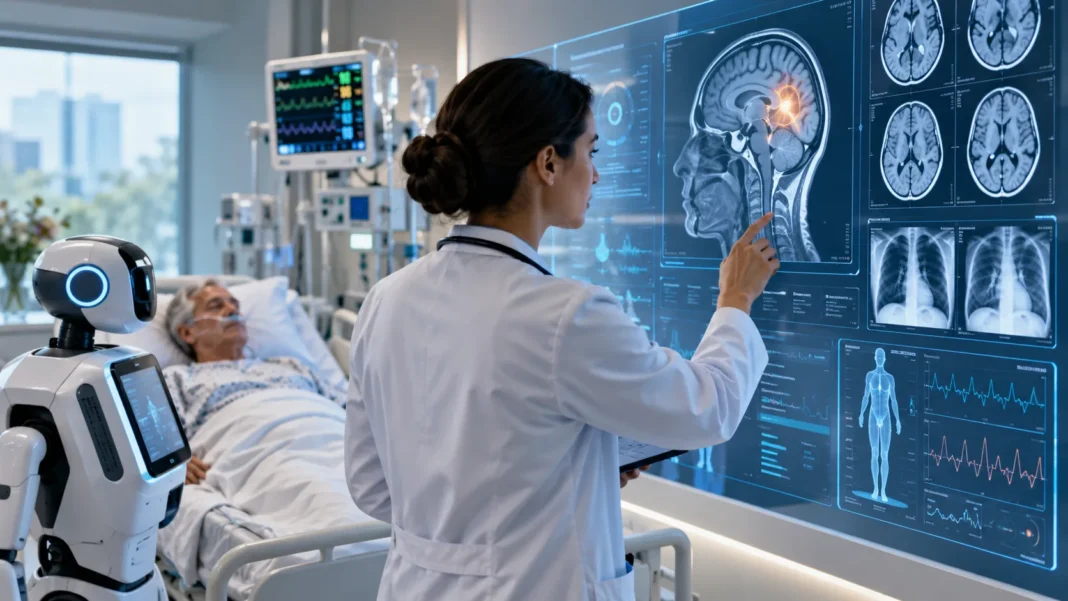
Artificial intelligence is changing healthcare by helping professionals analyze information, automate repetitive work, identify patterns, and make faster decisions. Hospitals, clinics, researchers, insurers, and health technology companies are using AI across areas ranging from medical imaging to appointment scheduling. Rather than replacing healthcare professionals, most practical systems are designed to support people by making complex tasks more efficient.
AI in healthcare includes machine learning, natural language processing, computer vision, predictive analytics, and generative AI. These technologies can examine large volumes of medical data that would be difficult for people to review manually at the same speed. When implemented responsibly, AI can support diagnosis, clinical workflows, patient communication, research, and administrative operations while keeping qualified professionals involved.
However, healthcare AI also introduces significant challenges involving privacy, accuracy, bias, security, regulation, and patient trust. Medical decisions affect real people, so an algorithm that performs well in testing still requires careful validation and oversight. This guide explains what AI in healthcare means, how it works, its most important uses, practical examples, benefits, limitations, and its potential future impact.
What Is AI in Healthcare?
AI in healthcare refers to the use of computer systems that can perform tasks normally requiring human intelligence, such as recognizing patterns, interpreting language, predicting outcomes, and supporting decisions. These systems learn from health-related information, including images, clinical notes, laboratory results, and operational data. Their purpose varies depending on the healthcare problem they are designed to address.
A medical imaging model, for example, may examine scans and highlight areas that deserve closer review by a clinician. Another AI system may analyze appointment history and predict which patients are more likely to miss scheduled visits. Generative AI tools can also summarize information, draft documentation, or help healthcare staff retrieve relevant knowledge more quickly.
The concept developed through decades of advances in computing, machine learning, and data science rather than appearing suddenly. Readers interested in that wider development can explore our AI history guide, which covers major milestones in artificial intelligence. Healthcare represents one of the most important areas where these broader technological advances are now being applied.
How Does AI Work in Healthcare?
Healthcare AI generally begins with data that represents the problem an organization wants to understand or improve. Depending on the application, this information may include medical images, symptoms, clinical records, vital signs, claims data, or operational information. Machine learning algorithms analyze patterns within that data and learn statistical relationships that can later be applied to new cases.
Training is only one stage because healthcare models also need testing and validation before they can be trusted in real environments. Developers assess whether the system performs accurately across relevant patient groups, clinical settings, and realistic conditions. A model that performs impressively on one dataset may still produce unreliable results when introduced into a different hospital or patient population.
Many AI systems therefore work as decision-support tools rather than independent decision makers. The software may identify patterns, suggest priorities, generate summaries, or flag potential concerns while healthcare professionals review the output. This human-in-the-loop approach is particularly important because medical data can be incomplete, unusual cases occur frequently, and clinical judgment often requires context unavailable to an algorithm.
Why Is Artificial Intelligence Important in Healthcare?
Healthcare organizations handle enormous amounts of information every day, including patient records, scans, laboratory results, prescriptions, appointments, insurance documentation, and operational data. Reviewing everything manually can consume substantial time and increase administrative pressure. AI can help organize and analyze this information more efficiently, allowing healthcare teams to focus attention where professional judgment and patient interaction matter most.
Another reason AI matters is the growing complexity of medical knowledge. Healthcare professionals must consider symptoms, test results, medical histories, research, treatment guidelines, and individual patient circumstances when making decisions. AI tools can help process large information volumes and surface potentially relevant patterns, although final decisions should still consider clinical expertise, patient preferences, and appropriate medical standards.
AI also creates opportunities to move healthcare from reactive treatment toward earlier intervention. Predictive systems may identify patterns associated with deterioration, readmission, or other risks before problems become more obvious. When such tools are accurate and integrated responsibly, they can help organizations prioritize resources and respond sooner rather than waiting until a patient’s condition becomes more difficult to manage.
AI for Medical Diagnosis and Decision Support
One widely discussed use of AI in healthcare is supporting diagnosis. Machine learning models can compare patient information with patterns learned from previous cases and identify possibilities that may deserve further investigation. These systems can assist clinicians by organizing complex information, highlighting unusual findings, or generating probability estimates rather than attempting to make definitive medical decisions independently.
Decision-support tools can be particularly helpful when clinicians must evaluate many variables simultaneously. A system might consider laboratory values, symptoms, medications, medical history, and vital signs before highlighting potential risks. The output gives clinicians another source of information, but it does not automatically account for every personal, social, or clinical factor influencing an individual patient.
Accuracy and appropriate use remain essential because false positives can cause unnecessary testing while false negatives may delay needed care. Diagnostic AI therefore requires careful validation, monitoring, and professional interpretation. Effective systems should complement medical expertise rather than encourage clinicians or patients to accept automated recommendations without understanding their confidence, limitations, or relevance to the specific situation.
AI in Medical Imaging
Medical imaging is one of the most established areas for healthcare AI because images contain patterns that machine learning systems can analyze systematically. Computer vision models can assist with X-rays, CT scans, MRIs, mammograms, retinal images, and other medical scans. The software may highlight suspicious regions, measure structures, classify findings, or help prioritize cases requiring faster specialist review.
Radiologists and other specialists often examine large numbers of images under significant workload pressure. AI can potentially reduce repetitive tasks by automatically performing measurements or flagging images that may need urgent attention. This does not eliminate the specialist’s role because professionals still interpret images within the broader context of symptoms, history, previous scans, and other clinical information.
Medical imaging AI must also be evaluated carefully across different scanners, hospitals, patient populations, and image qualities. A model trained on highly controlled data may struggle when encountering unfamiliar equipment or uncommon conditions. Continuous monitoring is therefore important to ensure that performance remains reliable after deployment rather than assuming that accuracy measured during development will remain unchanged indefinitely.
Predictive Analytics and Early Risk Detection
Predictive analytics uses historical and real-time information to estimate the likelihood of future outcomes. Healthcare organizations can apply these systems to issues such as patient deterioration, hospital readmission, appointment no-shows, resource demand, or potential complications. The goal is not to predict the future perfectly but to identify patterns that help teams decide where attention may be needed earlier.
For example, a hospital may use an AI model to analyze vital signs and clinical information for signs that a patient’s condition could worsen. When risk indicators appear, the system can alert healthcare staff so they can review the patient more closely. Early detection may provide additional time for assessment, although alerts must be accurate enough to avoid overwhelming teams.
Predictive models can also support operational planning by estimating bed demand, staffing needs, or patient flow. Better forecasts may help hospitals allocate resources more efficiently and reduce bottlenecks. However, predictions should always be interpreted as probabilities rather than guarantees because healthcare environments change, patient behavior varies, and unexpected events can influence outcomes that historical data cannot fully anticipate.
AI for Personalized Treatment
Personalized healthcare aims to adapt treatment decisions to the characteristics of an individual patient rather than assuming the same approach works equally well for everyone. AI can help analyze combinations of medical history, laboratory data, treatment response, genetics, and other information. These patterns may support clinicians when considering which treatments are potentially more appropriate for different types of patients.
Cancer care is one area where data-driven approaches have generated particular interest because treatment choices can depend on numerous biological and clinical factors. AI may help specialists interpret complex information and compare it with previously observed responses. However, personalized recommendations require strong evidence and clinical oversight because correlation in historical data does not automatically prove that a particular treatment will benefit an individual.
Personalization may also apply to less complex areas such as rehabilitation, chronic condition management, and patient education. Digital systems can adapt reminders, content, or monitoring based on how people respond over time. This can make healthcare experiences feel more relevant, but organizations should avoid treating algorithmic personalization as a replacement for conversations between patients and qualified healthcare professionals.
AI in Drug Discovery and Medical Research
Developing medicines traditionally requires extensive research, testing, and investment. AI can assist researchers by analyzing large chemical, biological, and clinical datasets to identify patterns that may guide drug discovery. Machine learning systems can help prioritize potential molecules, predict certain properties, analyze existing research, or identify relationships that researchers might not discover as quickly through manual review.
Artificial intelligence can also support the process of finding potential new uses for existing compounds. By analyzing biological pathways and previously collected information, researchers may identify hypotheses worth investigating further. The technology does not remove the need for laboratory experiments, clinical trials, or regulatory evaluation because computational predictions must ultimately be tested against real biological and clinical evidence.
Generative AI is expanding this area further by helping scientists explore molecular structures, summarize research, and design potential experiments. These capabilities can reduce time spent searching through enormous scientific information collections. Their greatest value may come from helping researchers narrow possibilities more efficiently, allowing laboratory and clinical teams to concentrate resources on the most promising questions.
AI Virtual Assistants and Healthcare Chatbots
Healthcare chatbots and virtual assistants use conversational technology to interact with patients through text or voice. They can help answer common administrative questions, provide appointment information, send reminders, explain preparation instructions, or direct users toward appropriate services. By handling routine communication, these systems can reduce pressure on front-desk staff and make basic information available outside traditional office hours.
More advanced assistants can gather preliminary information before appointments by asking structured questions about symptoms or patient needs. This information may help healthcare teams prepare for consultations, although automated symptom conversations should not be treated as definitive diagnosis. Clear escalation pathways are essential when users describe serious symptoms, emergencies, or situations that require direct professional evaluation.
Generative AI has made virtual healthcare communication more natural, but fluent language can create a misleading impression of certainty. A chatbot may produce confident-sounding information even when its answer is incomplete or incorrect. Organizations therefore need appropriate safeguards, approved knowledge sources, monitoring, and clear explanations of when patients are interacting with automated systems rather than healthcare professionals.
AI for Remote Patient Monitoring
Remote patient monitoring uses connected devices and digital systems to collect health information while patients are outside traditional clinical settings. Depending on the program, devices may measure heart rate, blood pressure, oxygen levels, glucose readings, activity, or other relevant signals. AI can help analyze these data streams and identify patterns that may require attention from a healthcare team.
Without automation, clinicians could struggle to manually review continuous readings from large patient populations. Algorithms can prioritize unusual changes and help teams focus on patients whose data indicates potential problems. This approach may support chronic disease management and post-treatment monitoring, although the usefulness depends heavily on device accuracy, patient adherence, and appropriate clinical response processes.
Remote monitoring can also help healthcare organizations understand trends over time rather than relying only on measurements taken during occasional appointments. Longitudinal data may reveal changes that would otherwise go unnoticed. However, collecting more information does not automatically improve care unless the organization has clear procedures for interpreting alerts, responding appropriately, and avoiding unnecessary alarm fatigue.
AI in Robotic and Assisted Surgery
Robotic surgery combines advanced mechanical systems with software that helps surgeons perform certain procedures with high precision. Not every surgical robot uses artificial intelligence, but AI capabilities are increasingly being explored for planning, imaging, navigation, and decision support. These tools may help surgeons understand anatomy, optimize movements, or identify important structures during complex procedures.
AI-assisted surgical systems can analyze video and sensor information generated during an operation. Researchers are exploring how such systems might recognize surgical phases, identify anatomical landmarks, or warn when actions approach sensitive areas. These technologies remain highly dependent on trained professionals because surgery involves rapidly changing situations where experience, judgment, and responsibility cannot simply be delegated to software.
Future robotic systems may become more capable of assisting with specific surgical tasks under close supervision. Even then, healthcare organizations must consider training, equipment reliability, cybersecurity, maintenance, and clear responsibility for decisions. The objective is usually to extend the surgeon’s capabilities and consistency rather than create completely autonomous operating rooms without qualified human oversight.
AI for Electronic Health Records
Electronic health records contain valuable clinical information, but much of it exists as lengthy notes rather than neatly structured data. Natural language processing can help analyze these documents and identify diagnoses, medications, symptoms, procedures, and other relevant information. This can reduce the time healthcare professionals spend manually searching through extensive records before or during patient encounters.
Generative AI can also assist with clinical documentation by transforming conversations or notes into structured drafts. Clinicians may then review, correct, and approve the documentation rather than creating everything manually. Reducing documentation burden could improve workflow efficiency, but accuracy remains essential because mistakes in medical records can influence future treatment, billing, communication, and patient safety.
Another application involves summarizing long patient histories into concise overviews. A clinician seeing a patient with years of records may benefit from a structured summary highlighting major conditions, medications, and recent events. Such summaries still require verification because an AI system might omit important details or emphasize information differently from what the current clinical situation requires.
AI for Administrative Automation
A significant portion of healthcare work involves administrative activities rather than direct patient care. Scheduling, insurance verification, referrals, documentation, coding, prior authorization, billing, and routine communication can consume substantial staff time. AI and automation tools can reduce repetitive manual work by extracting information, routing requests, preparing documents, and helping employees process large volumes of routine tasks.
Scheduling systems can analyze appointment demand, provider availability, cancellation patterns, and historical no-show behavior. These insights may help organizations use available appointment slots more effectively while reducing unused capacity. Automated reminders and rescheduling tools can further improve efficiency by giving patients easier ways to confirm, cancel, or change appointments before valuable clinical time is lost.
Administrative AI can create significant value even when patients never directly interact with the technology. Faster back-office processes may reduce delays, decrease repetitive workload, and allow employees to spend more time resolving complicated issues. However, organizations should still provide human support because insurance, billing, and access questions often involve circumstances that automated workflows cannot handle appropriately.
AI in Medical Coding and Revenue Cycle Management
Medical coding translates healthcare services into standardized codes used for billing, reporting, and insurance processes. Reviewing clinical documentation and assigning appropriate codes can be time-consuming, particularly for complex cases. AI systems can analyze medical notes and suggest relevant coding possibilities, helping human coding professionals work more efficiently while maintaining review and quality-control processes.
Revenue cycle teams can also use AI to identify incomplete claims, potential billing errors, or patterns associated with denials. Addressing problems before claims are submitted may reduce unnecessary administrative work later. Machine learning can analyze historical payment outcomes and prioritize cases that need additional review, although organizations must ensure systems follow current coding and payer requirements.
Automation should not encourage inaccurate billing or remove accountability from healthcare organizations. Coding rules can be detailed and change over time, while clinical documentation may contain ambiguities requiring professional interpretation. Effective AI-assisted coding therefore combines technology with trained staff who can verify suggestions, investigate unusual cases, and ensure that final submissions accurately reflect documented care.
AI for Population Health Management
Population health focuses on improving outcomes across groups of patients rather than treating every encounter as an isolated event. AI can help healthcare organizations analyze patterns across large populations to identify people who may benefit from additional support. Data can include diagnoses, medications, hospital visits, demographic information, utilization patterns, and other factors relevant to health management.
Risk-stratification models may help organizations identify patients with higher likelihood of hospitalization, complications, or gaps in care. Care teams can then prioritize outreach and resources instead of applying identical interventions to everyone. These systems must be designed carefully because historical healthcare data can contain inequalities that algorithms may reproduce if developers do not examine performance across different populations.
Population-level analytics can also help organizations understand where services are being underused or where health needs are changing. Visual dashboards and predictive tools may support planning for outreach, staffing, and preventative programs. The strongest programs combine data analysis with clinical knowledge and community understanding rather than assuming mathematical patterns alone explain why health outcomes differ.
Real-World Examples of AI in Healthcare
One common healthcare AI example is a medical imaging system that highlights potentially suspicious findings for a radiologist to review. Another is software that analyzes hospital data and flags patients whose condition may be deteriorating. Both examples show how AI can function as an additional layer of analysis while trained healthcare professionals remain responsible for interpreting the information.
Administrative examples include systems that draft clinical notes, answer common patient questions, process referrals, or identify missing insurance information. Hospitals may also use predictive analytics to forecast bed demand and improve staffing decisions. These applications receive less public attention than diagnostic AI but can create significant operational value because healthcare organizations manage thousands of repetitive processes every day.
Research organizations use AI differently, applying machine learning to scientific literature, molecular data, clinical trials, and drug discovery. Public health teams may analyze large datasets to identify trends, while digital health companies use AI in remote monitoring platforms. The variety of examples demonstrates that healthcare AI is not one technology but a broad collection of tools addressing different problems.
Benefits of AI for Patients
One potential benefit for patients is faster access to information and support. AI-powered scheduling, communication, and administrative systems can reduce delays involved in routine tasks such as confirming appointments or receiving instructions. When healthcare employees spend less time processing repetitive requests, they may have more capacity to focus on issues requiring personal attention and professional judgment.
AI may also help healthcare teams recognize certain risks sooner by analyzing data continuously or highlighting patterns within complex records. Earlier identification does not guarantee better outcomes, but it can provide clinicians with additional information when deciding whether further evaluation is appropriate. Patients benefit most when technology improves professional decision-making without replacing conversations about their concerns, preferences, and circumstances.
Remote monitoring and personalization can make care more continuous instead of restricting every interaction to an occasional clinic visit. Digital tools may help patients track progress and maintain recommended routines between appointments. However, access should remain inclusive because not every patient has the same technology, digital literacy, language preferences, connectivity, or comfort with automated healthcare systems.
Benefits of AI for Healthcare Providers
Healthcare professionals frequently face heavy workloads involving both clinical care and extensive documentation. AI can reduce some repetitive tasks by summarizing information, drafting notes, prioritizing messages, or organizing records. When these systems work reliably, clinicians may spend less time navigating software and more time communicating directly with patients or addressing complex medical decisions.
Decision-support systems can also help providers manage increasingly large amounts of clinical information. AI may surface relevant details from lengthy records, highlight unusual findings, or provide reminders that support established workflows. These tools are most helpful when they deliver useful information at the right moment rather than creating additional alerts that clinicians must dismiss or investigate unnecessarily.
Healthcare organizations may also use AI to improve resource allocation and operational planning. Predictive analytics can support staffing, scheduling, patient flow, and capacity decisions while automation reduces repetitive back-office work. These improvements can indirectly benefit clinicians by reducing organizational friction, although poor implementation may create the opposite effect if systems add complexity or require excessive correction.
Challenges and Limitations of Healthcare AI
AI systems can make mistakes, and healthcare is an environment where those errors may have serious consequences. A model can produce false alarms, miss important findings, or behave unpredictably when encountering data unlike its training examples. Healthcare organizations therefore need validation, monitoring, escalation procedures, and professional oversight rather than assuming strong average performance makes every individual prediction reliable.
Another limitation is that medical records frequently contain missing, inconsistent, or outdated information. Machine learning systems depend heavily on data quality, meaning poor input can lead to poor output even when the underlying model is technically sophisticated. Different hospitals may also document information differently, making it difficult to transfer a successful AI system from one environment to another.
Integration presents an additional challenge because healthcare organizations often rely on many disconnected technology systems. A useful AI model may still fail operationally if employees must open another application, duplicate documentation, or interrupt existing workflows. Successful adoption therefore depends as much on usability, implementation, training, and organizational design as it does on algorithmic accuracy.
Privacy and Security Concerns With Healthcare AI
Healthcare information is highly sensitive, so privacy must be considered whenever AI systems process patient data. Organizations need clear controls covering how information is collected, stored, accessed, shared, and retained. Using third-party AI services without understanding their data practices can create risks, particularly when employees enter identifiable patient information into tools that were not approved for clinical use.
Cybersecurity is equally important because connected AI systems can become part of the broader technology environment attackers may target. Healthcare organizations already manage substantial security risks involving patient records, medical devices, and operational systems. Adding AI requires appropriate authentication, access controls, monitoring, vendor assessment, encryption, and incident-response planning rather than treating security as something to address after deployment.
Generative AI introduces additional concerns because employees may accidentally expose private information while requesting help with documentation or analysis. Organizations should establish clear policies identifying which tools are approved and what information users can provide. Training staff on safe AI use is often just as important as technical safeguards because privacy failures frequently involve everyday workflows and human behavior.
Bias and Ethical Issues in Healthcare AI
AI models learn patterns from historical information, and healthcare data may reflect existing inequalities, inconsistent access, or differences in how patients were previously treated. If developers use these datasets without careful evaluation, models can reproduce or even amplify unfair patterns. Performance should therefore be examined across relevant patient groups rather than relying only on one overall accuracy number.
Transparency is another ethical concern because healthcare professionals and patients may want to understand why an AI system recommended a particular action. Some advanced models are difficult to interpret, creating challenges when decisions have significant consequences. Organizations should match the level of explainability and oversight to the seriousness of the task rather than accepting opaque recommendations simply because a model appears powerful.
Responsibility must also remain clear when AI contributes to healthcare decisions. Patients need to know who is accountable when automated recommendations are wrong or incomplete. Ethical deployment requires defined roles for developers, healthcare organizations, and professionals, along with mechanisms for challenging decisions and reporting problems instead of allowing responsibility to disappear behind complicated technology.
The Future of AI in Healthcare
The future of AI in healthcare is likely to involve deeper integration into everyday clinical and administrative workflows. Instead of employees opening separate AI applications, intelligent capabilities may become built directly into electronic records, imaging systems, scheduling platforms, and patient communication tools. This could make AI less visible while allowing it to support thousands of small decisions throughout healthcare operations.
Multimodal AI may become particularly important because healthcare information exists in many formats. Future systems could potentially analyze combinations of text, images, laboratory data, audio, sensor readings, and other information within a more unified workflow. Combining several data types may provide richer context, although it also increases privacy, validation, and technical complexity.
AI agents could eventually handle longer healthcare workflows involving multiple steps, such as gathering documents, coordinating appointments, preparing summaries, and completing administrative processes under supervision. High-stakes clinical autonomy is likely to require much stronger evidence and safeguards. The most realistic future is therefore collaboration, where increasingly capable AI supports healthcare professionals rather than removing humans from important care decisions.
Conclusion
AI in healthcare refers to a wide range of technologies that help professionals analyze data, recognize patterns, automate work, and support decisions. Its applications already extend across medical imaging, predictive analytics, documentation, drug discovery, remote monitoring, patient communication, administrative automation, and research. These systems can improve efficiency and expand what healthcare teams can manage when implemented appropriately.
The technology also carries substantial limitations involving accuracy, privacy, cybersecurity, bias, explainability, and workflow integration. Healthcare organizations should therefore evaluate AI according to the specific problem being solved rather than adopting tools simply because artificial intelligence is popular. Human oversight, strong data governance, continuous monitoring, and clear accountability remain essential wherever automated systems influence patient care.
The future of AI in healthcare will likely involve more personalized, multimodal, and increasingly automated systems integrated directly into everyday healthcare platforms. The strongest results will come from combining technological capability with clinical expertise, patient needs, and responsible governance. AI can become a powerful healthcare tool, but its value ultimately depends on how carefully people design, deploy, and supervise it.
FAQs About AI in Healthcare
What does AI mean in healthcare?
AI in healthcare means using technologies such as machine learning, natural language processing, and computer vision to analyze medical information, automate tasks, and support healthcare professionals in clinical and operational decision-making.
What are common examples of AI in healthcare?
Common examples include medical image analysis, clinical documentation tools, hospital risk prediction, healthcare chatbots, remote patient monitoring, scheduling automation, drug discovery systems, and software that helps clinicians review complex patient information.
Can AI replace doctors and nurses?
AI is generally designed to support rather than replace healthcare professionals. Medical care requires clinical judgment, communication, empathy, responsibility, and context that automated systems cannot reliably provide on their own.
What are the biggest risks of AI in healthcare?
Major risks include inaccurate recommendations, biased algorithms, privacy breaches, cybersecurity problems, poor-quality data, lack of transparency, and overreliance on automation without appropriate clinical review or human oversight.
How will AI change healthcare in the future?
AI will likely become more integrated into clinical workflows, medical research, monitoring, documentation, and administrative systems. Multimodal models and AI agents may automate more complex tasks while professionals continue supervising high-stakes decisions.