


What Muscles Are Behind the Knee?
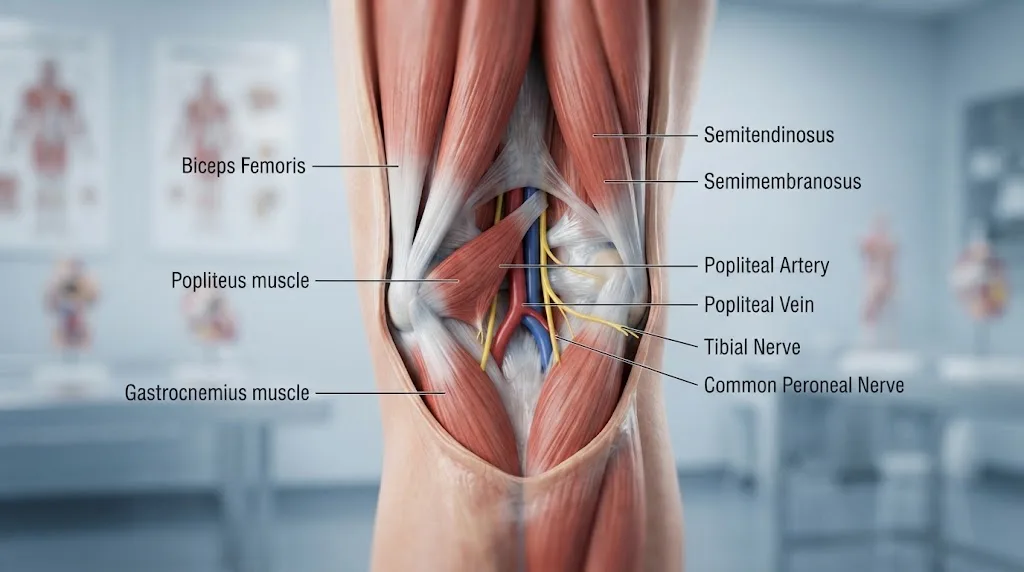
The area behind the knee is called the popliteal region, and several muscles and tendons pass through or near it. The hamstrings approach the knee from above, while the gastrocnemius calf muscle begins just below the joint. A smaller muscle called the popliteus also sits deep behind the knee and helps control movement.
These structures work together whenever you bend, straighten, rotate, walk, run, or climb stairs. Although people often refer to a single “muscle behind the knee,” discomfort in this area can come from different tissues. Tendons, ligaments, nerves, blood vessels, and joint structures are also located close together.
Understanding the anatomy can help explain why pain behind the knee has many possible causes. A tight hamstring may feel different from calf strain, tendon irritation, or joint swelling. Persistent pain, significant swelling, weakness, or symptoms after a serious injury should be assessed rather than automatically blamed on a tight muscle.
Hamstring Muscles Behind the Knee
The hamstrings are a group of muscles located along the back of the thigh. They include the biceps femoris, semitendinosus, and semimembranosus, all of which cross the knee joint. Their tendons attach around the upper shin and outer or inner knee, making them important structures in the area behind the joint.
The hamstrings help bend the knee and extend the hip. They are active during walking, running, sprinting, climbing stairs, and lifting movements such as deadlifts. Because they cross two major joints, they must coordinate hip and knee movement while also helping control the leg during faster athletic activity.
Hamstring tightness or strain can sometimes cause discomfort close to the back of the knee. Pain may become more noticeable when straightening the leg, running, or bending forward. However, sudden severe pain, bruising, weakness, or a popping sensation may indicate a more significant strain that deserves professional evaluation.
Gastrocnemius Muscle and the Back of the Knee
The gastrocnemius is the large superficial calf muscle that gives the lower leg much of its visible shape. It has two heads that begin above the knee joint on the lower part of the thigh bone. Because the muscle crosses both the knee and ankle, it can influence movement at both areas.
The gastrocnemius helps point the foot downward, which is important during walking, running, and jumping. It also assists with bending the knee, particularly when the leg is not bearing heavy weight. This dual role explains why calf fatigue or injury can sometimes create discomfort surprisingly close to the back of the knee.
A gastrocnemius strain can develop during sprinting, jumping, or sudden acceleration. Pain may feel sharp in the upper calf or just below the knee and can make walking difficult. Significant swelling, bruising, or difficulty pushing off the foot should be evaluated, especially when symptoms appear suddenly.
Popliteus Muscle Function
The popliteus is a small, deep muscle located directly behind the knee. It runs from the outer side of the thigh bone toward the back of the shinbone. Although it is much smaller than the hamstrings or gastrocnemius, it plays an important role in initiating and controlling knee movement.
One of its key functions is helping “unlock” the knee from a fully straight position. It contributes to slight rotation between the femur and tibia as the knee begins to bend. This movement is subtle, but it helps the joint transition smoothly from standing into walking, squatting, or other activities.
The popliteus also contributes to stability during weight-bearing movement. Overuse, downhill running, or repetitive knee loading may irritate the area in some people. Because the muscle lies deep behind the joint, symptoms can be difficult to distinguish from meniscus, ligament, or other posterior knee problems.
Tendons Behind the Knee
Several important tendons cross the back and sides of the knee. The hamstring tendons connect muscles from the back of the thigh to the lower leg, while the gastrocnemius begins with strong attachments above the knee. These tendons transfer force from muscle to bone and help coordinate movement between the hip, knee, and ankle.
Tendon irritation may develop gradually rather than after one major injury. Repeated running, jumping, cycling, or heavy resistance training can overload tissues when volume increases too quickly. The pain is often localized and may feel worse when the involved muscle contracts strongly or is stretched under load.
Recovery usually depends on reducing excessive load temporarily and then rebuilding strength gradually. Tendons often respond better to progressive strengthening than prolonged complete rest. If pain remains persistent, worsens, or limits normal walking, assessment can help determine whether the tendon or another nearby structure is responsible.
What the Muscles Behind the Knee Do
The muscles behind the knee help control both bending and straightening movements. Hamstrings actively bend the knee, while the gastrocnemius can assist depending on position. The popliteus contributes to rotational control and helps initiate bending when the knee moves out of a fully extended position.
These muscles also help absorb and transfer force. During walking or running, they manage changing loads as the foot hits the ground and the body moves forward. During stairs, squats, and lunges, they help stabilize the knee and prevent movement from becoming uncontrolled.
Their role becomes even more important during fast or powerful activity. Sprinting, jumping, cutting, and rapid changes in direction place significant demand on the hamstrings and calf muscles. Strong, coordinated posterior leg muscles help the knee respond efficiently when speed or resistance increases.
Muscles Behind the Knee During Walking and Running
Walking requires continuous coordination between the hamstrings, gastrocnemius, popliteus, and other lower-body muscles. The hamstrings help control the leg as it swings forward, while the calf muscles help propel the body during push-off. The popliteus contributes to small rotational adjustments as the knee bends and straightens.
Running increases these demands because the leg moves faster and absorbs greater forces. The hamstrings work strongly to control the thigh and prepare the foot for contact, while the calf muscles contribute to propulsion. Fatigue can make these muscles less efficient, especially during longer or more intense sessions.
Gradual training progression helps these tissues adapt. Sudden increases in running distance, sprint volume, hills, or speed work can overload the muscles behind the knee. Strength training and appropriate recovery can improve their ability to handle repeated stress without becoming excessively sore or irritated.
How to Strengthen Muscles Behind the Knee
Hamstring curls are a direct way to strengthen muscles that bend the knee. They can be performed with a machine, resistance band, or exercise ball depending on equipment and experience. Keep the movement controlled and avoid using momentum to pull the heel quickly toward the body.
Romanian deadlifts strengthen the hamstrings through hip extension while also training the glutes. Keep a slight bend in the knees, move the hips backward, and stop when you feel a comfortable stretch through the back of the thighs. Maintain a neutral spine instead of reaching the weight toward the floor at all costs.
Calf raises can strengthen the gastrocnemius and soleus while supporting ankle and knee control. A broader routine with squats, step-ups, lunges, and other leg strengthening exercises can improve the entire lower-body chain. Balanced strength is often more useful than focusing on one muscle in isolation.
Stretching the Muscles Behind the Knee
Gentle hamstring stretching can reduce temporary tightness along the back of the thigh. One simple option is to place the heel on a low surface and lean forward slightly from the hips. Keep the back relatively straight and stop once you feel mild tension rather than forcing a deep stretch.
Calf stretches can also target tissues that cross behind the knee. A straight-knee calf stretch emphasizes the gastrocnemius, while bending the knee slightly changes the focus toward deeper calf muscles. Both versions should feel comfortable and should not produce sharp pain behind the knee.
Stretching is not always the best answer for posterior knee discomfort. If the pain feels nerve-like, swollen, or mechanical, aggressive stretching may make symptoms worse. Use stretching to support comfortable mobility, and seek professional advice if symptoms persist or are difficult to explain.
Common Causes of Pain Behind the Knee
Muscle strain is one possible cause, particularly after running, sprinting, or sudden acceleration. Hamstring or upper calf injuries can produce localized pain behind the knee and may be accompanied by tenderness or weakness. Mild strains often improve gradually, while more significant injuries can create bruising and difficulty walking.
Tendon irritation can also cause aching near the back or sides of the knee. Repetitive activity, increased training load, or poor recovery may contribute. Symptoms often build gradually and are more noticeable during activities that require strong knee bending, hip extension, or ankle push-off.
Not all posterior knee pain is muscular. A Baker’s cyst, meniscus problem, joint swelling, nerve irritation, or vascular condition can create similar symptoms. Significant swelling, redness, warmth, numbness, or calf swelling should not automatically be treated as a muscle problem.
Baker’s Cyst and Posterior Knee Fullness
A Baker’s cyst is a fluid-filled swelling that can develop behind the knee, often when the joint produces extra fluid. It can create a feeling of fullness, tightness, or pressure in the popliteal area. Some people notice the swelling more when standing or fully straightening the knee.
The cyst itself is usually related to another problem inside the joint, such as arthritis or inflammation. Treating only the lump without addressing the underlying knee issue may not provide lasting relief. Symptoms can sometimes improve as joint irritation settles, but larger cysts can remain noticeable.
A Baker’s cyst can occasionally rupture and cause pain or swelling in the calf. Because calf swelling can also have more serious causes, sudden changes should be medically assessed. Do not assume every lump or tight feeling behind the knee is simply a muscle knot.
When Pain Behind the Knee Needs Medical Attention
Seek evaluation if pain follows a significant injury and you cannot bear weight normally. A loud pop, major swelling, visible deformity, or sudden weakness can indicate damage involving muscles, ligaments, tendons, or other joint structures. These symptoms deserve assessment rather than repeated attempts to stretch the knee.
Prompt medical care is also important for unexplained calf swelling, warmth, redness, or tenderness, especially if one leg looks noticeably different from the other. Chest pain, shortness of breath, or sudden breathing difficulty requires urgent attention. These symptoms are not typical of ordinary muscle tightness.
Persistent pain that lasts several weeks despite sensible activity changes should also be reviewed. A physical therapist, sports medicine clinician, or other qualified healthcare professional can assess knee movement, strength, swelling, and nerve function. This helps distinguish muscular causes from problems involving other structures behind the joint.
Conclusion
The muscles behind the knee include portions of the hamstrings, gastrocnemius, and the small popliteus muscle. Together, they help bend the knee, control rotation, stabilize the joint, and transfer force during walking, running, stairs, and sports. Their tendons also contribute significantly to movement around the back of the knee.
Strengthening the hamstrings, calves, glutes, and surrounding leg muscles can improve support and movement control. Romanian deadlifts, hamstring curls, calf raises, squats, and step-ups are useful options when performed with good technique. Gentle stretching can complement strengthening when tightness is present, but it should never be forced into sharp pain.
Pain behind the knee can come from muscles and tendons, but it may also involve joint fluid, a Baker’s cyst, nerves, or other medical conditions. Seek professional care for significant swelling, major trauma, weakness, redness, or persistent symptoms. Understanding the anatomy can help you respond more appropriately when discomfort develops.
FAQs
What muscle is directly behind the knee?
The popliteus is the small muscle located directly behind the knee joint. The hamstring tendons and upper gastrocnemius are also nearby and contribute to movement and stability around the area.
Can tight hamstrings cause pain behind the knee?
Yes. Tight or irritated hamstrings can create pulling or aching behind the knee, particularly during leg straightening or activity. Persistent or severe pain should still be assessed for other possible causes.
What exercises strengthen the back of the knee?
Hamstring curls, Romanian deadlifts, calf raises, bridges, and controlled step-ups can strengthen muscles that support the posterior knee. Progress resistance gradually and maintain good technique throughout each exercise.
Is a lump behind the knee a muscle problem?
Not always. A lump can be caused by a Baker’s cyst or another condition rather than a tight muscle. Persistent or enlarging swelling should be checked by a healthcare professional.
When should pain behind the knee be considered serious?
Seek medical care for severe pain, significant swelling, redness, warmth, inability to bear weight, major trauma, or sudden calf swelling. Persistent unexplained pain also deserves professional evaluation.