


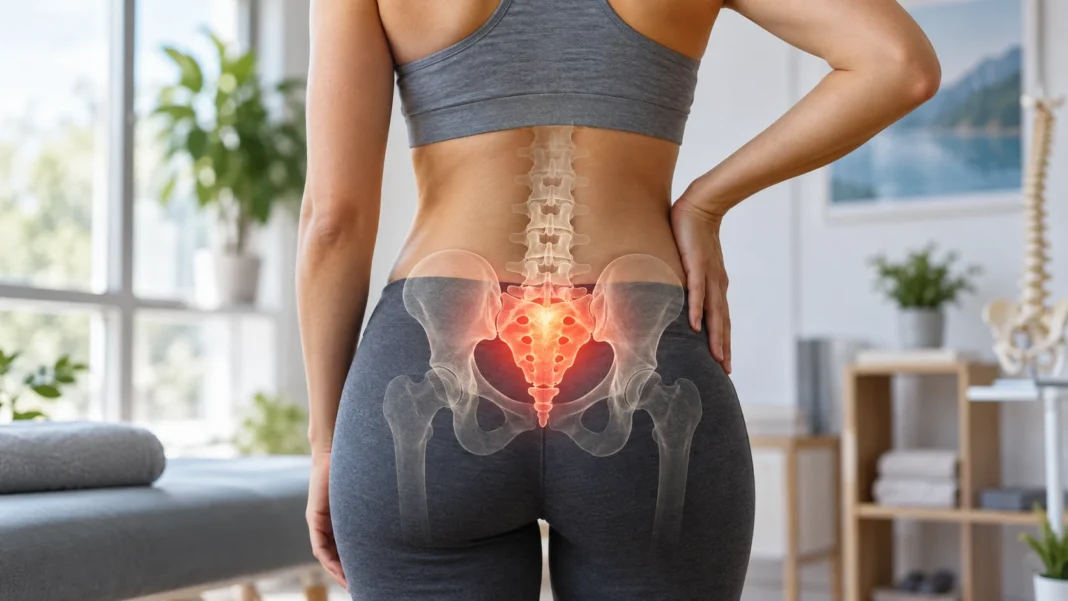
The sacrum is a strong, triangular bone located at the base of the spine between the two hip bones. It connects the lower spine to the pelvis and plays an important role in supporting body weight, stabilizing the trunk, and transferring forces between the upper and lower body during everyday movement.
Although the sacrum is often discussed when talking about lower-back or pelvic pain, it has several important anatomical functions beyond simply supporting the spine. Understanding its location, structure, joints, and relationship with surrounding muscles and nerves can make terms such as sacroiliac joint, sacral pain, and pelvic stability much easier to understand.
What Does Sacrum Mean?
The sacrum is the large bone positioned between the lumbar spine and the tailbone. It forms the back portion of the pelvis and connects with the right and left hip bones. Its name comes from the Latin term for “sacred bone,” reflecting the historical importance given to this part of the human skeleton.
In adults, the sacrum is formed from five vertebrae that gradually fuse together. These bones are commonly labeled S1 through S5. Instead of moving independently like the vertebrae higher in the spine, they combine into one sturdy structure that provides stability at the base of the spinal column.
The sacrum acts as a bridge between the spine and pelvis. Body weight travels downward through the lumbar spine into the sacrum and then through the pelvis toward the legs. This makes the sacrum an important part of standing, walking, lifting, sitting, and many other movements that require the upper and lower body to work together.
Where Is the Sacrum Located?
The sacrum sits at the lower end of the spine, directly below the fifth lumbar vertebra and above the coccyx, or tailbone. If you place your hand over the center of your lower back just above the buttocks, the sacrum lies deeper beneath that general area.
On each side, the sacrum connects with part of the pelvis called the ilium. These connections form the sacroiliac joints, often shortened to SI joints. The sacrum therefore sits in the middle of several important structures and helps connect the spine, pelvis, hips, and lower extremities.
Its triangular shape is wider at the top and narrower toward the bottom. The broad upper portion supports the lower spine, while the lower portion connects with the coccyx. This shape helps distribute forces across the pelvis instead of allowing all body weight to concentrate in one small area.
What Is the Structure of the Sacrum?
The sacrum has a broad upper surface called the base and a narrow lower end called the apex. The base connects with the lowest lumbar vertebra, while the apex meets the coccyx. Its front surface is generally smoother, while the back surface contains ridges and landmarks created by fused spinal structures.
Several openings called sacral foramina appear on both sides of the bone. Nerves pass through these openings as they travel toward different parts of the pelvis and legs. These nerve pathways are one reason conditions affecting the lower spine or sacral region can sometimes produce symptoms beyond the immediate area.
The sacrum also contains a continuation of the spinal canal known as the sacral canal. This region protects important nerve structures as they travel downward. Although the five sacral vertebrae fuse together, the bone retains anatomical features that reflect its origin as several separate vertebrae earlier in development.
What Does the Sacrum Do?
One major function of the sacrum is transferring body weight from the spine into the pelvis. When you stand, walk, or lift something, forces move through the lower spine and must be distributed toward the hips and legs. The sacrum helps manage this load while maintaining stability.
The sacrum also forms part of the pelvic ring, which helps protect organs in the lower abdomen and pelvis. Its connection with the hip bones creates a stable foundation for movement. Although the sacroiliac joints allow only limited motion, this small amount of movement contributes to normal force transfer during activities such as walking.
Muscles and ligaments attached around the sacrum also contribute to posture and pelvic stability. The glutes, spinal muscles, pelvic floor, and surrounding connective tissues all interact with this region. The sacrum therefore functions as more than a passive bone; it forms part of a larger system responsible for coordinated movement.
What Are the Sacroiliac Joints?
The sacroiliac joints are located where the sacrum meets the right and left sides of the pelvis. These joints are designed primarily for stability rather than large ranges of motion. Strong ligaments surrounding them help prevent excessive movement while still allowing small adjustments during walking, bending, and other activities.
Because these joints carry substantial forces, irritation around them can sometimes cause pain near the lower back, buttock, or pelvic region. The discomfort may be felt more strongly on one side. However, pain in this area can also come from muscles, lumbar joints, nerves, or hip structures.
Diagnosing sacroiliac joint pain can therefore be challenging based only on symptom location. A healthcare professional may assess movement, strength, tenderness, and other possible causes before deciding whether the SI joint is involved. Persistent pain should not automatically be labeled as a sacral or sacroiliac problem without evaluation.
Sacrum vs Coccyx: What Is the Difference?
The sacrum and coccyx are located close together but are not the same structure. The sacrum is the larger triangular bone connecting the spine and pelvis, while the coccyx is the much smaller bone positioned directly below it. The coccyx is commonly known as the tailbone.
The sacrum consists of five fused vertebrae, whereas the coccyx usually contains several smaller fused vertebral segments. The sacrum carries significant body weight and connects with the pelvis, while the coccyx mainly serves as an attachment point for muscles, ligaments, and pelvic floor structures.
Pain around the tailbone may be felt lower than typical sacral discomfort, particularly when sitting on hard surfaces. Sacral pain often feels higher and may extend into the lower back or buttocks. Because the areas are close together, professional assessment may be needed when the source of pain is unclear.
What Can Cause Sacral Pain?
Sacral-region pain can develop from muscle strain, prolonged sitting, falls, repetitive loading, or irritation around the sacroiliac joints. Lower-back conditions can also create pain that is felt near the sacrum. The exact cause often depends on how symptoms started and which movements make them better or worse.
Trauma can sometimes injure the sacrum itself. Falls, vehicle accidents, or significant direct impact may cause bruising or, in more severe situations, fractures. People with reduced bone density may be more vulnerable to stress or insufficiency fractures even when there has not been a major accident.
Not every ache over the sacrum means the bone is damaged. Tight muscles, hip problems, lumbar spine issues, or nearby nerve irritation can all create similar sensations. Persistent, severe, or unexplained pain should be evaluated rather than repeatedly treated with stretching or massage without knowing the actual source.
How Core and Hip Muscles Support the Sacral Region
The muscles around the abdomen, hips, back, and pelvis help control forces moving through the sacral area. Strong glutes and trunk muscles can support the pelvis during walking, lifting, and standing. These muscles do not directly “hold the sacrum in place,” but they contribute to overall movement control.
Mobility matters too, particularly when prolonged sitting makes the hips and trunk feel stiff. Gentle core stretches can support comfortable movement around the torso when performed appropriately. Stretching should be combined with strengthening rather than treated as the only solution for discomfort near the sacrum.
Exercises such as bridges, controlled squats, bird dogs, and appropriate core-stability movements may help improve strength around the pelvis. The best exercise depends on the cause of symptoms and your current ability. Painful movements should be modified instead of forced simply because they are commonly recommended for lower-back health.
Sacrum Changes During Pregnancy and Childbirth
Pregnancy changes how forces move through the pelvis because body weight, posture, hormones, and abdominal size all change. Ligaments around the pelvis can become more flexible, which may alter how the sacroiliac region feels. Some people notice new discomfort around the lower back, hips, or sacral area during pregnancy.
The sacrum is also part of the bony pelvis involved in childbirth. Small changes in pelvic joint position can help create space as labor progresses. These movements are limited, but they are important enough that pelvic anatomy, including the sacrum, plays a major role in obstetric care.
Pregnancy-related pelvic pain should be discussed with a maternity care provider when it becomes severe, persistent, or limits walking. Gentle movement and targeted physical therapy can sometimes help. However, exercises and stretches should be selected based on pregnancy stage, symptoms, and individual medical guidance.
When Sacral Pain Needs Medical Attention
Seek professional evaluation if pain around the sacrum is severe, follows a significant fall, or makes standing and walking difficult. A direct impact can injure bone or surrounding tissues. Significant bruising, swelling, or pain that does not improve with basic activity modification deserves further assessment.
Medical attention is also important when pain occurs with numbness, weakness, tingling, or symptoms traveling down the legs. These signs may indicate nerve involvement rather than a simple local muscle problem. Changes in bladder or bowel control or numbness around the groin require urgent medical care.
Persistent unexplained pain should also be investigated, especially when it occurs at night, steadily worsens, or is accompanied by fever or other systemic symptoms. A healthcare professional can determine whether the problem is coming from the sacrum, SI joints, lumbar spine, hips, muscles, or another nearby structure.
Conclusion
The sacrum is a triangular bone at the base of the spine formed from five fused vertebrae. It sits between the lumbar spine and coccyx and connects with both sides of the pelvis through the sacroiliac joints. Its position makes it central to stability and weight transfer between the trunk and legs.
The sacrum works closely with surrounding ligaments, muscles, nerves, and joints during walking, lifting, standing, and other everyday movements. Although pain may be felt around this region, the source is not always the bone itself. Muscles, nerves, lumbar structures, hips, and SI joints can all produce similar symptoms.
Understanding the meaning and function of the sacrum makes many lower-back and pelvic terms easier to understand. If discomfort around the area is persistent, severe, or accompanied by neurological symptoms, seek professional assessment. Accurate diagnosis is much more useful than assuming every pain near the lower spine comes directly from the sacrum.
FAQs
What is the sacrum in simple terms?
The sacrum is a large triangular bone at the bottom of the spine. It connects the lower spine to the pelvis and helps transfer body weight toward the hips and legs.
How many bones make up the sacrum?
The adult sacrum is formed from five fused vertebrae, usually labeled S1 through S5. These vertebrae begin as separate bones and gradually fuse into one structure.
Is the sacrum the same as the tailbone?
No. The sacrum is the larger bone connecting the spine to the pelvis, while the coccyx, or tailbone, is the smaller structure directly below the sacrum.
Can the sacrum cause lower-back pain?
Pain can occur around the sacral region, but it may come from the SI joints, muscles, nerves, hips, or lumbar spine rather than the sacrum itself.
Where do you feel sacral pain?
Sacral pain is generally felt near the center or sides of the lower back above the tailbone and between the hip bones. It may sometimes extend into the buttocks.