


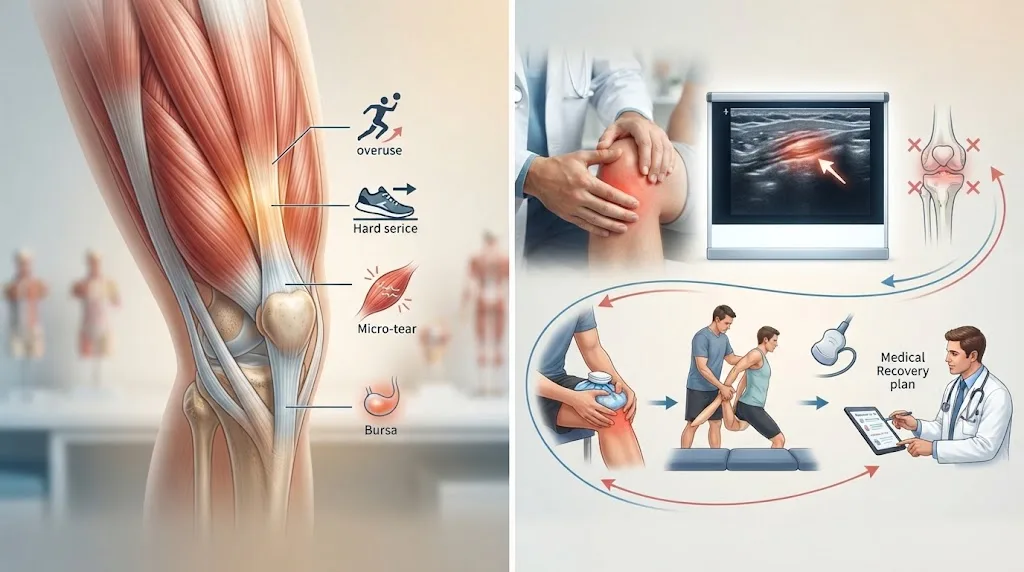
Quadriceps tendonitis is irritation involving the quadriceps tendon, the strong tissue connecting the muscles at the front of the thigh to the top of the kneecap. It commonly causes pain just above the patella, especially during activities that load the knee. Running, jumping, squatting, and climbing stairs can make the area feel more uncomfortable.
The term tendonitis traditionally suggests inflammation, although persistent tendon problems may involve more complex tissue changes and are sometimes described as quadriceps tendinopathy. Symptoms can develop gradually when the tendon repeatedly handles more force than it can currently tolerate. A sudden increase in exercise intensity is a common reason previously comfortable activity starts becoming painful.
Quadriceps tendon pain can affect athletes, active adults, and people returning to exercise after inactivity. Mild cases may improve with sensible activity changes and progressive strengthening. However, severe pain, significant weakness, or an inability to straighten the knee should be evaluated because these symptoms may indicate something more serious than routine tendon irritation.
Common Causes of Quadriceps Tendon Pain
Repeated loading is one of the most common causes of quadriceps tendon irritation. Sports involving jumping, sprinting, running, or repeated squatting can place substantial force through the tendon. Problems often appear when training volume increases suddenly, such as adding more mileage, heavier leg workouts, or additional sports sessions without enough time for recovery.
Reduced lower-body strength can also contribute because the tendon may be exposed to loads it is not prepared to manage. Returning immediately to demanding exercise after several weeks or months away can therefore trigger symptoms. The issue is often not that the activity itself is harmful, but that the jump in workload happens faster than the tissue can adapt.
Movement patterns, ankle mobility, hip strength, recovery, and previous knee injuries may influence tendon loading as well. There is rarely one single cause that explains every case. A useful treatment plan usually considers training habits and overall lower-body capacity instead of focusing only on the painful spot above the kneecap.
Quadriceps Tendonitis Symptoms to Watch For
Pain just above the kneecap is the most characteristic symptom. The area may feel tender when pressed, and discomfort often becomes more noticeable during squats, stairs, running, jumping, or getting up from a low chair. Some people describe an aching sensation after exercise, while others notice sharper pain during movements that require stronger knee extension.
Stiffness can also occur after rest, particularly when getting up in the morning or standing after sitting for a long time. The knee may initially feel uncomfortable and then loosen somewhat once you begin moving. In more persistent cases, symptoms can return later in the day after the tendon has been repeatedly loaded.
Mild swelling can occasionally appear, but major swelling is less typical and deserves further assessment. Weakness, instability, or difficulty straightening the knee may indicate a more significant problem. If you heard or felt a sudden pop followed by severe pain or loss of function, seek medical evaluation rather than treating it as ordinary tendonitis.
Who Is More Likely to Develop Quadriceps Tendonitis?
Athletes who participate in basketball, volleyball, running, football, and other high-impact sports may be more likely to develop quadriceps tendon pain. Repeated jumping and rapid acceleration create high forces around the knee. Training on consecutive days without enough recovery can increase the problem when the tendon is already becoming sensitive.
People starting a new exercise routine are also vulnerable, especially if they progress quickly from very little activity to frequent squats, lunges, running, or stair workouts. Tendons adapt more slowly than motivation often does. Beginning with a manageable workload gives the muscles and tendon more time to build capacity before harder training is introduced.
Age, previous knee injuries, and some medical conditions can also affect tendon health. However, having a risk factor does not guarantee that tendonitis will develop. The most practical approach is to monitor workload, strength, and symptoms rather than assuming that one characteristic automatically means you should avoid exercise.
How Quadriceps Tendonitis Is Diagnosed
A healthcare professional will usually ask where the pain is located, when it started, and which activities aggravate it. They may also ask about recent training changes, previous knee injuries, sports participation, and how symptoms behave after exercise. This history often provides valuable clues before any imaging is considered.
During the physical examination, the clinician may check tenderness above the kneecap, knee range of motion, quadriceps strength, and responses to movements such as squatting or resisted knee extension. They may also examine the hip and ankle because lower-body mechanics can affect how force is distributed through the knee.
Imaging is not always necessary for a straightforward case. Ultrasound or MRI may be considered when symptoms are unusual, severe, long-lasting, or when a tendon tear needs to be ruled out. X-rays may help evaluate other knee problems but do not show tendon tissue as clearly as soft-tissue imaging.
Early Treatment and Activity Modification
The first step is often reducing the activities that clearly aggravate the tendon rather than stopping all movement. You may need to temporarily cut back on jumping, deep squats, running hills, or heavy leg training. Keeping some comfortable activity in your routine can help maintain strength and mobility while symptoms begin to settle.
Cold packs may provide temporary relief after irritating activity, while gentle warmth can feel better when stiffness is more noticeable. Over-the-counter pain medication may be appropriate for some people, but individual medical conditions and medications matter. Pain relief can make activity easier, yet it should not replace the longer-term process of rebuilding tendon capacity.
Avoid repeatedly testing the painful movement throughout the day to see whether the tendon still hurts. Constantly provoking symptoms can make it harder for irritation to settle. Instead, choose a manageable activity level and monitor how the knee feels during exercise, later that day, and the following morning.
Best Exercises for Quadriceps Tendon Recovery
Early strengthening may include isometric quadriceps exercises that create muscle tension without much knee movement. Wall sits or controlled knee-extension holds can sometimes provide a starting point, depending on symptom severity. The goal is to challenge the tendon enough to promote adaptation without causing a major increase in pain afterward.
As tolerance improves, training may progress toward squats, step-ups, split squats, and other controlled knee-loading exercises. Resistance should increase gradually over time because tendons need progressive loading to become stronger. Moving slowly through the lowering phase can also make an exercise challenging without immediately requiring very heavy weights.
A balanced program should strengthen the rest of the leg as well. Glutes, calves, and hamstrings all contribute to lower-body control, so exercises such as hamstring exercises can complement knee rehabilitation. The exact routine should match your symptoms, current strength, and the activities you plan to return to.
Exercises and Activities to Modify Temporarily
Jumping, sprinting, and repeated deep squats may need to be reduced when they clearly increase pain. This does not mean these movements are permanently unsafe. They simply create higher loads that the tendon may not tolerate comfortably during an irritated stage, so temporarily using easier alternatives can allow rehabilitation to progress more smoothly.
High-volume leg workouts can also be a problem even when each individual exercise feels manageable. Several sets of squats, lunges, step-ups, and leg extensions in one session may create more total tendon load than expected. Reducing volume can be just as important as changing the exercise itself when symptoms are related to training overload.
Avoid making decisions based only on how the knee feels during the workout. Tendons can become more painful several hours later or the next morning. If symptoms consistently increase after training and remain elevated, reduce the workload until your knee can recover more predictably between sessions.
How Long Does Quadriceps Tendonitis Take to Heal?
Recovery time varies widely. Mild symptoms that have only been present for a short time may improve within several weeks when aggravating loads are managed early. Long-standing tendon pain often requires several months of progressive rehabilitation because rebuilding tendon capacity is a slower process than simply waiting for soreness to disappear.
Feeling less pain does not automatically mean the tendon is ready for full sports intensity. Running, jumping, heavy squats, and explosive movements place significantly more demand on the quadriceps tendon than normal walking. Rehabilitation should continue until strength and load tolerance are appropriate for the activities you want to perform.
Temporary flare-ups can happen during recovery, especially when exercises become harder. A small increase in soreness does not always mean damage has occurred, but symptoms should generally return toward your usual level. Persistent worsening after every progression suggests that the increase in workload may be too aggressive.
How to Prevent Quadriceps Tendon Pain From Returning
Gradual training progression is one of the most effective ways to reduce repeated tendon overload. Avoid sudden increases in running distance, jumping volume, squat intensity, or weekly training frequency. Your cardiovascular fitness may improve faster than your tendon capacity, so feeling energetic does not necessarily mean the knee is prepared for a dramatic workload increase.
Maintain lower-body strength even after pain improves. Regular squats, step-ups, hip exercises, hamstring work, and calf strengthening can help create a more balanced foundation. Continuing strength training after rehabilitation is more useful than stopping as soon as symptoms disappear and then returning later to the same demanding activity level.
Recovery habits also matter. Sleep, appropriate rest days, adequate nutrition, and variation in training can help you manage overall workload. Pay attention to early warning signs such as recurring tenderness above the kneecap or pain that appears at the same point in every workout, and adjust before symptoms become more persistent.
When Should You Get Help for Quadriceps Tendonitis?
Seek professional assessment if pain continues for several weeks despite sensible activity modification. Recurring symptoms that prevent you from progressing your exercise routine also deserve attention. A physical therapist or other qualified clinician can assess the tendon, strength, movement, and training habits and help build a more individualized rehabilitation plan.
You should seek care sooner when there is significant swelling, severe pain, instability, or difficulty using the leg normally. These symptoms can suggest another knee condition or a more serious tendon injury. Pain following a direct blow or sudden explosive movement may also need assessment, particularly when function changes immediately afterward.
Urgent evaluation is appropriate if you cannot straighten the knee, cannot bear weight, or notice a visible change above the kneecap after a sudden injury. A complete quadriceps tendon rupture requires different treatment from tendonitis. Do not continue exercising through major weakness or loss of knee function while hoping the problem will settle.
Conclusion
Quadriceps tendonitis usually causes pain and tenderness above the kneecap, particularly during squatting, running, jumping, or stair climbing. It often develops when the tendon is exposed to more load than it can currently tolerate. Sudden changes in exercise volume are therefore a common factor, especially among athletes and people returning to training.
Treatment typically involves modifying aggravating activities and gradually rebuilding strength rather than relying on complete rest. Isometric work, controlled squats, step-ups, and other progressive exercises can improve tendon capacity over time. A balanced program should also consider the hips, hamstrings, calves, and overall training workload.
Most cases can improve with appropriate rehabilitation, but severe or persistent symptoms should not be ignored. Significant weakness, inability to straighten the knee, or sudden loss of function requires prompt assessment. Getting the correct diagnosis early can help you choose the right treatment and return to normal activity more safely.
FAQs
Where does quadriceps tendonitis hurt?
Pain is usually felt just above the kneecap where the quadriceps tendon attaches. It may become more noticeable during squats, stairs, running, jumping, or other activities that load the knee.
Can I exercise with quadriceps tendonitis?
Often yes, but aggravating exercises may need to be modified temporarily. Choose movements and resistance levels that remain manageable and gradually increase tendon loading as your symptoms and strength improve.
Is stretching good for quadriceps tendonitis?
Gentle mobility can be useful when stiffness is present, but aggressive stretching is not the main treatment. Progressive strengthening and sensible workload management are generally more important for restoring tendon capacity.
How long does quadriceps tendonitis last?
Mild cases may improve within several weeks, while long-standing symptoms can require months of rehabilitation. Recovery depends on symptom duration, training load, strength, and how consistently treatment is followed.
When should I see a doctor for quadriceps tendon pain?
Seek medical care for persistent pain, significant swelling, major weakness, or difficulty straightening the knee. Sudden severe pain with loss of function may indicate a tendon tear requiring prompt evaluation.