


Choline Supplement: Benefits, Dosage & Side Effects
Choline is an essential nutrient your body needs for cell membranes, nervous-system signaling, fat transport, liver function, and several metabolic processes. Although the liver can produce a small amount of choline, that production is generally not sufficient to meet the body’s complete needs, which is why food remains an important source. Eggs, meat, fish, poultry, dairy products, soybeans, beans, cruciferous vegetables, nuts, seeds, and whole grains can all contribute choline to the diet. Choline supplements are also available for people who have difficulty meeting recommended intake through food. However, taking more choline than necessary does not automatically provide additional health or cognitive benefits.
Interest in choline supplements has grown because choline is used to produce acetylcholine, a neurotransmitter involved in memory, muscle control, attention, and other nervous-system functions. Certain supplements, particularly alpha-GPC, citicoline, choline bitartrate, phosphatidylcholine, and lecithin, are promoted for memory, focus, athletic performance, liver health, and healthy aging. Some research involving specific forms of supplemental choline and particular patient groups is promising, but evidence is much less convincing for healthy adults trying to achieve a general cognitive boost. A systematic review of supplements marketed for cognitive performance in healthy adults found that the overall certainty of evidence was too low to support firm recommendations.
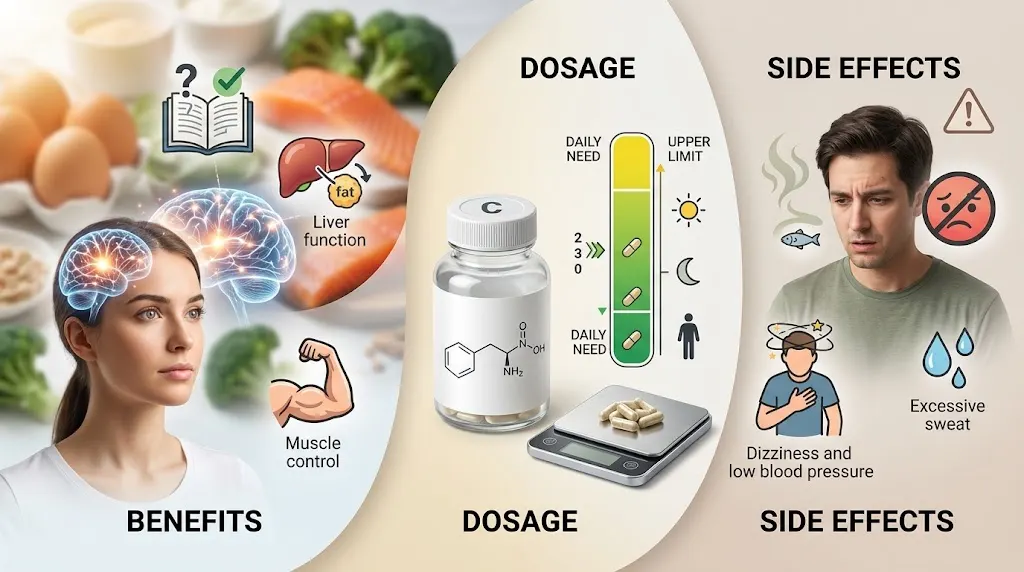
Dosage also deserves careful attention because choline has recommended intake targets as well as an upper limit. The National Institutes of Health lists adequate intakes of 550 mg per day for adult men and 425 mg for adult women, increasing to 450 mg during pregnancy and 550 mg while breastfeeding. These targets refer to total choline from foods and supplements rather than the amount that should automatically come from a capsule. Adults should generally remain below the tolerable upper intake level of 3,500 mg per day unless a healthcare professional recommends otherwise. This guide explains choline supplement benefits, dosage, forms, side effects, and safety considerations in practical, evidence-aware terms.
What Is Choline and Why Does Your Body Need It?
Choline is sometimes grouped informally with the B vitamins because it performs several related metabolic functions, but it is technically an essential nutrient of its own. Your body uses choline to produce phosphatidylcholine and sphingomyelin, two major phospholipids that help form and maintain cell membranes throughout the body. Choline also contributes methyl groups required for numerous metabolic reactions and is involved in transporting and metabolizing fats. The NIH Office of Dietary Supplements emphasizes these roles when explaining why inadequate choline can affect organs such as the liver and muscles. Because every organ contains cells with phospholipid membranes, choline contributes to much more than simply brain function.
Another major role involves acetylcholine, one of the nervous system’s important chemical messengers. The body uses choline as a precursor for acetylcholine, which participates in memory, attention, muscle contraction, autonomic nervous-system activity, and communication between nerves and muscles. This relationship explains why many choline supplements for brain health are marketed toward students, professionals, older adults, and people interested in nootropics. However, having an essential biochemical role does not mean taking increasingly large amounts will continually increase acetylcholine or improve cognition. Human physiology regulates these systems carefully, and cognitive performance is influenced by sleep, health, medications, genetics, mental health, nutrition, and many other factors besides dietary choline.
Choline also plays an important role in fat transport and liver function. The body needs phosphatidylcholine to package and move fats from the liver, and inadequate choline intake can contribute to abnormal fat accumulation in this organ. Controlled feeding studies helped researchers establish recommended intake levels partly by observing liver and muscle changes that occurred when dietary choline was restricted. NIH guidance notes that severe choline deficiency can contribute to liver and muscle damage, although outright deficiency is uncommon among otherwise healthy people eating varied diets. This biological role is different from claiming that high-dose choline supplements can “detox” or cure fatty liver disease, which current evidence does not support.
Choline requirements vary between individuals because metabolism is influenced by genetics, sex, life stage, and the availability of nutrients such as folate, betaine, and methionine. Premenopausal women may produce more choline internally under the influence of estrogen, although individual variation remains substantial. Pregnancy increases demand because choline is transferred to the developing fetus, while breastfeeding requires additional choline for breast milk. Certain genetic variants affecting choline and folate metabolism can also influence how much dietary choline a person needs. This variability is one reason nutrition authorities established Adequate Intake values for choline rather than an Estimated Average Requirement based on more precise population data.
Choline is naturally present in both animal and plant foods, although some of the richest sources are animal-derived. Eggs are particularly well known, while meat, poultry, fish, and dairy products also make meaningful contributions. Soybeans and certain beans, cruciferous vegetables, nuts, seeds, and whole grains provide plant-based choline as well, making adequate intake possible without relying entirely on animal products. NIH data indicate that many people in the United States consume less than recommended amounts even when supplements are included. Falling below an Adequate Intake does not automatically prove deficiency, but it can justify reviewing overall diet before assuming supplementation is necessary.
Potential Benefits of Choline Supplements
The clearest benefit of a choline supplement is helping someone reach an appropriate nutrient intake when food alone is not providing enough. This situation can occur because of dietary restrictions, low appetite, pregnancy-related needs, limited food variety, or a diet containing few choline-rich foods. Supplements can provide predictable amounts that are easy to track alongside dietary intake. However, the goal should generally be to close a nutritional gap rather than automatically add several hundred or thousand milligrams on top of an already adequate diet. NIH guidance emphasizes getting most nutrients from food and using supplements when they are useful for meeting needs that cannot be reached consistently through diet alone.
Supporting normal liver function is another legitimate reason choline matters nutritionally. Choline deficiency can interfere with normal fat transport from the liver and can contribute to fatty liver and liver injury under controlled deficiency conditions. Maintaining adequate intake therefore supports normal hepatic metabolism, particularly in people whose diets are chronically low in choline. Evidence is much less certain about whether extra supplemental choline treats established metabolic dysfunction-associated steatotic liver disease or other liver conditions. NIH concludes that additional research is needed to determine whether choline supplementation can prevent or treat nonalcoholic fatty liver disease. Anyone with abnormal liver enzymes or diagnosed liver disease should seek medical guidance rather than relying on supplements alone.
Normal nervous-system function is another potential benefit because choline is required for acetylcholine production and healthy cell membranes. Correcting genuinely inadequate choline intake would therefore help restore normal physiological conditions, just as correcting another nutrient insufficiency can benefit the systems dependent on that nutrient. This does not mean everyone who experiences poor concentration, forgetfulness, or fatigue has low choline. Those symptoms are nonspecific and can arise from sleep deprivation, stress, depression, thyroid disease, medication effects, anemia, vitamin deficiencies, or neurological problems. Choline benefits for the brain should consequently be described as supporting normal function rather than guaranteeing sharper memory or intelligence in people who already consume enough.
Choline is also required for one-carbon metabolism and works alongside nutrients such as folate and vitamin B12 in processes involving methyl groups. These pathways are involved in DNA methylation, gene regulation, amino-acid metabolism, and other fundamental biological functions. This is one reason choline becomes especially relevant during rapid growth and development, including pregnancy. Nevertheless, consumers sometimes encounter broad supplement claims suggesting that additional methyl donors automatically improve energy, mood, detoxification, or genetic function. These claims simplify a highly regulated biological network and should not be treated as established clinical benefits. The nutritional goal remains adequate intake rather than indiscriminately maximizing every nutrient involved in methylation.
Potential cardiovascular effects remain complicated and should not be presented as a simple benefit. Some observational research associates adequate dietary patterns containing choline-rich foods with good nutrition, while other studies have examined whether gut bacteria convert choline into trimethylamine and subsequently trimethylamine N-oxide, or TMAO. Higher circulating TMAO has been associated with cardiovascular risk in some research, but these relationships are influenced by kidney function, diet, microbiome composition, and other factors and do not prove that normal dietary choline causes heart disease. NIH currently notes that some research raises questions about high choline intake and cardiovascular risk. This uncertainty is another reason high-dose supplementation should not be assumed beneficial.
Choline Supplements for Memory and Brain Health
Choline’s relationship with acetylcholine makes memory one of the most heavily marketed reasons for supplementation. Acetylcholine participates in learning, memory formation, attention, and communication between neurons, so researchers have investigated whether increasing choline availability can improve these processes. The biological rationale is plausible, but nutritional pathways are rarely as simple as taking more precursor and producing proportionally better cognitive performance. The brain regulates acetylcholine synthesis and release according to many factors, and memory depends on complex networks rather than one neurotransmitter. Consequently, choline for memory needs to be evaluated according to clinical outcomes rather than biochemical theory or the fact that choline crosses into acetylcholine metabolism.
Studies examining ordinary choline or phosphatidylcholine for cognitive impairment have often produced disappointing or inconsistent results. A 2023 review of available choline supplements noted that controlled trials of choline and phosphatidylcholine did not reliably demonstrate meaningful cognitive improvements in dementia-related disorders, whereas research involving alpha-GPC and citicoline produced more encouraging findings in some populations. This difference matters because products marketed as “choline” are not interchangeable simply because their names contain the same nutrient. Pharmacological properties, absorbed compounds, clinical doses, populations, and treatment duration can differ considerably. Results involving one form should not automatically be used to advertise another.
Alpha-GPC has received particular attention in neurological research. A systematic review and meta-analysis involving adults with cognitive disorders associated with neurological disease found improvements in certain cognitive and functional measures when alpha-GPC was used alone or alongside treatment such as donepezil. More recent comparative research has also examined alpha-GPC against citicoline in dementia populations, with some outcomes favoring alpha-GPC but other memory measures showing no significant difference. These studies concern people with established cognitive disorders and should not be generalized to healthy young adults taking alpha-GPC supplements for focus before studying or working.
Citicoline, also called CDP-choline, is another choline-related compound studied for cognition and neurological conditions. It contributes choline and cytidine-related metabolites involved in phospholipid synthesis and has been investigated in areas ranging from stroke recovery to age-related cognitive changes. Results vary depending on the clinical condition, dosage, duration, and research design, and regulatory treatment of citicoline differs between countries. Consumers should therefore be cautious when advertisements describe citicoline as a clinically proven universal memory enhancer. Evidence that a compound helps some people with a diagnosed neurological condition does not demonstrate that it improves examination scores, productivity, or everyday memory in otherwise healthy individuals.
For healthy adults specifically, evidence for cognitive enhancement remains uncertain. A systematic review of dietary supplement ingredients marketed for improving cognitive performance evaluated choline alongside several popular “brain health” supplements and concluded that the low certainty of evidence prevented reliable consumer recommendations. Sleep quality, physical activity, cardiovascular health, education, social engagement, stress management, and treatment of medical problems have stronger and broader relevance to long-term brain health than relying on one supplement. If someone regularly experiences worsening memory, confusion, language problems, or difficulty completing familiar tasks, choline supplementation should not delay medical assessment for potentially treatable causes.
Choline During Pregnancy and Breastfeeding
Choline becomes especially important during pregnancy because it contributes to fetal growth, cell membranes, nervous-system development, and methylation processes. The U.S. Adequate Intake rises from 425 mg per day for most adult women to 450 mg of choline per day during pregnancy. NIH notes that most pregnant women in the United States do not reach recommended choline intake, making this an important nutritional consideration during prenatal care. Eggs, meat, fish, dairy, soy foods, beans, and certain vegetables can contribute significant amounts. People avoiding eggs and animal products may need particularly thoughtful meal planning to reach their target consistently.
Prenatal vitamins do not always solve the problem because many contain little or no choline. NIH’s updated pregnancy guidance cites an evaluation of 188 prenatal products in which only 40% contained choline, and the median amount among products containing it was only 25 mg per serving. Someone can therefore take a prenatal vitamin every day while still obtaining very little supplemental choline. Checking the Supplement Facts panel is more reliable than assuming “complete prenatal” means every nutrient relevant to pregnancy is supplied in a meaningful amount. Food intake should also be counted because the recommended 450 mg target refers to total daily intake rather than a required 450 mg supplement dose.
Interest in prenatal choline supplements has increased because some small studies have suggested potential effects on infant information processing, attention, or neurodevelopment. However, a recent systematic review examining randomized trials and observational research concluded that evidence remains insufficient to confirm or rule out improved child neurodevelopment from increasing maternal choline intake beyond typical levels. Most assessed developmental outcomes across available studies did not consistently show benefits, and study limitations reduce certainty. Choline is unquestionably necessary during pregnancy, but that established nutritional requirement should be separated from claims that high-dose supplementation will make a child smarter or prevent developmental disorders.
Choline requirements rise further during breastfeeding because substantial amounts are transferred into human milk. The U.S. Adequate Intake is 550 mg per day during lactation, the same amount recommended for adult men. Maintaining adequate intake supports the mother’s nutritional needs as well as the choline supplied to the infant. Dietary strategies may include eggs, fish, meat, dairy products, soybeans, legumes, and a varied selection of plant foods, depending on dietary preferences and allergies. A dietitian can be helpful when someone follows a restrictive vegan diet, has significant food intolerances, or struggles with appetite after delivery.
Pregnancy is not the time to experiment casually with high-dose nootropic formulations. The adult upper limit is 3,500 mg daily for pregnant people aged 19 to 50, while the upper limit for pregnant teenagers aged 14 to 18 is 3,000 mg. These are maximum total intakes unlikely to cause harm for most people, not recommended supplementation targets. Pregnant or breastfeeding individuals should discuss concentrated choline, alpha-GPC, citicoline, or combination nootropic products with their obstetrician, midwife, pharmacist, or dietitian. The most appropriate goal is meeting nutritional requirements safely, not consuming the largest dose that appears on a supplement label.
Types of Choline Supplements and How They Differ
Choline bitartrate is one of the most common forms found in inexpensive standalone products and multivitamins. It combines choline with tartaric acid to create a stable salt that can supply nutritional choline after ingestion. The form is widely available and may be useful when the main goal is increasing total choline intake rather than targeting a specific neurological condition. NIH lists choline bitartrate among the common supplemental forms sold in the United States. Consumers should check how much actual choline a serving provides because the weight of a choline compound is not necessarily identical to the amount of elemental or usable choline declared on the Supplement Facts panel.
Phosphatidylcholine is a phospholipid containing choline and forms an important part of cell membranes. It occurs naturally in foods and can also be consumed through supplements or lecithin, a mixture of phospholipids commonly derived from soybeans or sunflower seeds. Approximately half of dietary choline in the United States is consumed as phosphatidylcholine according to NIH data. Lecithin supplements are sometimes marketed for liver health, brain function, cholesterol, and other purposes, but the amount of actual choline can vary significantly between products. Anyone trying to meet a specific daily intake should rely on the labeled choline amount rather than assuming one gram of lecithin equals one gram of choline.
Alpha-GPC, or alpha-glycerylphosphorylcholine, is marketed heavily as a nootropic because it can raise circulating choline and has been studied in neurological disorders. It contains a relatively high proportion of choline by weight and participates in pathways involved in phosphatidylcholine and acetylcholine metabolism. Clinical research has produced some positive findings in people with certain cognitive disorders, but evidence for routine enhancement in healthy people remains much less certain. Alpha-GPC products can also provide doses much larger than the choline amounts found in ordinary multivitamins. This makes it particularly important to account for total intake and avoid stacking several brain supplements containing choline without realizing how much is being consumed.
Citicoline, also called CDP-choline, contains both choline and cytidine-related components and is frequently included in cognitive-health supplements. Research has investigated it in neurological disease, brain injury, stroke, and age-related cognitive problems, although results and approved medical uses differ internationally. Citicoline should not be considered equivalent to choline bitartrate because the compounds differ pharmacologically and have been studied for different purposes. The same principle applies to alpha-GPC. When choosing citicoline vs choline, consumers should first ask whether their goal is simply meeting nutritional choline requirements or using a specialized compound that has been investigated for a particular clinical outcome.
There is currently no strong evidence establishing that one ordinary nutritional choline form is universally superior for everyone. NIH specifically notes that studies have not adequately compared the relative bioavailability of choline from commonly used supplement forms such as choline bitartrate, phosphatidylcholine, and lecithin. Marketing terms such as “premium,” “brain optimized,” or “maximum absorption” should therefore be interpreted cautiously unless the manufacturer can support them with relevant research on the actual formulation. For correcting low dietary intake, cost, labeled choline amount, quality testing, tolerability, and professional guidance may matter more than choosing the most fashionable nootropic ingredient.
How Much Choline Do You Need Each Day?
In the United States, recommended choline intake is expressed as an Adequate Intake, or AI, because researchers do not have enough evidence to establish an Estimated Average Requirement for different groups. Adult men aged 19 and older have an AI of 550 mg per day, while adult women have an AI of 425 mg. Pregnant people need 450 mg daily, and breastfeeding increases the target to 550 mg. These values include choline from everything consumed throughout the day, including food, beverages, multivitamins, and standalone supplements. They should not be interpreted as instructions to purchase a 550 mg capsule regardless of what the person already eats.
Requirements are lower during childhood and gradually increase with age. NIH lists 200 mg daily for children aged one to three, 250 mg for ages four to eight, and 375 mg for children aged nine to thirteen. Adolescents aged fourteen to eighteen have an AI of 550 mg for males and 400 mg for females, with higher pregnancy and breastfeeding targets when applicable. Children should not routinely receive adult choline or nootropic supplements simply because a product is available over the counter. Nutritional questions in children are better addressed through diet and pediatric guidance, particularly when supplements contain multiple active ingredients.
The FDA Daily Value for choline is 550 mg, which is the reference amount used when manufacturers voluntarily list choline on Nutrition Facts or Supplement Facts labels. A product supplying 110 mg would therefore provide 20% of the Daily Value, even though an individual woman’s AI may be 425 mg. Daily Values are designed for standardized labeling rather than personalized nutrient prescriptions. This distinction can prevent confusion when someone notices that the percentage on a supplement bottle does not align perfectly with their age- or sex-specific AI. Reading both the milligram amount and the percentage gives a more complete picture of what the product contributes.
There is no universal choline supplement dosage because the appropriate supplemental amount depends on how much choline a person already consumes from food and why supplementation is being considered. NIH reports that many supplements contain approximately 10 to 250 mg of choline per serving, although specialized products may provide different quantities. Someone regularly eating eggs, fish, meat, dairy, soy, and other choline-rich foods may need little or no additional choline, while a restrictive diet could leave a larger gap. A short dietary assessment can therefore be more useful than simply selecting the highest-dose supplement on a store shelf.
European guidance demonstrates why nutrition recommendations should also be interpreted according to the authority relevant to where someone lives. The European Food Safety Authority established an adequate intake of 400 mg daily for adults, 480 mg during pregnancy, and 520 mg during lactation, which differs somewhat from U.S. values. These differences do not mean one authority considers choline dangerous at the other’s intake level; they reflect different methods and evidence used to establish population reference values. For an individual with a medical condition or unusual dietary needs, professional advice remains more useful than attempting to reconcile international recommendations personally.
Choline Side Effects and Risks of Taking Too Much
Most concern about choline side effects relates to excessive intake rather than ordinary food quantities. NIH lists fishy body odor, vomiting, excessive sweating, increased salivation, low blood pressure, and liver damage among possible effects of consuming too much choline. The characteristic fishy odor can occur because intestinal bacteria metabolize some choline into trimethylamine, a compound with a strong smell. Sensitivity varies, and not everyone taking the same dose develops the same reaction. Experiencing unpleasant effects is a reason to stop escalating the dose and review total intake rather than assuming the body is “detoxing” or adapting to the supplement.
The tolerable upper intake level for choline is 3,500 mg per day for adults aged nineteen and older. This limit includes choline obtained from food, beverages, and dietary supplements combined, although reaching it through ordinary food alone would be difficult for most people. Teenagers aged fourteen to eighteen have a lower upper limit of 3,000 mg, while younger children have progressively lower limits. An upper limit should never be confused with a target dose because it represents the highest average daily intake considered unlikely to cause adverse effects in most people. Staying just below 3,500 mg does not make a high-dose regimen necessary or beneficial.
Low blood pressure can become relevant for people who already experience dizziness or take medications that reduce blood pressure, although NIH does not list established medication interactions with choline. A person developing lightheadedness, weakness, fainting, severe nausea, or other unusual symptoms after beginning a supplement should stop self-escalation and seek appropriate medical guidance. The exact side-effect profile can also vary between choline compounds because alpha-GPC, citicoline, lecithin, and choline salts are not identical substances. Combination nootropic products make causality even harder to determine because caffeine, herbs, amino acids, and other active ingredients may be present in the same capsule.
Questions have also been raised about high choline intake, TMAO, and cardiovascular health. Intestinal microbes can convert dietary choline into trimethylamine, which is further processed in the liver into TMAO, and observational studies have associated higher TMAO concentrations with cardiovascular disease. However, this relationship does not prove that normal choline intake causes cardiovascular disease, and TMAO concentrations are influenced by many dietary, microbial, metabolic, and kidney-related factors. NIH currently describes the cardiovascular evidence surrounding choline as inconsistent and notes that further research is needed. Avoiding excessive supplementation is more reasonable than attempting to eliminate an essential nutrient from the diet.
Supplement quality is another practical risk because products can contain amounts or combinations that differ greatly between brands. Consumers should read the Supplement Facts panel, verify how much choline is actually supplied per serving, and account for other products taken simultaneously. Someone using a multivitamin, prenatal, alpha-GPC nootropic, and fortified nutrition drink could unknowingly obtain choline from several sources. Third-party quality certification can provide additional reassurance about manufacturing and ingredient verification, although it does not prove that the supplement provides the advertised health benefit. A sensible choline supplement safety strategy focuses on an identified need, an appropriate dose, transparent labeling, and periodic reassessment rather than indefinite high-dose use.
Who May Need a Choline Supplement and How to Choose One
People whose diets consistently provide little choline are the most logical candidates for considering supplementation. This may include individuals who avoid eggs, meat, fish, dairy, and soy while also eating relatively small amounts of beans, cruciferous vegetables, nuts, seeds, and whole grains. Pregnancy can create another gap because requirements increase at the same time that nausea, food aversions, or dietary restrictions may reduce intake. NIH identifies pregnant people among groups more likely to have difficulty obtaining adequate choline. Rather than assuming deficiency, start by reviewing normal meals for several days and estimating whether food regularly contributes amounts close to the relevant intake target.
People receiving long-term intravenous nutrition or those with certain genetic differences affecting choline metabolism can also be at increased risk of inadequate choline status. These situations are more medically complex than ordinary supplement shopping and should be managed by clinicians or dietitians familiar with the person’s medical history. Someone with known liver disease, kidney disease, a neurological condition, or several prescription medications should similarly discuss supplementation before using large doses. NIH reports no established medication interactions for choline, but absence of documented interactions does not guarantee that every specialized form or combination supplement is appropriate for every medical situation.
When choosing a product, determine the goal first. Someone trying to add 100 or 200 mg to a nutritionally low diet may not need an expensive alpha-GPC or citicoline product marketed as a cognitive enhancer. Choline bitartrate or a multivitamin containing a clearly stated amount may provide a simpler nutritional solution. Conversely, a clinician considering alpha-GPC or citicoline for a specific neurological purpose is making a different decision based on clinical evidence and patient circumstances. The best choline supplement therefore cannot be selected meaningfully without defining whether the objective is nutritional adequacy, prenatal support, or an investigated therapeutic application.
Check the label carefully because compound weight and choline content can be confusing. Compare products using the actual amount of choline listed on the Supplement Facts panel whenever possible rather than relying only on the milligrams of a branded compound printed on the front. Examine serving size because a bottle advertising a large amount may require several capsules to reach it. Also review other active ingredients, particularly in nootropic blends where caffeine, herbs, vitamins, or stimulatory compounds may change tolerability. A transparent product should make it easy to understand exactly what a daily serving provides without requiring consumers to decipher proprietary blends or exaggerated marketing language.
Finally, remember that supplementation does not need to be permanent simply because it was useful during one stage of life. Dietary changes, pregnancy, breastfeeding, medical treatment, appetite, and supplement routines can all change the amount of choline someone needs from a capsule. Reassessing intake periodically can prevent both unnecessary expense and excessive consumption. People using choline primarily for memory or concentration should also evaluate whether there is objective improvement rather than continuing indefinitely because the label promises cognitive support. An evidence-based choline supplementation plan uses the smallest practical amount needed to address a genuine nutritional gap while keeping food quality, medical conditions, and overall health habits in perspective.
What does a choline supplement do?
A choline supplement provides additional choline that the body can use for cell membranes, acetylcholine production, fat metabolism, and other essential processes. Its clearest role is helping someone meet nutritional requirements when dietary intake is insufficient, rather than guaranteeing improved memory or focus.
How much choline should I take per day?
U.S. Adequate Intakes are 550 mg daily for adult men, 425 mg for adult women, 450 mg during pregnancy, and 550 mg during breastfeeding. These amounts include choline from food and supplements combined, so the appropriate supplemental dose depends on what your diet already provides.
What is the best form of choline supplement?
There is no single best form for everyone. Choline bitartrate, phosphatidylcholine, and lecithin can supply nutritional choline, while alpha-GPC and citicoline are more often marketed and studied for neurological or cognitive purposes; NIH notes that comparative bioavailability research among common nutritional forms is limited.
Can choline improve memory and focus?
Choline is essential for normal nervous-system function and acetylcholine production, but evidence that supplementation improves cognition in healthy adults remains uncertain. Some alpha-GPC and citicoline research in people with neurological disorders is promising, yet those findings should not be generalized automatically to healthy people seeking a nootropic effect.
What happens if you take too much choline?
Excessive choline can cause fishy body odor, vomiting, heavy sweating, increased salivation, low blood pressure, and liver damage. The tolerable upper intake level for adults is 3,500 mg per day from food, beverages, and supplements combined, and this number is a safety ceiling rather than a recommended daily dosage.