


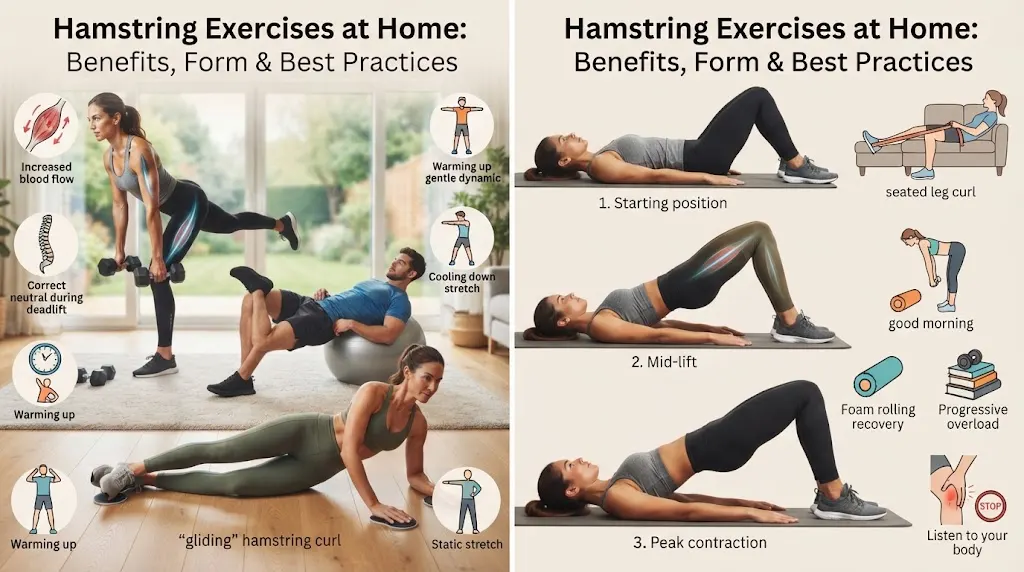
Your hamstrings are a group of muscles running along the back of your thighs. They help bend the knee, extend the hip, stabilize the pelvis, and control movements such as walking, running, climbing stairs, and bending forward. Strengthening them at home can improve lower-body function without requiring heavy gym equipment or complicated machines.
Home hamstring exercises are especially useful because many effective movements rely on body weight, resistance bands, sliders, or common household items. You can train both major hamstring functions by including hip-hinge exercises and knee-flexion movements. A balanced routine can also support the glutes, lower back, and surrounding leg muscles.
Consistency matters more than having expensive equipment. Two or three focused sessions each week can be enough for many beginners to build strength and control over time. Start with exercises you can perform smoothly, then increase repetitions, resistance, or difficulty gradually instead of rushing into advanced variations before your technique is ready.
Glute Bridges for Beginner Hamstring Strength
Glute bridges are an accessible starting point for training the back of the legs and hips. Lie on your back with your knees bent and feet flat on the floor. Keep your feet about hip-width apart, brace your abdomen lightly, and press through your feet to lift your hips until your body forms a comfortable line from shoulders to knees.
Your glutes will do much of the work, but the hamstrings also assist with hip extension and stabilization. To increase hamstring involvement, move your feet slightly farther away from your hips while still keeping your heels firmly planted. Avoid placing them so far away that you lose control or feel cramping immediately.
Lower your hips slowly instead of dropping back to the floor. Begin with two or three sets of controlled repetitions and pause briefly at the top. As the exercise becomes easier, progress toward longer holds, single-leg bridges, or slider variations rather than simply performing very high numbers of easy repetitions.
Single-Leg Bridges for More Hamstring Challenge
Single-leg bridges increase the demand on one hamstring and glute at a time. Begin in the same position as a standard bridge, then lift one foot from the floor while keeping your thighs relatively aligned. Press through the planted foot and raise your hips without allowing your pelvis to rotate strongly toward either side.
This variation can help identify strength differences between your legs that may be hidden during two-leg exercises. Keep the movement small if your hips drop or twist, because maintaining control is more important than lifting as high as possible. You may also keep the nonworking heel lightly touching the floor for support while you build strength.
If you feel strong hamstring cramping, move the planted foot slightly closer to your body or return to a standard bridge temporarily. Cramping often means the muscle is working harder than it can currently tolerate. Progress gradually until you can complete each repetition smoothly without holding your breath or compensating through the lower back.
Romanian Deadlifts With Household Weights
Romanian deadlifts train the hamstrings through a hip-hinge pattern. Stand with your feet around hip-width apart and hold dumbbells, water bottles, or a loaded backpack in front of your thighs. Keep your knees slightly bent, push your hips backward, and allow your torso to lean forward while maintaining a comfortable, controlled spinal position.
Lower only until you feel a strong but manageable stretch through the hamstrings. The movement should come mainly from your hips rather than by squatting deeply or rounding your back. Press your feet into the floor and drive your hips forward to return to standing, finishing tall without leaning backward.
Start with light resistance while learning the hinge. Once you can maintain balance and consistent form, gradually add weight or slow the lowering phase to increase difficulty. Romanian deadlifts are especially useful because they strengthen the hamstrings while they are lengthened, which complements knee-bending exercises such as curls.
Towel Hamstring Curls on a Smooth Floor
Towel hamstring curls are a challenging home exercise that require very little equipment. Lie on your back with your heels resting on small towels over a smooth surface. Lift your hips into a bridge, then slowly slide your heels away from your body while keeping your pelvis elevated as much as you can.
Pull your heels back toward your hips by bending your knees and using the hamstrings. Keep the movement controlled because the muscles often work hardest while the legs are extending outward. If keeping your hips elevated is too difficult, lower them between repetitions or perform only the outward sliding portion at first.
This exercise can create significant muscle soreness when it is new, so begin with fewer repetitions than you think you need. A partial range is completely acceptable. Over time, increase the sliding distance or perform more continuous repetitions while maintaining control through both the outward and inward phases.
Resistance Band Hamstring Curls at Home
Resistance band curls provide a more traditional knee-flexion exercise without requiring a gym machine. Anchor a band securely near floor level and attach the other end around your ankle. Lie face down or stand while holding a stable surface, then bend your knee and bring your heel toward your glutes against the band’s resistance.
Keep your thigh relatively still so the movement comes mainly from your knee. Avoid arching your lower back or swinging the leg to generate momentum. Pause briefly when the knee is bent, then straighten the leg slowly rather than allowing the band to pull your foot back quickly.
Choose a resistance level that allows controlled repetitions through a comfortable range. If the band feels too easy, step farther from the anchor or use a stronger band. Inspect the band and attachment point before each workout because damaged elastic or an unstable anchor can snap unexpectedly during the exercise.
Hip Hinges Without Weights for Better Form
Bodyweight hip hinges are useful when you want to learn deadlift mechanics before adding resistance. Stand tall with your feet about hip-width apart and place your hands on your hips. Push your hips backward while keeping your knees softly bent, allowing your torso to lean forward as your hamstrings lengthen.
Think about closing a car door with your hips rather than sitting downward into a squat. Your shins should remain relatively upright, and the movement should feel concentrated around the hips and back of the thighs. Stop before your back rounds or you lose the sensation of controlled hamstring tension.
Practicing this movement can improve your form for Romanian deadlifts, good mornings, and many everyday lifting tasks. Once the pattern feels natural, hold a light object close to your body. Gradually increasing load makes the exercise useful for strength instead of keeping it only as a technique drill.
Stability Ball Hamstring Curls for Core and Leg Control
If you have a stability ball, hamstring curls can combine knee flexion with hip and core control. Lie on your back and place your heels on top of the ball. Lift your hips, then bend your knees to roll the ball toward you while trying to keep your pelvis steady.
Extend your legs slowly to roll the ball away while keeping the movement controlled. This outward phase can be particularly challenging because the hamstrings must resist the ball as the knees straighten. Reduce the range if your hips drop suddenly or your lower back begins taking over the movement.
You can make the exercise easier by lowering your hips between repetitions or harder by keeping them elevated continuously. Advanced users can eventually progress toward single-leg versions. The goal is not simply moving the ball quickly, but controlling the entire motion without losing alignment through the hips and trunk.
Best Benefits of Strong Hamstrings
Strong hamstrings contribute to walking, running, jumping, climbing stairs, and many other lower-body activities. They work with the glutes to extend the hips and help control the knee during movement. Better strength can make everyday activities feel easier while also providing a useful foundation for recreational exercise and sports.
Hamstring training can also improve balance within a lower-body strength program. Many routines heavily emphasize squats and other knee-extension movements, so adding hinges and curls helps train the back of the legs more directly. Balanced strength around the hips and knees can improve movement control and overall lower-body capacity.
For athletes, stronger hamstrings are important during sprinting and rapid changes of direction because the muscles help control the leg at high speeds. Strength alone cannot prevent every injury, but progressive conditioning can improve how much force the muscles tolerate. Consistency and gradual progression are more useful than occasionally performing extremely demanding workouts.
Common Hamstring Exercise Mistakes to Avoid
One common mistake is using the lower back instead of the hips during hinge exercises. If your back rounds significantly or you lean backward at the top, you may not be controlling the movement effectively. Reduce the resistance and practice pushing the hips backward until you can feel the hamstrings working without discomfort in the spine.
Another mistake is performing curls too quickly. Letting a resistance band, towel, or exercise ball pull your leg back removes much of the controlled muscle work. Slow down both phases of each repetition so the hamstrings remain active while shortening and lengthening instead of relying on momentum.
Avoid assuming that every sensation of tightness requires aggressive stretching. Hamstrings can feel tight because they are fatigued or weak, not necessarily because they are physically too short. If discomfort extends into the groin or you also experience persistent inner thigh pain, consider whether another muscle group or underlying issue needs attention.
How Often Should You Train Your Hamstrings?
For general strength, two or three hamstring-focused sessions per week can work well for many people. You do not need to train the muscles every day to make progress. Allow enough recovery between harder workouts, especially when you are new to exercises that create significant soreness through the back of the thighs.
A simple session might include one hip-hinge movement and one knee-curl movement. For example, combine Romanian deadlifts with towel curls or bridges with resistance band curls. This gives the hamstrings different types of loading without requiring a long workout containing several exercises that all perform almost the same function.
Progress only when your current routine feels manageable. Add repetitions, resistance, sets, range of motion, or more difficult variations gradually. Increasing everything at once can create excessive soreness and make it difficult to tell which change your body was not prepared to handle.
How to Warm Up Before Hamstring Exercises
Begin with several minutes of easy movement such as walking, marching in place, or gentle cycling if available. The goal is simply to increase circulation and prepare the lower body for exercise. You do not need a complicated warm-up before a basic home strength session.
Next, use dynamic movements that take the hips and knees through comfortable ranges. Bodyweight hinges, easy squats, leg swings, and light bridges can prepare the hamstrings without holding long stretches. Keep the movements smooth and gradually increase the range as your body begins to feel warmer.
Long, aggressive static stretching immediately before heavy strengthening is usually unnecessary. If your hamstrings feel extremely stiff, use brief comfortable mobility rather than forcing a deep stretch. Save longer flexibility work for after training or separate sessions when improving range of motion is the main objective.
When Hamstring Exercises Should Be Modified
Muscle fatigue during exercise is normal, but sharp pain is a reason to stop or change the movement. A sudden pulling or tearing sensation in the back of the thigh may indicate a strain. Do not continue loading the muscle aggressively in an attempt to “work through” a possible acute injury.
People recovering from a recent hamstring injury should progress according to symptoms and professional advice. Early rehabilitation may begin with gentle isometric contractions before advancing toward bridges, curls, and loaded hinges. Returning too quickly to sprinting or explosive exercise can overload tissue that has not regained enough strength.
Seek professional assessment if hamstring pain persists for several weeks, repeatedly returns, or causes significant weakness or bruising. Numbness, tingling, or pain traveling from the lower back may also suggest nerve involvement rather than a simple muscle problem. Identifying the source helps determine which exercises are appropriate.
Conclusion
Hamstring exercises at home can build strength without requiring a gym or expensive equipment. Bridges, Romanian deadlifts, towel curls, resistance band curls, hip hinges, and stability ball exercises all train the muscles in useful ways. Combining hip-extension and knee-flexion movements provides a more complete approach than relying on one exercise alone.
Good form should remain your priority as the exercises become harder. Move slowly, maintain control, and increase resistance only when you can complete your current variation consistently. Avoid using momentum or forcing through sharp pain simply to finish a set, because quality repetitions are more useful than large numbers performed poorly.
Train consistently and allow enough recovery between challenging sessions. Over time, stronger hamstrings can support walking, running, lifting, sports, and overall lower-body stability. A simple home routine performed regularly can produce meaningful progress when the exercises are challenging enough and advanced gradually.
FAQs
What is the best hamstring exercise to do at home?
Romanian deadlifts, bridges, and sliding hamstring curls are all effective choices. The best option depends on your experience, available equipment, and whether you want to emphasize hip extension or knee flexion.
Can I strengthen my hamstrings without weights?
Yes. Bodyweight bridges, single-leg bridges, towel curls, stability ball curls, and controlled hip hinges can all strengthen the hamstrings without traditional weights when progressed appropriately.
How many hamstring exercises should I do per workout?
One or two well-chosen hamstring exercises can be enough for many home workouts. Combining one hip-hinge movement with one knee-curl movement provides useful variety without making the session unnecessarily long.
Why do my hamstrings cramp during bridges?
Cramping can occur when the hamstrings are working harder than they can currently tolerate. Move your feet slightly closer to your hips, reduce the difficulty, and build strength gradually.
How long does it take to strengthen hamstrings?
Noticeable strength improvements usually require several weeks of consistent training. Progress depends on workout difficulty, frequency, recovery, starting strength, and whether resistance is gradually increased over time.