


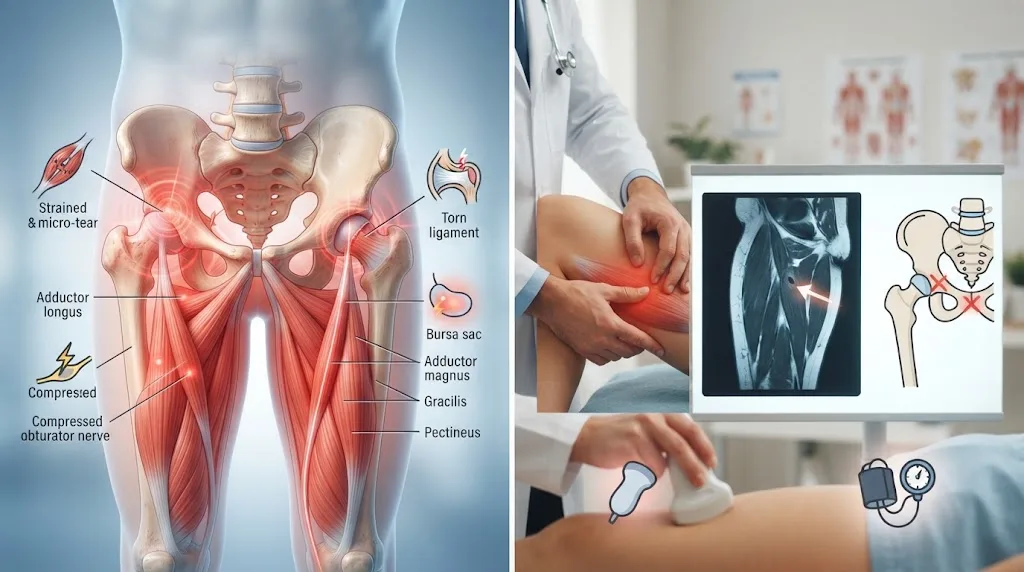
Inner thigh pain can come from muscles, tendons, joints, nerves, or nearby structures around the groin and hip. The adductor muscles along the inside of the thigh are common sources because they help pull the leg inward and stabilize the pelvis. Pain may feel sharp, aching, tight, burning, or tender depending on what is irritated.
Sometimes discomfort appears suddenly after running, changing direction, kicking, or slipping. In other cases, it develops gradually after repeated exercise, long periods of sitting, or increasing activity too quickly. The location, timing, and movements that trigger symptoms can help distinguish a muscle problem from a hip, nerve, or circulation issue.
Most mild cases improve with sensible activity modification and gradual return to movement. However, persistent pain should not automatically be blamed on muscle tightness. Swelling, weakness, numbness, severe groin pain, or difficulty walking can suggest another cause that deserves professional assessment.
Adductor Muscle Strain Is a Common Cause
An adductor strain occurs when one or more inner-thigh muscles are overstretched or overloaded. It is common in activities that involve sprinting, kicking, lateral movement, or sudden changes of direction. Football, tennis, hockey, martial arts, and running can all place significant demand on the adductors, especially when training intensity increases quickly.
A mild strain may feel like tenderness or tightness when you bring your legs together. More significant injuries can cause sharp pain, weakness, swelling, or bruising near the inner thigh or groin. Symptoms often become worse when squeezing the knees together, taking wide steps, or accelerating during sports.
Early treatment usually involves reducing activities that clearly aggravate the injury while keeping comfortable movement in your routine. Avoid aggressive stretching immediately after a fresh strain because it may irritate healing tissue. As symptoms improve, progressive strengthening is often more useful than repeatedly stretching the area as hard as possible.
Adductor Tendinopathy Can Cause Persistent Groin Pain
Adductor tendinopathy develops when the tendon connecting an inner-thigh muscle to the pelvis becomes irritated or less tolerant of load. Unlike an acute strain, symptoms may appear gradually rather than after one obvious injury. Pain is often felt high in the inner thigh or groin and can become noticeable during running, kicking, or changing direction.
People may also experience stiffness at the beginning of exercise that improves slightly after warming up, then returns later. Repeatedly training through this pattern without adjusting workload can allow symptoms to become more persistent. The tendon may be tender when pressed near its attachment point and uncomfortable during resisted squeezing movements.
Management usually focuses on controlling aggravating activity and gradually rebuilding strength. Complete rest for long periods is rarely ideal because tendons need appropriate loading to regain capacity. A physical therapist can help structure strengthening when pain has lasted several weeks or keeps returning each time you resume sports.
Hip Joint Problems Can Refer Pain Into the Inner Thigh
The hip joint itself can cause pain that feels like it comes from the inner thigh or groin. Osteoarthritis, labral problems, impingement, and other joint conditions may produce discomfort during walking, deep bending, twisting, or getting into and out of a car. Some people also notice reduced hip rotation or stiffness after sitting.
Hip-related pain may be difficult to separate from an adductor problem because the painful areas overlap. Joint symptoms are more likely when discomfort feels deep in the groin and is accompanied by catching, clicking, stiffness, or reduced range of motion. However, these signs are not enough to diagnose a specific condition without an examination.
A clinician may assess hip movement, muscle strength, and symptom patterns to determine whether the joint is involved. Imaging is sometimes used when symptoms are persistent, severe, or unclear. Treatment may include strengthening, activity modification, mobility work, and management of the underlying joint condition rather than focusing only on the inner-thigh muscles.
Hernias Can Sometimes Cause Groin and Inner Thigh Pain
An inguinal or femoral hernia can create pain or pressure near the groin that may be interpreted as inner-thigh discomfort. A hernia occurs when tissue pushes through a weak area in the abdominal wall. Some people notice a visible or palpable bulge that becomes more obvious when coughing, lifting, or standing.
Pain may increase during activities that raise abdominal pressure, such as heavy lifting, straining, or vigorous exercise. Not every hernia is severely painful, and some primarily cause a feeling of heaviness or pulling. Because groin strains can create similar symptoms, persistent discomfort in this region deserves careful evaluation when the cause is uncertain.
Seek prompt medical attention if a hernia becomes suddenly very painful, firm, discolored, or cannot be gently reduced when it previously could. Nausea, vomiting, abdominal pain, or inability to pass stool may also indicate a complication. These symptoms require medical care rather than stretching or self-massage.
Nerve Irritation Can Cause Burning or Tingling Pain
Nerve-related pain can sometimes travel into the groin or inner thigh. Irritation involving nerves from the lower back, pelvis, or upper leg may create burning, tingling, numbness, or electric sensations rather than a typical muscular ache. Symptoms can also change depending on spinal position, sitting posture, or certain hip movements.
If inner-thigh pain appears alongside lower-back pain, weakness, or altered sensation, a nerve source becomes more important to consider. Aggressive stretching is not always helpful because pulling strongly on sensitive neural tissue can increase symptoms. Gentle movement and professional assessment are usually more appropriate when neurological signs persist.
Stress and muscle guarding can sometimes make pain feel more intense even when they are not the original cause. Relaxation practices such as somatic breathwork may help some people reduce overall tension, but they do not replace assessment for persistent numbness, weakness, or nerve-related symptoms.
Circulation Problems Can Cause Inner Thigh Discomfort
Circulation issues are less common than muscle problems but can be more serious. A deep vein thrombosis, or DVT, is a blood clot that usually develops in a deep vein of the leg. It may cause pain, swelling, warmth, heaviness, or color changes, and symptoms are often more noticeable on one side.
Risk can increase after surgery, long-distance travel, prolonged immobility, pregnancy, certain medications, cancer, or a previous blood clot. DVT pain is not always located only in the calf and can sometimes involve the thigh. Because symptoms can vary, sudden unexplained one-sided swelling deserves medical assessment rather than being treated as an exercise injury.
Seek urgent medical care if thigh pain occurs with significant swelling, warmth, or redness. Emergency care is especially important if leg symptoms are accompanied by sudden shortness of breath, chest pain, fainting, or coughing blood. These signs can indicate a clot has traveled to the lungs.
Overuse and Training Changes Can Make the Inner Thigh Ache
Inner-thigh discomfort often develops after a sudden increase in exercise volume. Adding more running mileage, hills, sprinting, lateral drills, or sports sessions can overload muscles that were comfortable at a lower level. This does not necessarily mean the tissue is seriously injured, but it may signal that recovery has not kept pace with training.
Fatigue can reduce how well the hips and pelvis are controlled during movement. The adductors may then work harder to stabilize the leg, especially during single-leg activities or quick changes of direction. Tightness or aching later in the day can therefore reflect workload and endurance rather than simply a lack of flexibility.
Temporarily reducing the most demanding activities may help symptoms settle. When you return, increase distance, resistance, or intensity gradually rather than jumping back to your previous level immediately. Strengthening the glutes, adductors, hamstrings, and core can improve overall lower-body capacity and reduce repeated overload.
What You Can Do at Home for Mild Inner Thigh Pain
For mild pain after exercise, reduce the movements that clearly aggravate the area for several days. You do not necessarily need complete rest if walking and normal daily activities remain comfortable. Gentle movement can help prevent stiffness while allowing the irritated tissue to settle without repeatedly exposing it to high loads.
Cold packs may temporarily help after a recent strain or flare, while gentle warmth can feel better when the area is mainly stiff or tight. Use whichever provides comfort and protect the skin from extreme temperatures. Avoid deep massage directly over a fresh injury if the area is swollen, bruised, or highly sensitive.
Once symptoms begin improving, gradually reintroduce strength work and comfortable mobility. Side-lying adduction, controlled squats, bridges, and other lower-body exercises may be useful depending on the cause. Stop or reduce an exercise if it produces sharp pain or leaves the inner thigh significantly worse later the same day or the following morning.
When Should You Stretch the Inner Thigh?
Stretching can help when the main issue is ordinary stiffness rather than a fresh injury. A gentle butterfly stretch, wide stance shift, or kneeling adductor stretch can improve comfort for some people. The sensation should feel mild to moderate and should not create sharp groin pain, numbness, or a pulling sensation that lingers afterward.
Avoid aggressive stretching immediately after an adductor strain because healing muscle fibers may be sensitive to excessive lengthening. Early recovery often benefits more from comfortable movement and gradual strengthening. Stretching can be introduced later as tolerance improves, but it should complement strength work rather than replace it completely.
If stretching never changes the symptoms, the problem may not be simple muscle tightness. Hip joint irritation, nerve problems, tendinopathy, or a hernia can all create discomfort that feels similar. Repeatedly forcing deeper stretches without understanding the cause may delay more appropriate treatment.
When Inner Thigh Pain Needs Medical Attention
Seek medical advice if pain lasts several weeks, repeatedly returns, or limits your ability to walk, exercise, or perform normal daily activities. Assessment is particularly useful when there was no clear injury or when symptoms are becoming progressively worse. A clinician can determine whether the problem is more likely to involve muscle, tendon, hip, nerve, or another structure.
Prompt evaluation is also important for significant bruising, severe weakness, a visible groin lump, or pain after a major injury. Inability to bear weight normally may indicate a more substantial muscle or joint problem. Fever, unexplained weight loss, or pain that repeatedly wakes you at night should also be discussed with a healthcare professional.
Urgent care is required for sudden one-sided leg swelling, warmth, redness, or severe unexplained thigh pain because a blood clot needs to be ruled out. Chest pain or sudden shortness of breath alongside these symptoms is an emergency. Do not massage the leg aggressively when DVT is a possibility.
Conclusion
Inner thigh pain is commonly caused by adductor strain, overuse, or tendon irritation, but the hip joint, nerves, hernias, and circulation problems can sometimes produce similar discomfort. The pattern of symptoms matters. Pain after a sudden sports movement is different from burning sensations, a groin bulge, or unexplained one-sided swelling.
Mild muscular discomfort often improves with temporary activity modification, comfortable movement, and gradual strengthening. Stretching can be useful when stiffness is present, but it should not be forced during an acute injury. Returning to exercise gradually is usually safer than jumping straight back into sprinting, kicking, or heavy lower-body training.
Persistent or unusual inner-thigh pain deserves assessment rather than endless self-treatment. Seek care sooner when symptoms include major weakness, significant swelling, neurological changes, or difficulty walking. Understanding the underlying cause makes it much easier to choose treatment that actually addresses the problem instead of simply masking the pain.
FAQs
What is the most common cause of inner thigh pain?
Muscle strain or overuse of the adductors is one of the most common causes, especially after running, kicking, lateral movement, or sudden changes in exercise intensity.
Can tight adductors cause inner thigh pain?
Yes, fatigued or stiff adductors can feel tight and uncomfortable. However, persistent pain may involve tendon, joint, nerve, or other structures, so tightness should not always be assumed.
Should I stretch inner thigh pain?
Gentle stretching may help ordinary stiffness, but avoid strong stretching after a fresh strain or when movement causes sharp pain. Gradual strengthening is often equally important during recovery.
Can a hip problem cause inner thigh pain?
Yes. Hip joint conditions can refer pain into the groin and inner thigh, especially when symptoms occur with stiffness, reduced hip movement, catching, or pain during deep bending.
When is inner thigh pain serious?
Seek urgent care for sudden one-sided swelling, warmth, redness, severe unexplained pain, or symptoms accompanied by shortness of breath. These signs can indicate a circulation problem requiring prompt evaluation.