


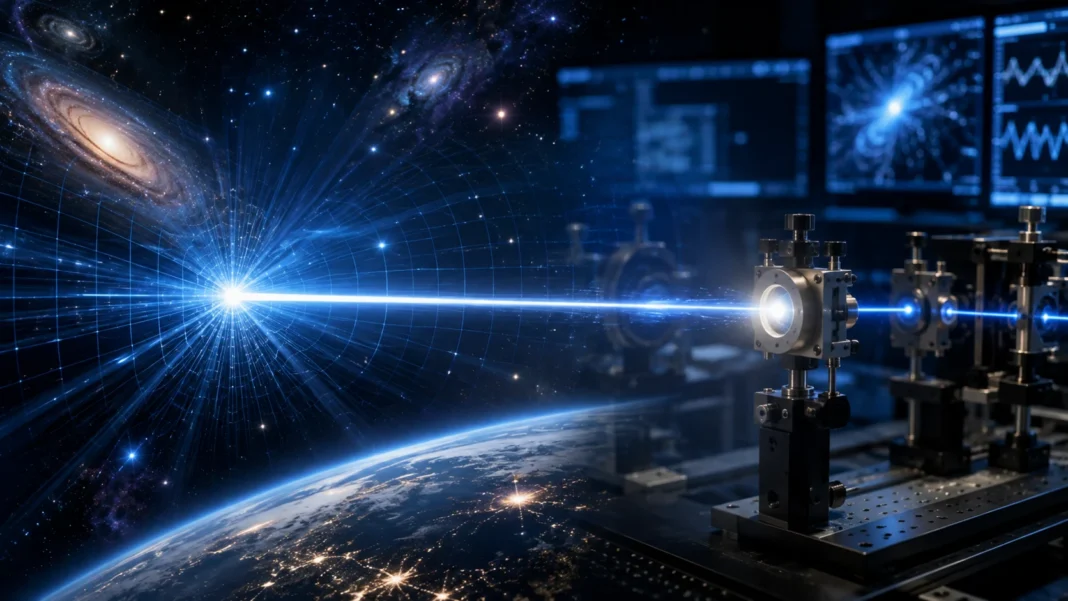
Why Is the Speed of Light Important?
The speed of light is one of the most important constants in physics because it helps define how space, time, matter, energy, and information behave. In a vacuum, light travels at exactly 299,792,458 meters per second, or about 300,000 kilometers per second. That is fast enough for light to travel around Earth roughly seven and a half times in a single second. Yet across the enormous distances of the universe, even light can take years, centuries, or billions of years to reach us.
What makes the speed of light especially significant is that it is not simply the speed at which visible light moves. According to modern physics, it represents the maximum speed at which information, energy, and causal influence can propagate through a vacuum. Radio waves, microwaves, infrared radiation, ultraviolet light, X-rays, and gamma rays are all forms of electromagnetic radiation, and they travel at the same fundamental speed in vacuum.
The speed of light also lies at the heart of Einstein’s theory of relativity. It connects space and time, explains why moving clocks can run differently, helps us understand why objects with mass cannot simply accelerate past light speed, and appears in the famous relationship between mass and energy. Without this constant, many of the rules used to describe the physical universe would look completely different.
It also matters outside theoretical physics. Satellite navigation, astronomy, telecommunications, space exploration, particle physics, and precision timekeeping all depend on understanding how quickly light and electromagnetic signals travel. Learning why the speed of light is important therefore provides a window into both the deepest laws of nature and technologies people use every day.
What Exactly Is the Speed of Light?
In physics, the symbol c is commonly used for the speed of light in a vacuum. Its exact value is 299,792,458 meters per second. Scientists often round this to approximately 300,000 kilometers per second or 186,000 miles per second when making everyday calculations. The value is so fundamental that the modern definition of the meter itself is based on how far light travels during a specific fraction of a second.
The phrase “speed of light” usually refers specifically to light traveling through a vacuum. Light can move more slowly through materials such as water, glass, or air because electromagnetic waves interact with the atoms and molecules in those substances. This slower effective propagation is why lenses can bend light and why objects sometimes appear displaced when viewed through water.
Visible light is only a narrow portion of the electromagnetic spectrum. Radio waves used for communication, microwaves used in radar, infrared radiation associated with heat, and high-energy X-rays all belong to the same electromagnetic family. In vacuum, these different types of electromagnetic radiation propagate at the same fundamental speed.
That universality makes the speed of light more than a measurement associated with lamps, stars, or lasers. It is built into the mathematical structure of electromagnetism and relativity. Whenever physicists discuss the fastest possible transmission of information or the relationship between space and time, the constant c appears naturally.
Why Is the Speed of Light a Fundamental Constant?
Physical constants describe features of nature that appear to remain the same wherever and whenever scientists measure them under equivalent conditions. The speed of light in a vacuum is one of these fundamental constants. It is not treated as a convenient average or an approximate rule but as a defining feature of modern physics.
Its importance became especially clear when scientists discovered that observers moving at different constant velocities still measure the same speed of light in vacuum. That result does not fit ordinary everyday intuition. If you throw a ball from a moving vehicle, its measured speed depends on how the observer is moving, but light does not follow this simple addition rule.
This surprising behavior became a foundation of special relativity. Instead of allowing the speed of light to change between observers, space and time themselves adjust through effects such as time dilation and length contraction. In other words, nature preserves the speed of light by making measurements of distance and time dependent on relative motion.
Because of this, the importance of the speed of light reaches far beyond electromagnetic radiation. It establishes a universal relationship between space and time and appears throughout equations describing particles, energy, gravity, and cosmology. Few constants influence as many areas of physics.
The Speed of Light Defines the Cosmic Speed Limit
One of the most famous consequences of relativity is that no object with mass can simply be accelerated through the speed of light using ordinary physical processes. As an object’s velocity approaches light speed, increasingly large amounts of energy are required to continue accelerating it. Reaching light speed would require an unlimited amount of energy for an object with nonzero rest mass.
Particles with no rest mass, such as photons, naturally travel at the speed of light in vacuum. Objects such as spacecraft, planets, people, or atoms have mass and therefore travel below this limit. Particle accelerators can push certain particles extremely close to light speed, but they never accelerate massive particles beyond it.
This limit protects the causal structure of relativity. If usable information could move faster than light, different observers could potentially disagree about the order in which certain events occurred. That would create serious problems for the usual relationship between cause and effect.
The cosmic speed limit therefore helps define which events can influence one another. A physical event cannot immediately affect every point in the universe. Its influence must propagate outward at or below the speed of light, creating a fundamental boundary on communication and interaction across space.
Why the Speed of Light Changed Our Understanding of Space and Time
Before Einstein’s work, space and time were often treated as separate and essentially universal backgrounds. People generally assumed that everyone would agree on how much time passed between events and how long an object was, regardless of their motion. Relativity dramatically changed this picture.
Because all inertial observers measure the same vacuum speed of light, measurements of time and distance cannot remain identical for everyone. An observer moving very quickly relative to another can experience time differently and measure distances differently. These effects are negligible at ordinary human speeds but become substantial as velocities approach the speed of light.
This connection led physicists to describe reality using spacetime, where three dimensions of space and one dimension of time are treated as parts of a unified structure. The speed of light helps determine how spatial and temporal measurements relate within this framework.
The idea may sound abstract, but it has measurable consequences. High-speed particles survive longer from certain observers’ perspectives because of time dilation, and precision clocks can show different elapsed times depending on their motion. The speed of light is therefore central to understanding how time itself behaves.
How the Speed of Light Leads to Time Dilation
Time dilation means that the amount of time measured between events can depend on the relative motion of observers. A clock moving very quickly relative to another observer can appear to tick more slowly. This effect emerges directly from the requirement that both observers still measure light traveling at the same speed.
Imagine a hypothetical clock that measures time using a pulse of light bouncing between two mirrors. To someone traveling with the clock, the light moves straight up and down. To another observer watching the clock move horizontally, the light follows a longer diagonal path between the mirrors.
Because both observers must measure the same speed of light, the observer who sees the longer path must also measure more time passing between the light pulses. This simple thought experiment captures the basic logic behind relativistic time dilation.
At everyday speeds, the effect is extraordinarily small. At velocities near light speed, however, it becomes dramatic. Modern experiments involving fast-moving particles and highly precise clocks have repeatedly confirmed that motion affects measured time exactly as relativity predicts.
How the Speed of Light Explains Length Contraction
Relativity predicts another strange effect known as length contraction. An object moving at very high speed relative to an observer is measured to be shorter along its direction of motion than when measured in its own rest frame. Like time dilation, this effect arises from the structure required to keep the speed of light invariant.
Length contraction is not something people normally notice because everyday speeds are tiny compared with 299,792,458 meters per second. A car, aircraft, or even spacecraft travels far too slowly for the change in measured length to be obvious without extremely sensitive calculations.
At particle-accelerator speeds, however, relativistic effects become essential. Physicists cannot accurately describe fast particles using only classical mechanics. Their measured lifetimes, energies, momenta, and interactions must be calculated using relativistic relationships.
Time dilation and length contraction show why the speed of light is more than a travel speed. It sets the scale at which classical ideas about space and time begin to break down and relativistic physics becomes necessary.
Why the Speed of Light Is Connected to E = mc²
Einstein’s equation E = mc² is perhaps the most famous formula in physics. It states that mass and energy are deeply related, with the conversion factor involving the speed of light squared. Because the value of c is enormous, even a small amount of mass corresponds to a tremendous amount of energy.
This relationship helps explain why nuclear reactions can release so much energy. In processes such as nuclear fission and fusion, small differences in mass correspond to significant changes in energy. The Sun itself shines because nuclear fusion converts part of the mass associated with its fuel into other forms of energy.
The equation does not mean that ordinary objects spontaneously release all of their mass as usable energy. Instead, it expresses a fundamental equivalence between mass and energy. Modern particle physics uses more complete versions of this relationship to describe particles moving at different velocities.
The appearance of the speed of light in this famous equation reveals how closely it is connected to the basic structure of matter. The same constant that determines how electromagnetic waves travel also links two of physics’ most fundamental quantities: mass and energy.
Why the Speed of Light Matters in Astronomy
Astronomy depends fundamentally on light because almost everything scientists know about distant stars, planets, galaxies, and nebulae comes from electromagnetic radiation reaching Earth. Astronomers study visible light along with radio, infrared, ultraviolet, X-ray, and gamma-ray signals to learn about distant objects.
Because light travels at a finite speed, looking farther into space also means looking farther into the past. Light from the Sun takes a little over eight minutes to reach Earth. This means that the Sun we see is actually the Sun as it appeared more than eight minutes earlier.
The effect becomes much more dramatic for stars and galaxies. If a star is 100 light-years away, the light arriving today began its journey about 100 years ago. When astronomers observe galaxies billions of light-years away, they are seeing those galaxies at much earlier stages of cosmic history.
The finite speed of light in space therefore allows telescopes to function as time machines in a scientific sense. By observing objects at different distances, researchers can study different eras of the universe and reconstruct how galaxies, stars, and large-scale cosmic structures evolved.
What Is a Light-Year and Why Does It Matter?
A light-year sounds like a unit of time, but it is actually a unit of distance. One light-year is the distance light travels through a vacuum in one year. Because light moves extremely quickly, this distance is enormous—roughly 9.46 trillion kilometers.
Astronomers use light-years because ordinary units such as kilometers become inconvenient when describing distances between stars. Saying that a nearby star is several light-years away is much easier than writing out tens of trillions of kilometers.
For even larger distances, astronomers also use units such as parsecs, kiloparsecs, and megaparsecs. Regardless of the unit chosen, the speed of light remains important because it connects cosmic distance with the amount of time electromagnetic information needs to reach us.
Understanding light-years also helps explain why space communication is not instantaneous. If a spacecraft were one light-year away, a radio message traveling at light speed would need approximately one year to reach it. A reply would then require another year to return.
Why the Speed of Light Matters for Space Exploration
Space missions depend on radio communication, and radio signals travel at the speed of light in vacuum. That means every command sent to a spacecraft and every piece of data returned to Earth experiences a delay determined by distance.
Communication with the Moon has only a relatively small delay because it is close to Earth on astronomical scales. Missions to Mars face delays of several minutes each way, depending on the planets’ positions. Spacecraft operating in the outer solar system can experience communication delays measured in hours.
This makes real-time remote control impossible for distant spacecraft. Engineers cannot drive a Mars rover exactly like a remote-controlled car because commands and responses take too long to travel between Earth and Mars. Rovers therefore need some level of autonomy to carry out tasks safely.
Future missions deeper into the solar system will face even greater communication challenges. No matter how advanced a transmitter becomes, a signal cannot simply bypass the light-speed delay under known physics. The speed of light limit therefore shapes how robotic and human exploration must be planned.
Why the Speed of Light Matters for GPS
Global Positioning System technology works by measuring the travel time of radio signals sent from satellites to receivers on Earth. Because those signals travel at approximately the speed of light, even extremely small timing errors can produce significant errors in calculated position.
A GPS receiver compares signals from several satellites and uses their precise timing information to determine its location. Since light travels almost 300,000 kilometers in one second, an error of only a tiny fraction of a second can translate into a noticeable distance error.
Relativity adds another layer of complexity. Satellite clocks move relative to observers on Earth and also experience different gravitational conditions. Both special and general relativity therefore affect how quickly those clocks run compared with clocks on Earth’s surface.
GPS systems correct for these relativistic effects so positioning remains accurate. This provides a practical example of how the speed of light and Einstein’s theories influence everyday technology. Navigation on smartphones, aircraft, ships, and vehicles depends partly on physics that once seemed purely theoretical.
Why the Speed of Light Is Important for Communication
Much of modern communication relies on electromagnetic signals. Radio broadcasts, satellite transmissions, Wi-Fi, mobile networks, and fiber-optic internet all carry information using electromagnetic phenomena whose ultimate propagation behavior is constrained by the speed of light.
Fiber-optic cables transmit information as pulses of light traveling through glass. Light travels somewhat slower through the material than it does in vacuum, but it still moves extraordinarily quickly. These systems can carry enormous quantities of data across long distances.
Even so, distance creates unavoidable latency. A signal traveling between continents cannot arrive instantly because it must physically travel through cables or space. Routing equipment, processing, and network congestion add additional delays beyond the basic propagation time.
This is why engineers often place data centers and computing infrastructure closer to users when extremely low latency is important. Software can become faster and networks can become more efficient, but the finite speed of electromagnetic propagation establishes a fundamental lower limit on communication delays.
Does Light Always Travel at the Same Speed?
Light travels at its maximum fundamental speed when moving through a vacuum. In materials such as water, glass, or transparent plastics, its effective propagation speed is lower because the electromagnetic field interacts with the material.
This behavior is described using a quantity called the refractive index. Materials with larger refractive indices generally cause light to propagate more slowly than it would through vacuum. These differences help explain familiar optical effects such as refraction.
When light crosses from one material into another, its speed changes and its direction may change as well. This bending allows lenses to focus light and is essential to technologies such as eyeglasses, cameras, microscopes, telescopes, and fiber-optic systems.
The slower speed of light inside materials does not contradict relativity’s fundamental speed limit. The constant c still describes the maximum local speed associated with electromagnetic propagation in vacuum and the underlying causal structure of spacetime.
How Scientists Measured the Speed of Light
People once debated whether light traveled instantaneously. Early attempts to measure its speed were difficult because light moves so rapidly that ordinary terrestrial distances produced delays too small for simple human observation.
One major historical breakthrough came from astronomical observations. By studying timing variations associated with Jupiter’s moon Io, astronomer Ole Rømer found evidence in the seventeenth century that light takes time to travel across space rather than arriving instantaneously.
Later experiments used rotating wheels, mirrors, and increasingly precise laboratory instruments to measure light’s speed more accurately. Advances in lasers, atomic clocks, interferometry, and modern electronics eventually allowed measurements of extraordinary precision.
Today, the value of the speed of light is not merely measured as an experimental approximation. It is defined exactly as 299,792,458 meters per second, and the meter is defined in relation to how far light travels in vacuum during a specified fraction of a second.
Why the Meter Is Defined Using the Speed of Light
Scientific measurement works best when units are based on universal constants rather than physical objects that could change or be damaged. For this reason, modern measurement systems increasingly define basic units using fundamental properties of nature.
The meter was once connected to physical standards and earlier definitions related to Earth’s dimensions. Modern physics allowed a much more precise approach. Because the speed of light is treated as an exact constant, scientists can define distance using extremely accurate measurements of time.
Under the modern definition, one meter is the distance light travels in vacuum during 1/299,792,458 of a second. This links the unit of length directly to the exact value assigned to the speed of light.
This definition is useful because laboratories around the world can reproduce measurements without depending on one physical measuring bar stored in a particular location. The constant speed of light therefore contributes directly to the global system used to measure length.
Can Anything Travel Faster Than Light?
According to special relativity, ordinary matter cannot be accelerated from below light speed to above it. The energy required to accelerate a massive object grows dramatically as the object’s velocity approaches c, preventing it from reaching the light-speed boundary through conventional acceleration.
Scientists have proposed hypothetical faster-than-light concepts, including particles sometimes called tachyons and speculative spacetime geometries associated with wormholes or warp-drive ideas. However, there is no confirmed evidence that usable matter or information can be transmitted faster than light through such mechanisms.
Some physical phenomena can appear to involve speeds greater than light without allowing information to violate relativity. For example, certain patterns or mathematical effects can move in ways that do not correspond to an object or message physically traveling through space faster than c.
Quantum entanglement is also frequently misunderstood in this context. Measurements of entangled particles exhibit remarkable correlations, but they do not provide a practical method for sending controllable information faster than light. Relativity’s causal speed limit remains intact.
What Would Happen If You Could Travel Near the Speed of Light?
Traveling close to the speed of light would produce dramatic relativistic effects. From the perspective of distant observers, a high-speed traveler’s clock would appear to run more slowly compared with clocks left behind.
From the traveler’s own perspective, time would feel normal. The traveler would not experience their own watch slowing down. Instead, the relationship between their measurements of space and time and those of distant observers would differ according to relativity.
Distances in the direction of travel would also appear contracted from the traveler’s perspective. This means that, in principle, a traveler moving extremely close to light speed could experience a much shorter elapsed time during a journey to a distant star than observers remaining on Earth.
The practical challenge is enormous. Accelerating a macroscopic spacecraft to near-light speed would require extraordinary amounts of energy, while collisions with even tiny particles could become extremely energetic. Relativistic interstellar travel is therefore physically fascinating but technologically far beyond current capabilities.
Why Light Speed Matters in Particle Physics
Particle accelerators routinely push protons, electrons, and other particles to speeds extremely close to the speed of light. At these velocities, classical physics becomes insufficient for calculating their energy and momentum.
Relativistic equations are therefore essential to the design and interpretation of accelerator experiments. Scientists use them to understand particle collisions, measure particle properties, and search for new physical phenomena.
One fascinating consequence involves unstable particles called muons. Many muons created high in Earth’s atmosphere move rapidly enough that relativistic time dilation significantly extends their observed lifetime from Earth’s reference frame. This allows many of them to reach the surface before decaying.
Experiments like these provide direct evidence that the effects associated with the speed of light are not merely mathematical ideas. Relativity describes measurable physical behavior that appears repeatedly in particle physics and high-energy experiments.
Why the Speed of Light Matters in Black Hole Physics
Black holes create some of the most extreme conditions known in the universe. Their gravitational fields are so strong that within the event horizon, no signal traveling at or below the speed of light can escape to the outside universe.
The event horizon is therefore not simply a physical surface like the surface of a planet. It represents a boundary in spacetime beyond which all future-directed paths lead deeper toward the black hole rather than outward.
Because light establishes the fastest possible causal connection, understanding how light behaves near strong gravitational fields is essential for studying black holes. General relativity predicts that gravity can bend light and alter the paths that electromagnetic radiation follows through curved spacetime.
Observations of matter and light around black holes help scientists test these predictions. Gravitational lensing, black-hole shadows, and radiation from surrounding material all reveal how light behaves in environments where spacetime curvature becomes extreme.
Why the Speed of Light Matters for Understanding Gravity
Einstein’s general theory of relativity describes gravity not simply as a force pulling objects together, but as the curvature of spacetime created by matter and energy. Changes in gravitational fields do not propagate instantaneously across unlimited distances.
Gravitational influences propagate at the speed of light. Gravitational waves produced by accelerating massive objects, such as merging black holes or neutron stars, travel through spacetime at this fundamental speed.
The detection of gravitational waves gave scientists an entirely new way to study the universe. Instead of relying only on electromagnetic radiation, researchers can now observe ripples in spacetime created by some of the most energetic cosmic events.
The fact that gravitational waves propagate at essentially the same fundamental speed reinforces the importance of c as a property of spacetime itself. It is not merely a special rule that applies only to visible light.
How the Speed of Light Helps Us Study the Early Universe
Because light requires time to travel, observing extremely distant objects allows astronomers to investigate earlier periods of cosmic history. The farther away an object is, the older the light we receive from it generally is.
Powerful telescopes can therefore observe galaxies that existed when the universe was much younger than it is today. Scientists compare these distant galaxies with nearby ones to study how stars, galaxies, and cosmic structures changed over billions of years.
The cosmic microwave background provides an even more ancient view. This radiation has traveled for most of the age of the universe and carries information about conditions when the cosmos was only a small fraction of its current age.
Without the finite speed of light, the connection between distance and lookback time would not work in the same way. Astronomy’s ability to reconstruct cosmic history is therefore deeply tied to how quickly light propagates.
Why We Never See the Universe Exactly as It Is Now
Every time you look at something, you are technically seeing it in the past because light needs time to travel from the object to your eyes. Across a room, this delay is so tiny that it has no practical effect.
When looking at the Moon, the delay becomes noticeable scientifically because light takes a little over one second to travel from the Moon to Earth. The Moon we see is therefore already slightly different from its exact present state.
The Sun is seen more than eight minutes in the past, while nearby stars appear years in the past. Distant galaxies may appear millions or billions of years younger than they are in whatever present state exists relative to us.
This means there is no single instantaneous photograph of the observable universe available to an Earth-based observer. Everything we observe arrives through signals that have taken different amounts of time to reach us, with the speed of light setting that delay.
How the Speed of Light Shapes Cause and Effect
Cause and effect are fundamental concepts in physics. If one event causes another, information or influence must somehow travel from the first event to the second. Relativity limits how quickly that influence can propagate.
Physicists often represent this structure using a concept called a light cone. Events inside a future light cone can potentially be influenced by a particular event because signals traveling at or below light speed have enough time to reach them.
Events outside that light cone cannot be reached quickly enough without exceeding the speed of light. This means that, under ordinary relativity, one event cannot immediately cause another event located sufficiently far away.
Light cones help physicists visualize the geometry of spacetime and determine which events can have causal relationships. The constant c therefore defines not only a speed limit but also the basic structure of cause and effect throughout the universe.
Why the Speed of Light Matters in Everyday Technology
Most people will never operate a particle accelerator or calculate relativistic spacecraft trajectories, yet technologies used every day still depend on the physics associated with light and electromagnetic waves.
GPS navigation requires precise timing of radio signals traveling between satellites and receivers. Fiber-optic networks use light pulses to carry internet data, while wireless communication relies on radio waves that follow the same fundamental electromagnetic principles.
Lasers are used in barcode scanners, communications, manufacturing, medicine, surveying, data storage, and scientific instruments. Accurate knowledge of light propagation is essential to designing and operating many of these systems.
Modern electronics and communication infrastructure therefore rely on physical principles connected with electromagnetic radiation and the finite propagation speed of information. Fundamental physics may seem abstract, but its consequences are built deeply into modern technological society.
Could the Speed of Light Ever Change?
Current physics treats the speed of light in vacuum as a fundamental constant. Experiments have tested the underlying principles of relativity to extremely high precision, and no confirmed evidence has shown that the local vacuum speed of light changes under ordinary conditions.
Scientists can certainly change the effective speed at which light travels through materials. Glass, water, optical fibers, and specialized laboratory systems can slow light’s propagation substantially compared with vacuum.
That does not mean the fundamental constant c itself has changed. These effects result from interactions between electromagnetic fields and matter rather than a modification of the underlying maximum speed built into relativity.
Some speculative theories investigate whether fundamental constants could have behaved differently under extreme conditions in the early universe, but such ideas require strong observational evidence. For ordinary physics, the speed of light in vacuum remains one of nature’s most stable and important constants.
Why the Speed of Light Is So Important to Modern Physics
Few scientific constants connect as many different ideas as the speed of light. It appears in electromagnetism, special relativity, general relativity, particle physics, cosmology, quantum field theory, astronomy, and modern metrology.
It defines how quickly electromagnetic information can propagate, limits the motion of massive objects, connects space with time, and appears in the mathematical relationship between energy and mass.
It also determines how humanity observes the cosmos. Because light has a finite travel time, every astronomical observation carries information from the past. This allows scientists to study everything from nearby planets to galaxies formed billions of years ago.
For these reasons, asking why the speed of light is important leads directly into some of the deepest questions in science. Understanding c helps explain how the universe communicates information, how time behaves, how matter stores energy, and how events remain connected through spacetime.
Final Thoughts: Why Is the Speed of Light Important?
The speed of light is important because it is one of the basic constants that determines how our universe works. In vacuum, light travels at exactly 299,792,458 meters per second, and modern physics treats this value as a fundamental limit on the propagation of information and causal influence.
Its role reaches far beyond visible light. The same constant shapes relativity, time dilation, length contraction, particle physics, mass-energy relationships, gravitational waves, black holes, astronomy, and our understanding of the evolution of the universe.
The speed of light also has practical consequences. GPS navigation, satellite communication, fiber-optic networks, spacecraft operations, precision measurement, and many scientific instruments depend on accurately understanding how electromagnetic signals travel.
Most importantly, the speed of light shows that space and time are not independent backgrounds with absolute values for everyone. They are connected parts of spacetime, governed by rules in which c plays a central role. That is why one seemingly simple number has become one of the foundations of modern science.
Frequently Asked Questions
Why is the speed of light so important in physics?
The speed of light sets a fundamental limit on how quickly information and causal influence can travel. It also connects space, time, mass, energy, electromagnetism, and relativity.
What is the exact speed of light?
The speed of light in a vacuum is exactly 299,792,458 meters per second, which is approximately 300,000 kilometers per second or 186,000 miles per second.
Can anything travel faster than the speed of light?
According to special relativity, ordinary matter and usable information cannot be accelerated from below light speed to faster than light. No confirmed faster-than-light information transmission has been observed.
Why does time slow down near the speed of light?
Relativity requires every inertial observer to measure the same vacuum speed of light. As relative velocity increases, measurements of space and time adjust, producing the effect known as time dilation.
How does the speed of light affect everyday life?
The speed of light affects technologies such as GPS, satellite communication, wireless networks, fiber-optic internet, lasers, and precision timing. It also creates unavoidable communication delays over long distances.