


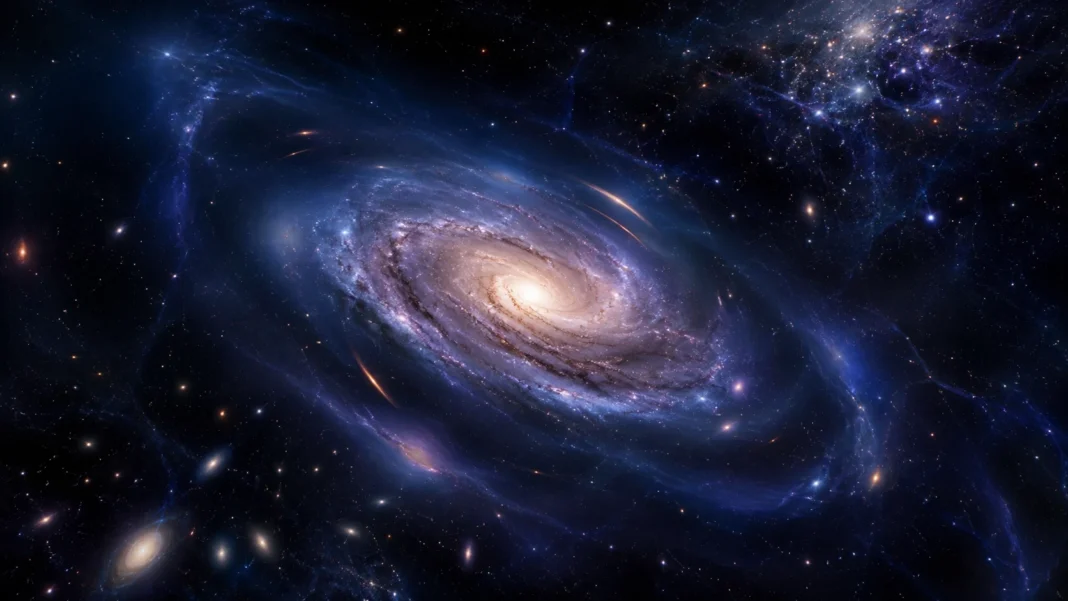
What Is Dark Matter?
Look into the night sky and almost everything you can see—stars, planets, glowing nebulae, and distant galaxies—is made from ordinary matter. Yet astronomers have strong evidence that this visible material represents only a relatively small part of the matter in the universe. Most matter appears to be something mysterious that does not shine, reflect, or absorb light in the ordinary way. Scientists call this invisible substance dark matter.
So, what is dark matter? In simple terms, dark matter is the name scientists give to unseen matter whose gravitational effects can be measured even though the material itself has not yet been directly identified. Astronomers infer its existence because galaxies and galaxy clusters behave as though they contain far more mass than telescopes can detect. Without additional invisible mass, many observed motions and structures would be difficult to explain with current gravitational theory.
Dark matter is not simply ordinary matter hidden in dark places. It appears to interact very weakly, if at all, with electromagnetic radiation, which is why telescopes cannot photograph it directly. Scientists instead study how its gravity affects stars, galaxies, light, and the growth of cosmic structures. These indirect clues have made dark matter one of the central components of modern cosmology.
Despite decades of research, scientists still do not know exactly what dark matter is made of. Numerous hypothetical particles and alternative explanations have been proposed, and experiments around the world continue looking for evidence. Understanding dark matter could therefore answer one of the biggest unanswered questions in physics: what is most of the matter in the universe actually made of?
Why Is It Called Dark Matter?
The word “dark” can sound as though dark matter is simply black material floating through space, but that is not what scientists mean. Dark matter is called dark because it does not appear to emit, reflect, or absorb enough electromagnetic radiation for astronomers to observe it directly using conventional telescopes.
Ordinary objects become visible because light interacts with them. The Sun produces light, planets reflect sunlight, and clouds of gas emit or absorb radiation at identifiable wavelengths. Dark matter does not appear to interact strongly with light in these familiar ways, making it effectively invisible to instruments designed to detect electromagnetic radiation.
Scientists can still infer its presence through gravity. If a galaxy contains large amounts of invisible mass, that mass influences how quickly stars move around the galaxy. It can also bend the path of light traveling from more distant objects through an effect known as gravitational lensing.
The name therefore describes an observational property rather than telling us what the substance actually is. Dark matter may consist of one type of unknown particle or potentially something more complicated. Until scientists identify its fundamental nature, “dark matter” remains a useful term describing the unseen mass required to explain multiple astronomical observations.
How Much Dark Matter Is in the Universe?
Current cosmological models indicate that ordinary matter makes up only a small fraction of the universe’s total energy content. Ordinary matter—the material that forms stars, planets, gas, dust, people, and everything built from atoms—accounts for roughly five percent of the overall cosmic budget.
Dark matter accounts for roughly another quarter of the universe. This means there is several times more dark matter than ordinary atomic matter. Although we cannot see it directly, its gravitational influence appears throughout galaxies, galaxy clusters, and the large-scale structure of the cosmos.
The remaining majority is associated with dark energy, another mysterious component that appears to be connected to the accelerating expansion of the universe. Dark energy and dark matter have similar names, but they describe very different phenomena and should not be confused.
This cosmic inventory is one reason dark matter research is so important. Everything humans directly experience is built from the comparatively small ordinary-matter component. Understanding dark matter therefore means investigating a major part of the universe that remains fundamentally unidentified.
How Do Scientists Know Dark Matter Exists?
Scientists do not rely on one single observation when arguing for dark matter. Instead, several independent lines of evidence point toward the presence of additional unseen mass. These include galaxy rotation, galaxy-cluster dynamics, gravitational lensing, the cosmic microwave background, and the development of large-scale cosmic structures.
When multiple independent measurements can be explained using the same general concept, confidence in that explanation grows. Dark matter provides a framework that helps scientists understand phenomena occurring across very different distances, from individual galaxies to enormous clusters containing thousands of galaxies.
Importantly, astronomers are not claiming that dark matter has been directly photographed. Most evidence comes from measuring gravity and comparing observed behavior with predictions based on visible matter alone. The amount of visible material often appears insufficient to produce the gravitational effects astronomers measure.
Scientists continue testing alternative explanations because science requires competing hypotheses to be evaluated. Nevertheless, dark matter remains a major component of the standard cosmological model because it successfully explains numerous observations when combined with established physics and measurements of the universe.
Galaxy Rotation Provides Important Evidence
One of the classic clues for dark matter comes from studying how stars rotate around galaxies. In a simple system where most mass is concentrated near the center, objects farther away might be expected to orbit significantly more slowly than objects closer to the center.
Astronomers instead found that stars and gas in the outer regions of many galaxies often move much faster than the visible distribution of matter alone would predict. These measurements are described using galaxy rotation curves, which compare orbital velocity with distance from the galactic center.
If only visible stars, gas, and dust supplied the galaxy’s mass, the outer material might not remain gravitationally bound in the observed way. The measurements suggest that galaxies are surrounded by large amounts of additional invisible mass extending well beyond the bright stellar disk.
Scientists describe these extended distributions as dark matter halos. A galaxy such as the Milky Way is therefore thought to sit inside a much larger halo of invisible matter whose gravity influences the movement of stars and surrounding objects.
What Is a Dark Matter Halo?
A dark matter halo is a large, approximately spherical distribution of dark matter surrounding a galaxy. The visible disk of stars that people commonly picture when imagining a spiral galaxy occupies only the inner region of this much larger gravitational structure.
Unlike the stars in a galaxy, dark matter does not appear to cool and collapse efficiently into thin disks through electromagnetic interactions. Models therefore predict more extended halos surrounding galaxies and larger structures.
The halo’s gravitational influence helps explain the unexpectedly high orbital speeds measured far from galactic centers. Scientists can estimate the distribution of this invisible mass by studying stellar motion, satellite galaxies, gas, and gravitational lensing.
Dark matter halos also play an important role in theories of galaxy formation. In the standard picture, concentrations of dark matter provide gravitational environments into which ordinary gas can fall, eventually contributing to the formation of stars and galaxies.
Galaxy Clusters Reveal Missing Mass
Evidence for unseen matter also comes from galaxy clusters, enormous collections containing hundreds or thousands of galaxies bound together by gravity. Astronomers can measure how rapidly galaxies move within these clusters and estimate how much gravitational mass is needed to keep the systems together.
Historically, measurements showed that visible galaxies alone did not provide enough mass to explain their observed motions. The clusters appeared to contain much more gravitational mass than could be accounted for by luminous stars.
Additional ordinary matter exists as hot gas between galaxies, and modern observations can detect this gas using X-rays. Yet even after accounting for stars and hot gas, scientists still find evidence for significantly more mass than ordinary visible material provides.
These cluster observations helped establish the missing-mass problem long before modern particle-physics searches for dark matter began. They remain one of several independent reasons scientists think enormous amounts of invisible matter exist throughout the universe.
Gravitational Lensing Can Map Invisible Matter
According to general relativity, mass bends spacetime, which means massive objects can change the path followed by light. Astronomers call this phenomenon gravitational lensing because galaxies and galaxy clusters can act somewhat like enormous natural lenses.
Scientists can examine how background galaxies appear stretched, magnified, or distorted when their light passes through a massive foreground region. The amount and pattern of distortion provide information about the total mass present, regardless of whether that mass produces visible light.
This makes gravitational lensing especially powerful for studying dark matter. Instead of trying to detect dark matter particles directly, astronomers use gravity to create maps showing where invisible mass appears to be concentrated.
In some galaxy-cluster collisions, gravitational lensing indicates that most of the mass lies in locations different from much of the ordinary hot gas. Such observations provide particularly interesting evidence that the dominant unseen mass behaves differently from ordinary matter during large cosmic collisions.
The Bullet Cluster and Dark Matter
The Bullet Cluster is one of the best-known examples used when discussing evidence for dark matter. It consists of galaxy clusters that have collided, creating a natural experiment in which different forms of matter can be studied during an enormous cosmic interaction.
Most ordinary matter in galaxy clusters exists as extremely hot gas. During the collision, this gas interacts strongly, slows down, and can be detected through X-ray observations. The galaxies themselves pass through one another more easily because there is enormous empty space between individual stars.
Gravitational lensing allows astronomers to estimate where most of the total gravitational mass lies. In the Bullet Cluster, much of the inferred mass is separated from the hot gas and more closely associated with regions containing the galaxies.
This separation is consistent with a form of matter that contributes significant gravity but does not interact strongly with ordinary gas during the collision. Although scientists continue studying such systems carefully, cluster collisions provide an important observational test for theories explaining unseen cosmic mass.
What Is Dark Matter Made Of?
This is the central unanswered question. Scientists know a great deal about what dark matter appears to do gravitationally, but they have not yet confirmed its microscopic composition. The leading possibilities generally involve particles that are not part of the ordinary atomic matter surrounding us.
Ordinary matter consists primarily of particles such as protons, neutrons, and electrons. Dark matter appears to require something different because known ordinary material cannot account for the total amount of unseen mass inferred from cosmological observations.
Researchers have proposed many possible candidates, including weakly interacting massive particles, axions, ultralight particles, and other hypothetical forms of matter. Each candidate would have different properties and require different experimental techniques to detect.
It is also possible that the final explanation will be more complicated than one particle species. Dark matter could involve an entire hidden sector containing several particles or interactions. Until convincing direct evidence is obtained, its composition remains open scientific territory.
What Are WIMPs?
Weakly interacting massive particles, commonly called WIMPs, have historically been among the most widely discussed dark matter candidates. The idea is that these particles would have significant mass while interacting very weakly with ordinary matter.
If WIMPs were produced in the early universe with suitable properties, theoretical calculations suggest that a population could remain today in quantities broadly consistent with the amount of dark matter inferred astronomically. This connection once made WIMPs particularly attractive candidates.
Scientists have built extremely sensitive underground experiments designed to detect rare collisions between hypothetical WIMPs and atomic nuclei. Underground locations reduce interference from cosmic rays and other sources that could imitate potential dark matter signals.
So far, researchers have not obtained universally accepted evidence confirming WIMPs as dark matter. Increasingly sensitive searches have ruled out portions of the possible parameter space, encouraging scientists to investigate a wider range of candidate particles and theories.
Could Axions Be Dark Matter?
Axions are another important hypothetical dark matter candidate. They were originally proposed in particle physics to address a separate theoretical problem involving the strong nuclear interaction, but researchers later realized that axion-like particles could potentially contribute to dark matter.
Axions would be extremely light compared with many WIMP models, yet enormous numbers of them could collectively account for substantial cosmic mass. Their weak interactions with ordinary matter would also help explain why dark matter has been difficult to detect.
Experiments searching for axions use very different techniques from traditional WIMP detectors. Some look for tiny conversions between axions and photons under carefully controlled electromagnetic conditions, while others test different possible axion masses and interactions.
No definitive axion detection has yet settled the dark matter mystery. Nevertheless, axion research remains active because these particles could potentially solve multiple theoretical problems while providing an explanation for unseen matter.
Could Dark Matter Be Primordial Black Holes?
Another possibility is that at least some dark matter could consist of primordial black holes. Unlike ordinary astrophysical black holes formed from collapsing stars, these hypothetical objects would have originated from unusually dense regions in the very early universe.
Because black holes do not emit ordinary visible light in the same way as stars, they initially appear to offer a natural explanation for hidden mass. However, astronomers can search for their gravitational effects and compare observations with predicted populations.
Measurements involving gravitational lensing, cosmic radiation, stellar dynamics, and other phenomena have restricted how much dark matter primordial black holes could represent across many possible mass ranges.
Whether they contribute a meaningful fraction of dark matter remains an active research question for some mass ranges and models. However, primordial black holes are not currently established as the complete explanation for all dark matter.
Is Dark Matter the Same as Antimatter?
Dark matter and antimatter are completely different concepts. Antimatter is made from antiparticles corresponding to ordinary particles. For example, the positron is the antimatter counterpart of the electron and has the same mass but opposite electric charge.
When ordinary matter and antimatter meet, they can annihilate and convert their mass into other forms of energy. Scientists routinely create and study small quantities of antimatter in laboratory experiments, so antimatter is not purely hypothetical.
Dark matter, by contrast, has not been directly identified. Its defining observational feature is the gravitational influence attributed to invisible mass that does not interact significantly with electromagnetic radiation.
If the missing cosmic mass consisted primarily of ordinary antimatter, scientists would expect other observable signatures from interactions between matter and antimatter. Those observations do not provide the explanation required for the large-scale dark matter phenomenon.
Is Dark Matter the Same as Dark Energy?
Dark matter and dark energy are not the same thing, despite their similar names. Dark matter behaves gravitationally like additional mass and contributes to the formation and structure of galaxies and galaxy clusters.
Dark energy is the name given to whatever is responsible for the observed accelerated expansion of the universe. Rather than helping pull structures together gravitationally in the way matter does, its large-scale effect is associated with the expansion of cosmic space.
Dark matter makes up substantially more of the matter content than ordinary atoms do, while dark energy appears to dominate the universe’s overall energy budget. Together, these two mysterious components represent most of the cosmos in the standard cosmological model.
The similarity in their names reflects our lack of complete understanding rather than a known physical connection. Scientists are investigating each through different observations and experiments, and solving one mystery would not automatically explain the other.
Can We See Dark Matter?
Dark matter cannot currently be seen directly using ordinary telescopes because it does not appear to emit or reflect detectable light in the way stars and planets do. However, saying that scientists cannot “see” it does not mean they have no way to investigate it.
Astronomers observe its inferred gravitational effects. They measure how stars orbit galaxies, how galaxies move inside clusters, and how massive regions bend background light. These measurements can reveal where unseen mass must apparently be located.
Think of wind moving through tree branches. You cannot see the air itself directly in the ordinary sense, but you can infer its movement by watching leaves and branches respond. Dark matter research uses a somewhat similar logic, although the physics and measurements involved are far more sophisticated.
Future discoveries might allow scientists to detect individual dark matter particles directly through laboratory interactions. Until then, gravity remains one of the primary ways researchers map and study the invisible matter distributed throughout the universe.
How Scientists Search for Dark Matter Underground
Some of the world’s most sensitive dark matter experiments operate deep underground. Their goal is to detect extremely rare interactions between hypothetical dark matter particles passing through Earth and carefully selected detector materials.
Placing experiments underground helps shield them from cosmic rays, which continuously strike Earth’s atmosphere and can create signals that resemble potential particle interactions. Thick layers of rock dramatically reduce this background noise.
Many detectors use materials such as liquid xenon or argon because they can produce measurable flashes of light or electrical signals when particles interact with atomic nuclei. Scientists look for events with characteristics that could potentially indicate dark matter.
The challenge is extraordinary because any interactions may be extremely weak and rare. Experiments must understand background radiation, detector materials, electronic noise, and environmental effects with remarkable precision before claiming evidence for a new particle.
How Particle Accelerators Could Help Find Dark Matter
Another search strategy uses high-energy particle accelerators. Machines such as the Large Hadron Collider smash particles together at extremely high energies, creating conditions where previously unknown particles might potentially be produced.
If dark matter particles can be created in collisions but do not interact strongly with detectors, researchers would not necessarily observe them directly. Instead, scientists would look for missing energy or momentum indicating that invisible particles may have escaped.
Detecting missing momentum alone would not automatically prove dark matter had been produced. Other particles can create similar experimental signatures, and researchers would need extensive evidence to determine whether a new phenomenon had actually been discovered.
Particle accelerators are valuable because they provide controlled laboratory environments for exploring physics beyond currently known particles. Combined with underground detectors and astronomical observations, they offer a complementary way of testing dark matter theories.
Scientists Also Search for Dark Matter in Space
Dark matter particles might potentially interact with one another or decay under certain theories, producing ordinary particles or radiation that telescopes could detect. Researchers therefore search the sky for unusual signals that might provide indirect evidence.
Gamma-ray telescopes, cosmic-ray detectors, neutrino observatories, and other instruments can investigate energetic phenomena where dark matter concentrations are expected to be high. The center of the Milky Way and nearby dwarf galaxies are examples of regions researchers often study.
The main challenge is distinguishing possible dark matter signatures from conventional astrophysical sources. Pulsars, supernova remnants, black holes, and other energetic objects can produce signals that may initially resemble theoretical dark matter predictions.
For this reason, a convincing discovery would likely require consistency across several measurements. An unexplained signal becomes much more meaningful if its energy, location, and behavior match predictions and cannot be explained by known astrophysics.
Why Is Dark Matter Important for Galaxy Formation?
Dark matter is thought to have played a central role in forming galaxies. Shortly after the early universe became sufficiently cool, small variations in matter density existed throughout space. Gravity gradually amplified these differences.
Because dark matter does not interact strongly with radiation, it could begin forming gravitational concentrations relatively efficiently. These concentrations became part of the framework within which ordinary gas later collected.
As gas fell into dark matter halos, it could cool, condense, and eventually form stars. Over billions of years, smaller systems merged and evolved into the galaxies and galaxy clusters astronomers observe today.
Computer simulations including dark matter successfully reproduce many important aspects of the large-scale cosmic web. Without dark matter, explaining how the universe developed its observed structure within the available cosmic time would become significantly more difficult under standard cosmology.
What Is the Cosmic Web?
On extremely large scales, matter in the universe is not distributed randomly. Galaxies and galaxy clusters form an enormous interconnected pattern containing dense filaments, clusters, sheets, and relatively empty regions called voids. Scientists refer to this structure as the cosmic web.
Dark matter appears to provide much of the gravitational framework underlying this web. Simulations suggest that dark matter gradually collected into filaments and halos as gravity amplified tiny density variations left from the early universe.
Ordinary gas then accumulated within these gravitational structures, eventually forming stars and galaxies. This means many of the bright galaxies visible through telescopes may effectively trace an underlying network dominated by invisible matter.
Mapping the cosmic web helps cosmologists test theories about dark matter, gravity, and the history of cosmic structure formation. Comparing simulations with observations allows researchers to determine whether their models produce a universe resembling the one we actually see.
How the Cosmic Microwave Background Supports Dark Matter
The cosmic microwave background, or CMB, is ancient radiation left over from the early universe. It provides scientists with a remarkably detailed picture of conditions when the cosmos was much younger.
Tiny temperature variations across the CMB contain information about the amounts of ordinary matter, dark matter, and other cosmic components. Scientists analyze the statistical pattern of these variations and compare it with predictions from cosmological models.
The resulting measurements support a universe containing substantially more non-ordinary dark matter than ordinary atomic material. This evidence comes from a completely different era and physical scale than galaxy rotation curves.
The fact that observations of the early universe and modern galaxies point toward compatible amounts of dark matter strengthens the overall case. A successful explanation must account for both the early cosmic conditions and the structures that developed billions of years later.
Does Dark Matter Exist in the Milky Way?
Scientists believe the Milky Way sits inside a large dark matter halo extending far beyond the galaxy’s visible disk. The combined motions of stars, gas, satellite galaxies, and other objects provide evidence for additional mass surrounding our galaxy.
This means dark matter should also exist in the region of space containing the Solar System. If particle dark matter models are correct, hypothetical dark matter particles may be passing through Earth continuously without noticeably interacting with us.
That possibility motivates underground detection experiments. Researchers estimate the expected local dark matter distribution and design instruments sensitive enough to search for extraordinarily weak particle collisions.
Although scientists infer that dark matter surrounds the Milky Way, they have not yet directly captured and identified the particle responsible. Establishing such a detection would be a major breakthrough connecting astronomical evidence with fundamental particle physics.
Can Dark Matter Pass Through Your Body?
If dark matter consists of weakly interacting particles, then enormous numbers could potentially pass through ordinary matter without producing noticeable effects. That would include buildings, planets, detectors, and human bodies.
The reason is not necessarily that the particles are physically tiny. Instead, their interactions with ordinary atomic matter may be extremely weak. A particle could therefore move through enormous amounts of material without colliding in a detectable way.
Scientists already know other particles capable of passing through matter easily. Neutrinos, for example, interact so weakly that vast numbers produced by the Sun move through Earth and our bodies continuously.
Dark matter could be even harder to detect depending on its properties. This is why experiments require enormous detector volumes, exceptionally clean materials, and long observation times while searching for a very small number of possible interactions.
Does Dark Matter Have Gravity?
Yes, gravity is the clearest known way dark matter appears to interact with the universe. In fact, nearly all astronomical evidence for dark matter is based on measuring gravitational effects that cannot be fully explained by visible matter.
Dark matter helps influence how stars orbit within galaxies, how galaxies move in clusters, how light is bent by massive structures, and how the large-scale cosmic web develops over billions of years.
Because gravity acts on all forms of mass and energy, dark matter does not need to emit light to influence surrounding objects. Its gravitational effects can therefore reveal its presence even when telescopes cannot observe the material itself.
Exactly whether dark matter interacts through additional forces remains unknown. Experiments are searching for possible weak interactions or other connections with ordinary particles, but gravity remains the observational interaction scientists can most confidently associate with it.
Could Gravity Be Wrong Instead of Dark Matter Existing?
Some researchers have explored whether the observations attributed to dark matter could instead indicate that our understanding of gravity is incomplete. These ideas are often grouped under various modified gravity theories.
One well-known approach attempts to modify the laws governing motion at extremely low accelerations. Certain versions can reproduce aspects of galaxy rotation without introducing conventional particle dark matter.
The challenge is explaining all available evidence simultaneously. A successful alternative must account not only for individual galaxy rotation curves but also for galaxy clusters, gravitational lensing, the cosmic microwave background, and the evolution of large-scale structures.
Research into modified gravity remains scientifically valuable because testing alternatives strengthens our understanding of fundamental physics. At present, however, models containing dark matter remain central to standard cosmology because of their broad ability to explain multiple independent observations.
Why Has Dark Matter Been So Difficult to Detect?
Dark matter appears to be abundant, yet direct detection has proved extremely difficult. The simplest reason is that whatever dark matter consists of does not seem to interact strongly with ordinary matter or electromagnetic radiation.
Scientists are therefore searching for something that may rarely leave measurable traces inside detectors. Even when an experiment records a tiny signal, researchers must determine whether it came from dark matter, natural radioactivity, cosmic rays, neutrinos, or instrumental noise.
Another difficulty is that scientists do not know the dark matter particle’s mass or interaction strength. Different theoretical candidates can differ enormously in their predicted properties, requiring entirely different experimental strategies.
The continuing absence of a confirmed signal does not mean experiments have failed scientifically. Each search eliminates or constrains portions of theoretical parameter space, forcing researchers to refine models and explore new possibilities.
What Would Happen If Scientists Discovered Dark Matter?
A confirmed direct detection would be one of the most important scientific discoveries in modern physics. Researchers would first need to demonstrate that the signal could not be explained by known particles, environmental effects, or experimental errors.
Scientists would then investigate the new particle’s mass, interactions, stability, and abundance. Multiple experiments would likely attempt independent confirmation, while particle physicists and cosmologists would compare the discovery with existing astronomical measurements.
The finding could reveal physics beyond the current Standard Model of particle physics. Although the Standard Model successfully describes many known particles and interactions, it does not provide an established particle matching the dark matter required by cosmology.
Identifying dark matter could therefore connect two major branches of science: the physics of the smallest particles and the evolution of the largest structures in the universe. It might even reveal an entirely new family of particles or forces.
Is Dark Matter Dangerous?
There is currently no evidence suggesting that ordinary exposure to dark matter presents a danger to people. If dark matter particles surround the Milky Way and pass through Earth, they have presumably been doing so throughout Earth’s history.
Their extremely weak interaction with ordinary matter is precisely what makes dark matter so difficult to detect. If these particles interacted strongly enough to damage biological tissue routinely, scientists would likely observe much more obvious effects.
Dark matter also should not be confused with black holes, antimatter, radiation, or dark energy. These are separate physical concepts with very different properties and effects.
The significance of dark matter is scientific rather than a direct everyday threat. Researchers study it because understanding its nature could transform physics and explain how galaxies and the larger universe developed.
Will We Ever Know What Dark Matter Is?
No one can guarantee when or whether a particular scientific mystery will be solved, but dark matter is being investigated using an unusually broad range of approaches. Underground detectors, particle accelerators, astronomical surveys, gravitational lensing observations, and precision cosmology all provide different ways of testing the problem.
Modern experiments are becoming increasingly sensitive, allowing researchers to explore candidates that would have been impossible to test several decades ago. At the same time, theorists are expanding beyond traditional WIMP models toward axions, ultralight particles, hidden sectors, and other possibilities.
New astronomical surveys will also create increasingly detailed maps of galaxies and gravitational lensing. These observations can reveal how dark matter appears to be distributed and test whether its behavior agrees with standard theoretical predictions.
Even a surprising result—such as evidence that gravity behaves differently from current expectations—would be scientifically transformative. Whether dark matter ultimately proves to be a new particle, several particles, or evidence of deeper physics, solving the mystery would fundamentally change our understanding of the universe.
Why Dark Matter Matters to Modern Science
Dark matter is important because it lies at the intersection of astronomy, cosmology, gravity, and particle physics. Few unsolved problems connect the largest structures in the universe with questions about the smallest fundamental particles so directly.
Its gravity appears to influence galaxies and galaxy clusters while helping shape the cosmic web. At the same time, identifying its microscopic nature may require discovering particles or interactions beyond established particle-physics theories.
Dark matter research also provides an excellent example of how science investigates something that cannot be observed directly. Scientists compare independent evidence, construct mathematical models, design experiments, test alternatives, and continually refine theories when new data arrive.
This makes the mystery valuable even before it is solved. Searching for dark matter is pushing advances in detectors, astronomical surveys, computing, theoretical physics, and precision measurements while forcing researchers to test some of their deepest assumptions about nature.
Final Thoughts: What Is Dark Matter?
So, what is dark matter? It is the name scientists give to an invisible form of matter inferred mainly from its gravitational influence on stars, galaxies, galaxy clusters, light, and the large-scale structure of the universe. It appears to be far more abundant than the ordinary atomic matter that forms everything we can directly see.
Researchers have compelling evidence that additional gravitational mass exists, but they still do not know its fundamental composition. Proposed candidates include WIMPs, axions, other unknown particles, and more unusual possibilities, while modified-gravity theories continue to test whether the mystery could have another explanation.
Dark matter does not appear to interact strongly with light, which is why scientists cannot simply point a telescope at it. Instead, they map its influence through galaxy motions, gravitational lensing, cosmic background measurements, and increasingly sophisticated experiments designed to detect potential particles.
Solving the dark matter mystery would reveal something fundamental about the universe. It could identify an entirely new type of particle, expose hidden physical interactions, reshape ideas about gravity, and explain more clearly how galaxies and the cosmic web formed. For now, dark matter remains invisible—but the evidence for its gravitational influence makes it impossible for modern physics to ignore.
Frequently Asked Questions
What is dark matter in simple terms?
Dark matter is invisible matter that scientists infer from its gravitational effects on galaxies, galaxy clusters, and light. Its exact composition has not yet been identified.
Why can’t we see dark matter?
Dark matter appears to interact very weakly with electromagnetic radiation, so it does not emit or reflect detectable light like ordinary stars and planets do.
What is dark matter made of?
Scientists do not yet know. Possible candidates include WIMPs, axions, ultralight particles, and other hypothetical forms of matter beyond known atomic particles.
Is dark matter the same as dark energy?
No. Dark matter acts gravitationally like additional mass and helps form cosmic structures, while dark energy is associated with the accelerating expansion of the universe.
Does dark matter exist on Earth?
If the Milky Way is surrounded by a dark matter halo as current models indicate, dark matter should also be present around Earth. However, scientists have not yet directly identified the particles responsible.