


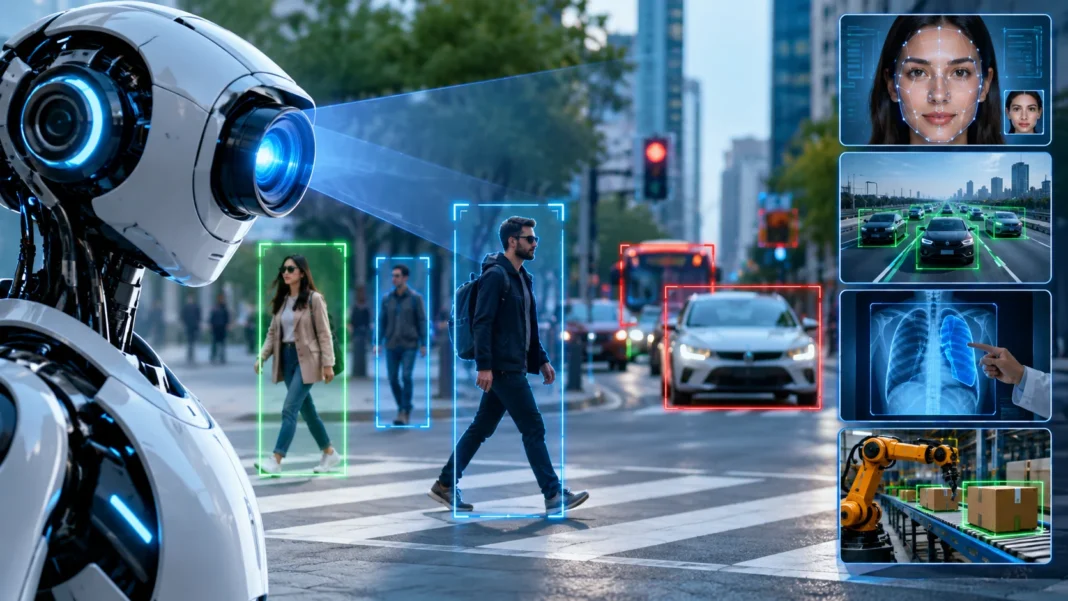
Computer vision is a branch of artificial intelligence that helps computers interpret and understand visual information such as images, videos, and camera feeds. Instead of simply storing a photograph as digital data, computer vision systems attempt to recognize objects, people, text, movements, patterns, and relationships within the visual scene.
The technology allows computers to perform tasks that normally depend on human eyesight and visual interpretation. A system might identify a vehicle in traffic footage, detect a damaged product on a factory line, or recognize written text inside an image. Machine learning and deep learning have significantly expanded what modern computer vision systems can accomplish.
Computer vision is already used across smartphones, healthcare, manufacturing, retail, transportation, agriculture, security, and many other industries. Some applications operate quietly in the background, so people may use the technology without realizing it. Understanding the basic concept makes it easier to see why visual AI has become an important part of modern digital systems.
How Computer Vision Works
Computer vision begins by converting images or video frames into numerical information that computers can process. Digital images are made from pixels, with each pixel containing information about color and brightness. Artificial intelligence models analyze these values and search for patterns that help identify shapes, textures, edges, objects, or other meaningful features.
Modern systems are usually trained using many examples. If developers want a model to recognize bicycles, they may provide thousands of images containing bicycles from different angles, environments, sizes, and lighting conditions. During training, the model gradually learns visual characteristics that help distinguish bicycles from cars, motorcycles, people, and unrelated objects.
Once trained, the system can analyze new images it has never seen before. It calculates which learned patterns appear in the visual input and produces a prediction or classification. Performance depends on factors such as training data quality, model architecture, image quality, environmental conditions, and how closely real-world situations resemble the examples used during training.
Computer Vision vs Human Vision
Human vision involves much more than receiving images through the eyes. The brain combines visual information with memory, context, experience, expectations, and common sense to understand what is happening. A person can often recognize an object even when it is partially hidden, poorly lit, damaged, or presented in an unfamiliar environment.
Computer vision relies on mathematical models and learned patterns rather than human experience. A well-trained system may identify objects extremely quickly across thousands of images, but unusual circumstances can still create mistakes. Changes in lighting, camera angles, backgrounds, or image quality may affect performance if those situations were poorly represented during training.
Machines and humans therefore have different visual strengths. Computers can process large quantities of visual data continuously without becoming tired, while humans generally bring stronger contextual understanding and common sense. Many practical applications combine both, allowing AI to identify potential findings while people review situations requiring interpretation, responsibility, or nuanced judgment.
Common Computer Vision Tasks
Image classification is one of the simplest computer vision tasks. A model examines an entire image and assigns it to a category, such as identifying whether a photograph contains a dog, cat, car, or another object. Classification is useful when the goal is understanding the overall subject rather than locating individual objects precisely.
Object detection goes further by identifying what objects appear and where they are located. A traffic system might detect several cars, bicycles, and pedestrians within one video frame and place bounding areas around each one. This capability is useful for autonomous systems, retail analytics, surveillance, manufacturing, and many other applications involving multiple objects simultaneously.
Other computer vision tasks include image segmentation, facial recognition, optical character recognition, pose estimation, and motion tracking. Segmentation identifies specific pixels belonging to different objects, while OCR converts visual text into machine-readable information. Together, these techniques allow computers to analyze increasingly detailed aspects of images and video rather than simply assigning one label.
Computer Vision in Smartphones and Everyday Technology
Smartphones use computer vision in many features people now consider ordinary. Camera applications can detect faces, improve focus, adjust lighting, recognize scenes, and separate subjects from backgrounds. Photo libraries can also organize images according to people, objects, locations, or visual themes, making large personal collections easier to search.
Face-based device unlocking is another familiar example. The system analyzes facial characteristics and compares them with securely stored information before granting access. Similar visual technology can support augmented reality effects, document scanning, QR recognition, and applications that identify objects through a phone camera.
Computer vision is also becoming part of broader AI experiences. Some AI personal assistants can work with uploaded images or camera input alongside text, allowing users to ask questions about documents, objects, interfaces, or visual scenes. This combination of language and vision makes digital assistants more flexible than text-only systems.
Computer Vision in Healthcare
Healthcare professionals can use computer vision to assist with the analysis of medical images. AI systems may examine X-rays, CT scans, MRIs, retinal images, or other visual data and highlight patterns that deserve closer attention. These tools can help specialists prioritize information when large quantities of medical images must be reviewed.
Computer vision may also support pathology, dermatology, surgery, and patient monitoring. A system could analyze tissue images, measure visible changes, or help identify certain patterns within medical photographs. The technology is generally intended to support qualified clinicians rather than independently replace the professional judgment required for diagnosis and treatment.
Medical computer vision requires careful validation because incorrect findings can have serious consequences. Models need appropriate training data representing the populations and conditions where they will actually be used. Healthcare organizations also need strong privacy, security, and review processes so visual AI improves efficiency without weakening patient safety or professional accountability.
Computer Vision in Manufacturing
Manufacturing is one of the strongest practical use cases for computer vision because production lines often require repetitive visual inspection. Cameras can monitor products and identify scratches, missing components, incorrect labels, unusual shapes, or other defects. Automated inspection can operate continuously and review more items than human workers could realistically examine manually.
Computer vision can also support equipment monitoring and workplace safety. Systems may detect whether machinery is positioned correctly, identify objects in restricted areas, or recognize when particular protective equipment is missing. These alerts can help employees investigate potential problems before they lead to larger quality or operational issues.
Human oversight remains important because visual systems can produce false alarms or miss unusual defects. Changes in lighting, camera position, packaging, or production materials may affect performance. Manufacturers should regularly test and update computer vision systems instead of assuming that a model trained once will remain perfectly accurate as production conditions change.
Computer Vision in Retail and E-Commerce
Retailers can use computer vision to understand products, shelves, customer movement, and inventory more efficiently. Cameras may help identify when shelves need restocking or whether products have been placed incorrectly. Visual systems can also support automated checkout experiences by recognizing items without requiring traditional barcode scanning in certain environments.
E-commerce businesses use visual search to help customers discover products from photographs. Someone might upload an image of shoes, furniture, or clothing and receive visually similar product recommendations. This reduces the need to describe every detail in words and can make shopping easier when customers know what they like visually but not what the product is called.
Computer vision can also improve catalog management by automatically classifying product images and identifying visual attributes. However, retailers need strong privacy practices whenever camera systems analyze customer behavior. Businesses should use visual data for clear operational purposes and avoid collecting unnecessary information simply because advanced recognition technology makes it technically possible.
Computer Vision in Transportation
Transportation systems use computer vision to interpret roads, vehicles, pedestrians, traffic signs, and other environmental information. Driver-assistance technologies can analyze camera feeds to recognize lane markings, nearby cars, obstacles, and people. These systems help vehicles understand parts of their surroundings and support features designed to assist drivers.
Traffic authorities can also use computer vision to monitor congestion, analyze vehicle flow, identify incidents, and understand road usage. Instead of manually watching many camera feeds continuously, AI systems can highlight unusual conditions that may require human attention. This can help transportation teams respond faster when problems appear.
Real-world driving environments are highly complicated, however. Weather, darkness, road construction, unusual objects, and unexpected human behavior can challenge visual systems. Transportation applications therefore require extensive testing and several layers of sensing, decision-making, and human responsibility rather than depending entirely on one computer vision model or camera.
Computer Vision in Security and Safety
Security systems can use computer vision to detect movement, recognize objects, and identify unusual activity within camera footage. Instead of requiring someone to watch every video feed constantly, AI can highlight events matching predefined conditions. This can help security personnel focus their attention on situations that may require closer investigation.
Computer vision can also support access control, workplace safety, and monitoring around sensitive facilities. Systems might identify whether someone entered a restricted area or detect objects that should not be present. These applications can improve response speed when large spaces or numerous camera feeds would be difficult for people to monitor continuously.
Privacy and responsible use are essential whenever computer vision involves people. Facial recognition and behavioral monitoring can create serious concerns when used without appropriate safeguards or transparency. Organizations need clear purposes, limited data access, security controls, and compliance with relevant rules before implementing visual monitoring systems at scale.
Benefits and Limitations of Computer Vision
One major benefit of computer vision is scale. Machines can review thousands of images or continuous video feeds without the fatigue that affects human visual inspection. This makes AI particularly useful for repetitive tasks such as quality control, image classification, traffic monitoring, and searching large collections of visual information.
Speed is another advantage. Computer vision can identify patterns within fractions of a second, enabling applications where rapid responses matter. Automated systems may highlight defects, recognize objects, or classify images almost immediately. This can improve efficiency when organizations would otherwise need large teams to perform repetitive visual analysis manually.
The limitations include data quality, bias, environmental changes, and lack of broader common sense. A model can perform extremely well during testing but struggle when real-world conditions differ. Organizations therefore need monitoring and human review, especially when visual decisions influence healthcare, employment, security, transportation, or other areas where incorrect predictions could seriously affect people.
The Future of Computer Vision
Computer vision is increasingly being combined with language models, audio processing, robotics, and other forms of artificial intelligence. Multimodal AI can interpret an image and then explain what it sees using natural language. This allows users to interact with visual information conversationally instead of relying only on specialized image-recognition interfaces.
Robotics may also benefit as visual models become more capable. Machines working in warehouses, factories, homes, or other physical environments need to recognize objects and understand their surroundings before taking useful actions. Better computer vision can improve how robots navigate, locate items, and respond to changing physical situations.
Future progress will depend not only on stronger models but also on responsible deployment. Better accuracy, privacy protections, security, transparency, and reliable evaluation will remain important as computer vision becomes more widespread. The technology has enormous potential, but its value will depend on whether organizations use visual AI to solve genuine problems while maintaining appropriate human oversight.
Conclusion
Computer vision is a branch of artificial intelligence that allows machines to interpret images, videos, and visual environments. It powers technologies such as image recognition, object detection, facial analysis, visual search, automated inspection, and medical-image support. Deep learning has made these systems considerably more capable than earlier forms of basic image processing.
The technology is already used across healthcare, manufacturing, retail, smartphones, transportation, security, and many other industries. Its strongest advantages are speed and the ability to analyze visual data at scale. However, performance depends heavily on training data, environmental conditions, model design, and the quality of human oversight.
Computer vision will likely become even more important as AI systems become multimodal and interact with the physical world. Machines will increasingly combine visual understanding with language, audio, and action. Understanding the basics today makes it easier to see how visual AI may shape future software, robotics, workplaces, and everyday digital experiences.
FAQs
What is computer vision in simple terms?
Computer vision is AI technology that helps computers understand images and videos. It allows machines to recognize objects, people, text, movements, patterns, and other visual information.
What are common examples of computer vision?
Examples include facial recognition, smartphone camera features, medical image analysis, factory defect detection, visual product search, traffic monitoring, document scanning, and object recognition in driver-assistance systems.
Is computer vision the same as image recognition?
No. Image recognition is one task within computer vision. Computer vision also includes object detection, segmentation, motion tracking, OCR, pose estimation, and other techniques for understanding visual information.
Does computer vision use deep learning?
Many modern computer vision systems use deep learning and neural networks because they can learn complex visual patterns from large datasets. Simpler applications may still use traditional image-processing or machine-learning techniques.
What are the limitations of computer vision?
Computer vision can struggle with poor lighting, unusual angles, low-quality images, biased training data, or unfamiliar situations. Human oversight remains important when incorrect visual predictions could create significant consequences.