


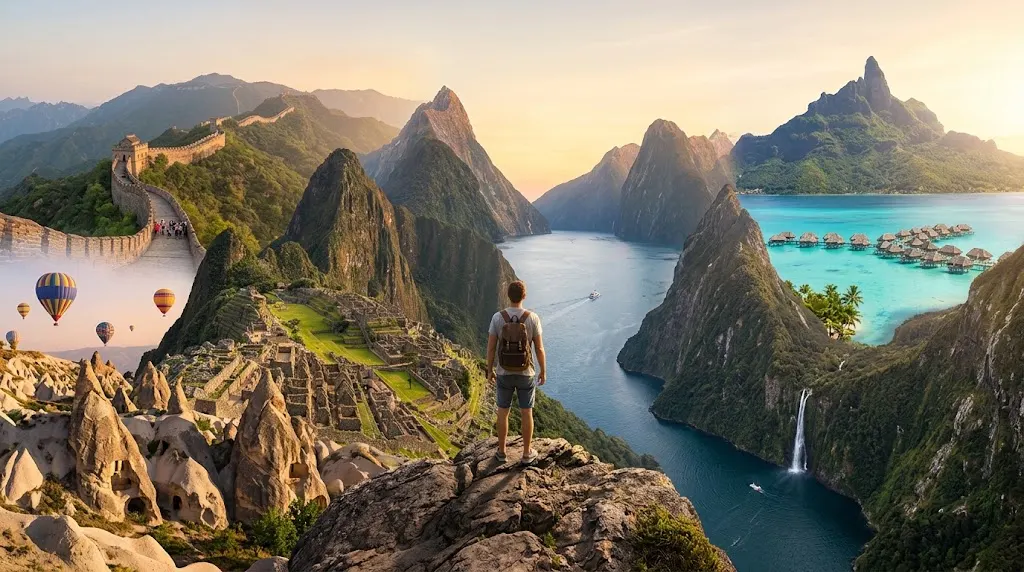
Best Bucket List Destinations Around the World
Some journeys are enjoyable for a weekend, while others stay in your memory for decades. Bucket-list travel is about those larger experiences: walking through an ancient city carved into desert rock, watching wildlife cross an African plain, standing beneath enormous mountains, snorkeling over a living coral reef, or exploring a place whose culture feels completely different from your everyday life. The best bucket list destinations around the world are not simply the places with the most recognizable photographs. They combine landscape, culture, history, food, wildlife, or adventure in ways that give travelers a compelling reason to build an entire trip around them. What deserves a place on your own list ultimately depends on what makes you curious.
A good bucket list should therefore contain variety rather than twenty versions of the same vacation. Mountain lovers might dream about Patagonia or the Canadian Rockies, while history-focused travelers may prioritize Machu Picchu and Petra. Ocean enthusiasts could build a major trip around Australia’s Great Barrier Reef, whereas wildlife travelers may spend years planning an African safari. Cities such as Paris, Tokyo, and Istanbul offer another kind of once-in-a-lifetime experience through architecture, food, neighborhoods, and cultural depth. This guide explores globally memorable destinations while also explaining when to go, what makes each place special, how to manage crowds and costs, and how to build a travel bucket list that reflects your interests rather than somebody else’s social-media feed.
1. Machu Picchu, Peru
Machu Picchu deserves its place on almost any serious list of historic travel destinations because the setting is as remarkable as the archaeological site itself. The fifteenth-century Inca complex stands approximately 2,430 meters above sea level in a dramatic mountain environment between the Andes and the upper Amazon Basin. UNESCO describes the site as an exceptional combination of architecture, engineering, land use, and natural beauty, with roughly 200 structures arranged across terraces and steep mountain terrain. Seeing the citadel surrounded by green peaks makes it easy to understand why photographs alone rarely communicate its scale. The ruins appear embedded within the mountain rather than simply placed on top of it.
Part of Machu Picchu’s appeal comes from the journey. Some travelers arrive relatively comfortably by train and bus, while others build the experience around a multi-day trek through Andean landscapes. Neither approach is automatically better. Travelers who enjoy hiking may value the gradual approach and changing scenery, whereas people with limited time or mobility can still experience the archaeological site deeply without completing a strenuous trail. What matters is allowing enough time to understand the place rather than treating it as a photograph taken between transportation connections. A knowledgeable guide can also explain terraces, ceremonial areas, water systems, building techniques, and what is known about how the settlement may have functioned.
Altitude should influence the itinerary. Travelers commonly spend time in Cusco or the Sacred Valley as part of the broader journey, and rushing directly into demanding physical activity can make the first days unnecessarily difficult. Plan a slower arrival, stay hydrated, and take your individual response to altitude seriously. The surrounding Sacred Valley deserves time in its own right, with archaeological sites, villages, mountain scenery, and opportunities to learn more about Andean culture. Turning Machu Picchu into part of a broader Peru itinerary makes the experience feel richer. The destination is far more meaningful when it sits within cultural and geographical context.
Timing affects both crowds and atmosphere. Popular periods can require advance planning, and entry systems, permitted routes, and transport arrangements may change as authorities manage visitor pressure. Always check current official information before booking rather than relying on an old itinerary copied from a travel blog. Shoulder periods can occasionally provide a more manageable visitor experience, though weather patterns must also be considered. Morning mist can add extraordinary atmosphere, but rain can influence trails and visibility. Flexibility is useful because no traveler can control how mountains will look on a particular morning.
Machu Picchu belongs on a bucket list because it brings history and landscape together unusually well. UNESCO recognizes both its cultural importance and its natural setting, noting the remarkable relationship between Inca development and the surrounding environment. Travelers who slow down often remember much more than the famous wide-angle view. The precision of stonework, agricultural terraces, steep ridges, cloud forest, and scale of the surrounding Andes all contribute to the experience. It is the kind of destination that rewards both curiosity and patience.
2. Petra, Jordan
Petra offers one of travel’s most dramatic entrances. Visitors approach through the Siq, a narrow gorge whose sandstone walls rise around the pathway, before the elaborate façade commonly called the Treasury suddenly appears ahead. Petra was an important Nabataean caravan city situated between the Red Sea and the Dead Sea, connecting trade routes between Arabia, Egypt, and Syria-Phoenicia. UNESCO describes it as a city that is partly built and partly carved directly into rock, surrounded by mountains, gorges, and extensive archaeological remains. The combination of desert geology and monumental architecture makes the approach feel cinematic even when you already know exactly what is coming.
The Treasury is only one part of a much larger archaeological landscape. Tombs, temples, religious sites, façades, paths, water channels, and the Monastery extend across a broad area that requires significant walking. UNESCO also highlights Petra’s sophisticated water-management network, which helped support substantial settlement within an arid environment. This engineering history adds another layer to the visual experience. Visitors who rush out immediately after photographing the Treasury miss much of what made Petra a complex functioning city rather than a single monument.
Spend enough time to explore beyond the busiest approach. The climb toward the Monastery can be tiring, but it reveals a different scale of the site and additional desert scenery. Comfortable walking shoes, sun protection, water, and realistic pacing are essential, particularly during warmer weather. Petra is not a destination where you should plan three other major activities on the same day. The site itself can absorb a full day or more. Travelers interested in archaeology may appreciate staying nearby for multiple visits rather than trying to see everything in one long session.
Jordan also allows Petra to become part of a broader bucket-list route. Wadi Rum offers vast desert landscapes and sandstone formations, while the Dead Sea provides an entirely different geographical experience. Amman, Jerash, and other historic areas can introduce further cultural context. Combining these places creates a journey where every few days the landscape changes dramatically. Avoid compressing the country into constant transfers simply because distances appear manageable. Long travel days plus extensive walking can make an ambitious itinerary feel less memorable than a slower one.
Petra deserves bucket-list status because it combines archaeological significance, engineering, trade history, and dramatic sandstone landscapes. UNESCO notes the exceptional fusion of Nabataean rock-cut traditions and Hellenistic architectural influences throughout the site. Yet technical importance is only part of what stays with visitors. The changing colors of the rock, scale of the gorges, quiet paths away from the central crowds, and sudden emergence of carved façades create emotional impact that is difficult to reproduce elsewhere. Petra feels designed by both geology and people.
3. Great Barrier Reef, Australia
The Great Barrier Reef is a bucket-list destination because much of its beauty is hidden beneath the ocean surface. From a boat, sections of tropical water may look beautiful but relatively ordinary until you enter the water and discover coral formations, schools of fish, changing colors, and an ecosystem operating below you. UNESCO identifies the Great Barrier Reef as the world’s most extensive coral reef ecosystem, covering roughly 348,000 square kilometers and containing around 2,500 individual reefs and more than 900 islands. Its enormous scale means no single excursion can represent the entire reef. Travelers are experiencing one tiny section of a much larger living system.
Snorkeling is one of the easiest ways to experience the reef, and you do not need to be an advanced diver to appreciate its biodiversity. Certified divers can reach deeper environments, while glass-bottom boats and other viewing experiences may work better for visitors who prefer not to swim. Choose activities based on confidence rather than pressure to have the most adventurous version of the trip. The reef contains more than 1,500 fish species and around 400 coral species, along with turtles, mollusks, seabirds, marine mammals, and many other forms of life. Slow observation often reveals more than simply swimming as far as possible.
Where you stay matters because the reef stretches along a huge portion of Australia’s northeast coast. Different departure points provide access to islands, outer reefs, beaches, sailing routes, and other marine experiences. Research current coral conditions, weather, operator practices, and seasonal marine activity rather than choosing entirely from promotional photographs. A high-quality operator should explain environmental rules and water safety before departure. Responsible tourism is particularly important in fragile marine environments. Never touch coral, stand on reef structures, feed wildlife, or treat marine animals as entertainment props.
Consider seeing the reef from more than one perspective if the budget allows. An aerial flight can reveal reef patterns and island shapes that are impossible to understand from water level, while snorkeling or diving reveals the life contained within those patterns. Island stays provide another way to slow down and experience the region beyond a single day tour. The surrounding Queensland coast also offers rainforest, beaches, wildlife, and cultural experiences that can turn the reef into part of a larger Australian journey. A bucket-list trip is often stronger when one headline destination leads naturally into several related landscapes.
The Great Barrier Reef belongs on a life list because it challenges the usual idea of what a landscape looks like. UNESCO describes it as a place of exceptional natural beauty both above and below water and one of the planet’s richest and most complex natural ecosystems. Travelers often arrive thinking about colorful fish and leave thinking more broadly about ecosystems, conservation, and how much of Earth’s beauty remains out of sight. The combination of scientific importance and sensory experience gives the destination unusual depth. It is not simply somewhere beautiful to swim; it is a living environment on an extraordinary scale.
4. Serengeti National Park, Tanzania
For wildlife lovers, few bucket-list experiences compare with seeing African animals moving through open landscapes rather than behind barriers. The Serengeti is famous for its plains, predators, birdlife, and seasonal animal movement, but the true appeal is the ecosystem as a whole. A safari teaches you quickly that wildlife sightings cannot be scheduled like museum tickets. Lions may disappear into grass, elephants may cross a road unexpectedly, or a seemingly empty plain may suddenly reveal large herds. That unpredictability gives each game drive its own personality. A traveler must slow down and observe rather than simply collect animal photographs.
The Serengeti’s Great Migration adds another level of spectacle, with huge numbers of grazing animals moving through the broader East African ecosystem in response to seasonal conditions. Exact locations vary throughout the year, which means visitors should plan around the experience they most want instead of assuming there is one perfect month. River crossings receive enormous publicity, but they are only one phase of a much larger natural cycle. Calving periods, predator activity, green landscapes, dry-season concentration, and birdlife can each provide different reasons to visit. Wildlife operates according to rainfall and ecology rather than tourist calendars.
Safari accommodation ranges from camps and lodges to more luxurious properties, and location can affect the experience significantly. Staying close to wildlife areas may reduce daily transit time and allow early morning or late afternoon game drives when conditions are favorable. A less luxurious camp in a strong location can provide more value than an elaborate property requiring long transfers. Ask operators about vehicle numbers, group sizes, guides, and itinerary design rather than focusing only on room photographs. A knowledgeable guide can transform an ordinary drive by interpreting animal behavior, tracks, ecosystems, and changing conditions.
Travelers should also resist the temptation to make every sighting about proximity. Animals do not need to stand beside a vehicle for an encounter to be extraordinary. Watching giraffes crossing a distant horizon or a herd moving steadily across plains can communicate the Serengeti’s scale better than a tightly framed photograph. Responsible safari behavior includes keeping appropriate distances, respecting park rules, reducing unnecessary noise, and never encouraging guides to disturb wildlife for a better image. Nature is not an interactive attraction. The greatest privilege is observing without changing what the animals are doing.
The Serengeti belongs on a bucket list because it provides something increasingly rare: the sense of an ecosystem functioning at immense scale. The most powerful moments may involve famous predators, but they can also involve sunrise, dust, migration, birds, or the silence of open plains. A safari is as much about landscape and patience as animals. Travelers who arrive expecting a documentary scene every ten minutes may become frustrated. Those willing to watch slowly often discover that the unscripted nature of the experience is exactly what makes it unforgettable.
5. Patagonia, Argentina and Chile
Patagonia is a bucket-list destination for travelers who want mountains to feel wild rather than carefully landscaped. Stretching across southern Argentina and Chile, the region contains granite peaks, enormous glaciers, lakes, steppe, forests, rivers, and weather that can change without warning. Torres del Paine, El Chaltén, Los Glaciares National Park, and other well-known areas provide some of the strongest hiking landscapes in South America. Yet Patagonia’s defining feature is scale. Long roads and vast open spaces make individual mountains feel part of something much larger than a single viewpoint.
Hiking is one of the best ways to experience Patagonia. Day routes can reach lakes and dramatic viewpoints without requiring a full expedition, while multi-day trails appeal to travelers who want deeper immersion. Fitness, weather, and route difficulty should guide your choices. The region’s famous wind can make otherwise manageable trails surprisingly demanding. Waterproof layers and flexible plans are essential because blue skies in the morning do not guarantee stable conditions all day. Patagonia rewards travelers who respect weather instead of trying to defeat it.
Glaciers provide another unforgettable experience. Perito Moreno is particularly accessible compared with many large glaciers, allowing visitors to observe massive walls of ice from designated viewpoints. Boat excursions and guided ice experiences may provide additional perspectives where conditions and regulations allow. Hearing ice crack or watching a section break away communicates the glacier’s movement more powerfully than a photograph. It is worth spending time simply observing rather than moving immediately to the next viewpoint. Large natural systems become more understandable when you watch them long enough to notice change.
Travel distances can be substantial, making route planning critical. Trying to combine too many distant areas often results in flights, buses, road transfers, and constant luggage handling. Choose fewer bases and give each several days. This creates space for poor weather and allows you to revisit landscapes in different light. Patagonia is a destination where a “lost” weather day may still become a memorable café, road, or town experience. Flexibility is not wasted time. It is part of traveling through a region where nature controls the schedule.
Patagonia deserves a place on the bucket list because it makes travelers feel small in the best possible way. A lone road, enormous glacier, sharp granite tower, or empty valley can create a perspective difficult to find in heavily developed destinations. The region is not primarily about comfort or convenience. Its appeal lies in exposure to weather, scale, and landscapes that remain visually dominant. For hikers, photographers, road trippers, and anyone drawn to wilderness, Patagonia can become one of the journeys against which later trips are compared.
6. Tokyo, Japan
Not every bucket-list destination needs to be a natural wonder. Tokyo earns its place through sheer urban depth. The city combines enormous transportation systems, quiet residential streets, traditional temples, neon-lit commercial districts, tiny restaurants, cutting-edge design, parks, shopping, art, and one of the world’s most influential food cultures. What makes Tokyo memorable is how drastically the atmosphere can change after a short train ride. A morning might begin at a shrine, lunch could involve a tiny ramen shop, the afternoon may take you through contemporary architecture, and the evening can end among some of the world’s busiest illuminated streets.
First-time visitors often assume Tokyo must feel chaotic because of its population and scale, yet everyday organization can make movement surprisingly efficient once the rail system becomes familiar. Stay near a useful station and group activities by neighborhood instead of crossing the entire city repeatedly. Shibuya, Asakusa, Ginza, Shinjuku, Ueno, Harajuku, and other districts each offer their own personalities. Trying to “finish Tokyo” is impossible. Choose several neighborhoods that match your interests and allow time to wander without a predetermined attraction at the end.
Food alone can justify the trip. Sushi, ramen, soba, tempura, yakitori, curry, tonkatsu, convenience-store snacks, pastries, coffee, and regional cuisines from across Japan appear at price levels ranging from inexpensive counters to elaborate tasting menus. Solo dining is common, making the city especially comfortable for independent travelers. You do not need reservations at famous restaurants for every meal to eat exceptionally well. Some of the most enjoyable experiences may involve choosing a busy neighborhood shop almost at random. Curiosity can be more valuable than a rigid restaurant checklist.
Tokyo also works as the beginning of a broader Japan itinerary. High-speed rail and domestic transport make it possible to combine the capital with Kyoto, Osaka, mountain towns, hot-spring regions, coastal destinations, or rural areas. Yet leaving too quickly is a mistake. Give Tokyo enough days that you can have at least one relatively unplanned afternoon. The city’s small discoveries—specialty stores, neighborhood cafés, shrines, stationery shops, basements full of food, or quiet side streets—often become more memorable than famous landmarks. Urban travel rewards exploration when there is time to notice details.
Tokyo deserves bucket-list status because it challenges simple categories. It can feel futuristic and deeply traditional within the same hour, crowded and peaceful within a few streets, luxurious and affordable within one neighborhood. The city does not reveal itself through one iconic monument. Its appeal comes from experiencing thousands of small systems, rituals, foods, and spaces working together. For travelers who love cities, food, culture, design, and the feeling of constant discovery, Tokyo can justify repeated visits rather than merely one.
7. Santorini and the Greek Islands
Santorini has become one of the world’s most recognizable island destinations because its whitewashed villages sit dramatically along the edge of a volcanic caldera above the Aegean Sea. Blue-domed churches, narrow streets, cliffside accommodation, and long evening light create the visual language travelers associate with Greek island romance. The popularity can be intense, especially around famous sunset viewpoints, but the scenery remains distinctive enough to justify the attention. The challenge is experiencing Santorini as an island rather than as a queue for photographs.
Stay overnight rather than treating the island only as a cruise or day-trip stop if your budget allows. Early mornings can provide quieter streets, while evenings allow you to experience villages after some daytime visitors leave. Explore beyond Oia’s most photographed lanes. Fira, smaller settlements, walking routes, vineyards, volcanic beaches, and archaeological sites provide a broader perspective. The island’s geology is central to what makes its cliffs and caldera so dramatic. Learning a little about that geological history can make the scenery much more interesting.
The wider Greek islands make an excellent bucket-list journey because each has a different personality. Some prioritize beaches and nightlife, while others offer hiking, villages, archaeological sites, food, or slower rural life. Pairing Santorini with a quieter island can balance the trip. Avoid trying to visit a new island every day simply because ferries exist. Transportation, check-in, luggage, and waiting can consume a surprising amount of vacation time. Two islands experienced slowly may provide more variety than five experienced hurriedly.
Food should be part of the itinerary. Greek island meals built around vegetables, seafood, cheese, olive oil, bread, grilled dishes, and local specialties can be as memorable as sunset viewpoints. Restaurants with famous views may be expensive, so balance one scenic meal with smaller tavernas or casual dining elsewhere. Markets, bakeries, and simple breakfasts add variety. Long evening meals are particularly well suited to island travel because the atmosphere becomes part of the experience. Food allows you to slow the trip naturally.
Santorini deserves bucket-list status when visited with realistic expectations. It is popular, expensive in certain areas, and far from secret, yet visual beauty does not disappear simply because millions of people recognize it. Good timing and a slower itinerary make the difference. Walk away from the most crowded viewpoint, explore under morning light, and allow yourself to experience the island without reproducing every photograph you have already seen online. The destination becomes more memorable when it feels personal rather than performative.
8. Banff and the Canadian Rockies
The Canadian Rockies belong on a bucket list because they combine spectacular mountain scenery with unusually accessible infrastructure. Turquoise lakes, glaciers, waterfalls, forests, wildlife, and long scenic roads allow travelers to experience huge landscapes without requiring technical mountaineering. Banff and nearby areas provide recognizable places such as Lake Louise alongside countless trails and viewpoints. Even driving between towns can become an attraction. The mountains repeatedly appear between trees and across valleys, making ordinary transfers feel like scenic excursions.
Lake colors are one of the region’s most memorable visual features. Fine glacial sediments suspended in the water contribute to the striking blue and turquoise appearance of several famous lakes. Walking around shorelines or paddling where permitted gives more time to appreciate them than simply stopping for a photograph. Popular locations can require advance transport planning because authorities manage congestion and environmental pressure. Check current access systems rather than assuming you can drive directly everywhere. Planning saves enormous frustration during busy periods.
Hiking offers the best escape from headline viewpoints. Trails range from relatively easy lakeside routes to demanding mountain experiences, making the region suitable for different fitness levels. Wildlife precautions matter, including understanding appropriate behavior around bears and other animals. Follow local guidance, carry recommended supplies, and never approach wildlife. The accessibility of the region should not create the illusion that the environment is controlled. These are still large mountain ecosystems with genuine natural hazards.
Season transforms the experience. Summer provides hiking, lakes, and long scenic road trips, while winter brings skiing, snowshoeing, frozen landscapes, and a completely different visual atmosphere. Shoulder periods may provide fewer crowds but can also involve trail closures or unpredictable weather. Choose dates based on what you want most rather than assuming there is one best season. Wildflowers, open trails, snowy mountains, skating, and skiing each belong to different versions of the Rockies.
The Canadian Rockies earn bucket-list status because they offer extraordinary scenery at multiple levels of adventure. Travelers can undertake demanding hikes, paddle mountain lakes, drive scenic highways, or simply sit somewhere beautiful with a coffee. The region does not require extreme physical ability to feel impressive. At the same time, people willing to hike farther can find quieter perspectives away from the busiest locations. That combination of accessibility and depth makes the Rockies suitable for families, couples, solo travelers, road trippers, and serious outdoor enthusiasts alike.
9. Paris, France
Paris remains one of the world’s great bucket-list cities because it offers far more than a collection of famous monuments. The Eiffel Tower, Louvre, Notre-Dame area, Seine, Arc de Triomphe, and grand boulevards create an iconic first impression, but the city becomes more interesting once travelers begin exploring neighborhoods. Cafés, bakeries, markets, small museums, parks, bookstores, architecture, and ordinary residential streets provide the experiences that make people want to return. A first visit should include famous sights, but it should not be limited to them.
Walking is one of the best ways to experience Paris. Different neighborhoods reveal changes in architecture, food, atmosphere, and street life that can disappear when you move only by underground transport. Group sights geographically and allow time for stops without a plan. A café break, bakery, small shop, or unexpected square may interrupt the itinerary and improve it. Trying to cross the city constantly to complete a list creates fatigue quickly. Paris becomes more enjoyable when sightseeing is arranged around neighborhoods rather than individual monuments.
Museums deserve selective planning. The Louvre alone can consume hours without providing any realistic possibility of seeing everything. Decide which collections or works matter to you and accept that leaving something unseen is normal. Smaller museums can offer more focused experiences with fewer visitors. Art lovers could spend weeks exploring the city, while travelers less interested in museums should not feel obligated to dedicate entire days to them merely because Paris is famous for culture. A bucket-list trip should still reflect personal interests.
Food can range from inexpensive bakery breakfasts to elaborate dining, making Paris adaptable to different budgets. Croissants, bread, cheese, markets, sandwiches, cafés, bistros, pastries, and regional French cooking can create memorable meals without requiring every restaurant to be prestigious. One carefully chosen higher-end meal can be balanced with picnics and casual places. Eating in a park or beside the Seine can feel as distinctly Parisian as dining beneath chandeliers. The atmosphere often matters as much as the bill.
Paris belongs on a bucket list because it rewards both first-time recognition and repeated discovery. You may arrive wanting to see a handful of famous places and leave remembering a particular street, café, rainy evening, or neighborhood walk. That is one of the city’s strengths. Its major landmarks justify the journey, but its small experiences make the trip personal. Instead of trying to “do Paris” in three frantic days, give the city enough time to surprise you.
10. Build a Bucket List That Matches Your Travel Style
A bucket list becomes more useful when it reflects what you actually enjoy rather than a standard ranking of global attractions. If hiking gives you your strongest travel memories, prioritize Patagonia, the Canadian Rockies, the Dolomites, or the Himalayas. If history matters most, Machu Picchu, Petra, Angkor, Rome, or Egypt might rise higher. Wildlife travelers may dream about the Serengeti, Galápagos, or polar regions, while food-focused travelers could build entire journeys around Japan, Italy, Mexico, Türkiye, or Southeast Asia. There is no obligation to want every famous destination equally.
Think about experiences rather than only place names. “See the northern lights,” “go on safari,” “learn to cook regional food,” “complete a multi-day trek,” or “snorkel a coral reef” can produce more personal travel goals than a list of countries. An experience-based approach also creates flexibility. If one destination becomes too expensive or overcrowded, another may provide the same kind of adventure. You are pursuing a feeling or activity rather than one photograph. This makes the bucket list easier to adapt over time.
Budget and travel time should influence priorities honestly. A remote destination requiring several flights may deserve a longer stay than somewhere reachable on a direct route. Combine nearby bucket-list places when geography makes sense, but avoid turning every trip into a marathon. One major destination experienced properly can feel more significant than five visited briefly. Long-haul travel also benefits from buffer days, particularly when weather-sensitive activities are involved. A dream trip should not depend on every connection running perfectly.
Consider physical demands too. Some destinations involve altitude, extensive walking, heat, cold, water activities, or demanding trails. Visiting them at a stage of life when you can comfortably enjoy the experience may influence when they move to the top of the list. This does not mean bucket-list travel is only for highly fit people. Many famous destinations provide accessible alternatives. It simply means matching the version of the trip to your needs instead of forcing yourself into somebody else’s definition of adventure.
Finally, leave room for destinations you have not discovered yet. Your travel interests will change as you visit more places. A country you barely considered may become a favorite after one recommendation or unexpected stop. Treat the bucket list as a living document rather than a contract. Famous places can provide extraordinary experiences, but some of your strongest memories may come from places that never appeared on the original list. Curiosity should remain more powerful than completion.
Final Thoughts on the Best Bucket List Destinations
The best bucket list destinations around the world offer more than attractive scenery. Machu Picchu combines Inca history with an extraordinary Andean setting, while Petra turns sandstone geology into monumental architecture. The Great Barrier Reef reveals one of the planet’s richest marine environments, and the Serengeti places travelers inside a vast wildlife ecosystem. Patagonia and the Canadian Rockies appeal to mountain lovers, while Santorini offers a striking volcanic island landscape. Tokyo, Paris, and other great cities prove that culture and urban life can be every bit as worthy of a once-in-a-lifetime journey as wilderness.
UNESCO’s descriptions of Machu Picchu, Petra, and the Great Barrier Reef help explain why these places endure beyond travel trends. Machu Picchu is recognized for its integration of cultural achievement and natural landscape, Petra for its extraordinary rock-cut city and water-management heritage, and the Great Barrier Reef for the scale and biodiversity of its living ecosystem. Their significance extends far beyond being photogenic. Understanding what makes a destination historically or ecologically important often deepens the experience considerably.
Planning matters more for bucket-list trips because these journeys are often expensive, distant, or difficult to repeat immediately. Research seasons, crowd patterns, permits, transportation, physical demands, and accommodation before committing to dates. Leave buffer time when weather controls an essential experience. Spending thousands to reach somewhere and allowing only a few hours for the thing you traveled to see creates unnecessary risk. A little extra time can protect the emotional and financial investment behind a major journey.
Travel responsibly as well. Bucket-list destinations often face enormous pressure precisely because so many people dream of visiting them. Stay on designated trails, respect archaeological sites, avoid disturbing wildlife, follow marine rules, and treat residential communities as homes rather than scenery. Support reputable local businesses and guides where possible. Travelers do not need to avoid famous destinations simply because they are popular, but they should recognize that their behavior contributes to what those places become.
Ultimately, your bucket list should make you excited rather than pressured. You do not need to visit every famous place in the world, and there is no deadline for completing the list. Choose destinations that connect with your interests, stay long enough to appreciate them, and allow unexpected places to earn their own position over time. Whether your dream involves mountains, ancient ruins, wildlife, oceans, food, or enormous cities, the best bucket-list trip is the one that feels meaningful to you long after you return home.
Frequently Asked Questions
What are the best bucket list destinations in the world?
Machu Picchu, Petra, the Great Barrier Reef, the Serengeti, Patagonia, Tokyo, Santorini, the Canadian Rockies, and Paris are strong options because they offer distinctive combinations of scenery, culture, history, food, or wildlife.
Which bucket list destinations are best for adventure travelers?
Patagonia, Machu Picchu and the Andes, the Canadian Rockies, the Great Barrier Reef, and safari destinations in Africa are particularly suitable for hiking, diving, wildlife exploration, paddling, and other active experiences.
What are good bucket list destinations for couples?
Santorini, Paris, the Greek islands, the Canadian Rockies, tropical island destinations, and scenic countryside regions work well for couples who want a combination of beautiful surroundings, food, and shared experiences.
How should I choose which bucket list trip to take first?
Prioritize your interests, available travel time, total budget, physical comfort, season, and how difficult the destination may be to visit later. Choose somewhere you genuinely want to experience rather than somewhere you feel obligated to visit because it is famous.
How can I save money on bucket list travel?
Travel during suitable shoulder seasons, compare full trip costs, stay longer in fewer places, use local transport where practical, balance expensive activities with free experiences, and reserve premium spending for the parts of the trip that matter most