


Best Places to Visit for Nature Lovers
For some travelers, the best vacation does not revolve around shopping streets, nightlife, or famous buildings. It begins with mountains emerging from morning mist, wildlife moving through open grasslands, waterfalls disappearing into forests, or waves breaking against an empty coastline. The best places to visit for nature lovers give travelers opportunities to experience landscapes as living environments rather than scenery viewed briefly from a window. Hiking, wildlife watching, snorkeling, kayaking, camping, scenic driving, and simply sitting somewhere quiet can become the main reasons for traveling. The destination itself provides the entertainment, often creating stronger memories than a packed schedule of conventional attractions.
Nature-focused travel can take many forms depending on comfort, budget, fitness, and curiosity. Wildlife lovers may dream about the Serengeti or Galápagos Islands, while hikers might place Patagonia or New Zealand’s South Island at the top of their lists. Yellowstone combines geothermal landscapes with large mammals, and the Canadian Rockies offer turquoise lakes, mountain roads, forests, and accessible hiking. Costa Rica is particularly appealing to travelers who want tropical biodiversity alongside established tourism infrastructure, while Norway’s fjords create a completely different experience built around mountains and water. This guide explores remarkable natural destinations around the world while also explaining when to visit, what to experience, and how to travel more responsibly.
1. Yellowstone National Park, United States
Yellowstone is one of the world’s most distinctive destinations because wildlife, forests, rivers, canyons, geothermal activity, and enormous open landscapes exist within one protected area. UNESCO notes that the park covers nearly 9,000 square kilometers and contains more than 10,000 geothermal features, including the world’s largest concentration of geysers. That combination makes Yellowstone especially rewarding for travelers who want geological wonders and wildlife within the same trip. One hour might involve watching steam rise from colorful hot springs, while another brings a herd of bison moving across a valley. Few nature destinations change character so frequently during an ordinary day of exploration.
Old Faithful may be Yellowstone’s most famous geothermal attraction, but stopping there alone would provide only a small understanding of the park. Boardwalk areas reveal hot springs, mud pots, fumaroles, mineral terraces, and pools containing intense colors created by geology and heat-loving microorganisms. Travelers should remain strictly on designated paths because geothermal ground can be dangerously thin and water temperatures may be extreme. The safest photographs come from established viewing areas rather than attempts to approach unusual formations. Moving slowly through geothermal basins also helps visitors appreciate subtle differences between features instead of treating them as one collection of steaming pools.
Wildlife provides another reason to stay several days. Yellowstone is known for bison, elk, grizzly bears, black bears, wolves, and numerous smaller species, with UNESCO highlighting the park as an important refuge within a remarkably intact large temperate ecosystem. Lamar and Hayden valleys are especially popular for wildlife observation, though sightings are never guaranteed. Early mornings and evenings can provide good opportunities while also producing beautiful light. Carry binoculars rather than approaching animals for photographs. Large mammals can move faster than people expect, and respecting official distance requirements protects both visitors and wildlife.
Hiking can reveal a quieter Yellowstone beyond roadside attractions. Trails lead through forests, meadows, geothermal areas, canyon landscapes, lakeshores, and mountain environments with options ranging from short walks to demanding backcountry routes. Before leaving, check trail conditions, wildlife advisories, weather, and any recommended bear-safety procedures. Yellowstone is enormous, and its excellent road network can create a false sense that wilderness is always nearby and controlled. Once you leave a busy viewpoint, conditions can become much more remote quickly. Beginners can still enjoy nature through shorter established trails while experienced hikers may plan longer excursions with appropriate preparation.
Yellowstone is best experienced as an ecosystem rather than a checklist of famous attractions. Spend enough time to watch a geyser erupt, sit quietly beside a river, scan distant hills for wildlife, and notice how landscapes change between forests and open valleys. Driving distances are substantial, so staying in strategic areas can reduce unnecessary backtracking. Peak summer brings larger crowds, while shoulder periods may provide a different atmosphere alongside changing weather and access conditions. Whatever the season, Yellowstone rewards patience. Its strongest moments often arrive unexpectedly when an ordinary road suddenly reveals wildlife, steam, waterfalls, or enormous open space.
2. Galápagos Islands, Ecuador
The Galápagos Islands are extraordinary for nature lovers because wildlife often behaves differently from animals accustomed to heavy human disturbance elsewhere. Situated around 1,000 kilometers from mainland South America, the archipelago developed in remarkable isolation, contributing to unusual species and ecological relationships. UNESCO describes the islands and surrounding marine reserve as a unique living showcase of evolution, shaped by volcanic activity and the meeting of major ocean currents. Giant tortoises, marine iguanas, sea lions, seabirds, finches, and penguins make the destination feel like an open-air natural history lesson. The real attraction is not simply seeing rare animals but observing how closely land and marine ecosystems interact.
Island experiences vary significantly, which makes itinerary design important. Some locations emphasize giant tortoises and volcanic landscapes, while others provide stronger opportunities for seabirds, snorkeling, or marine wildlife. Travelers can explore through land-based itineraries using inhabited islands as bases or join cruise-style journeys reaching more remote visitor sites. Cruises may provide broader access, while land-based travel can offer more independence and interaction with local communities. Neither style is automatically superior. Consider budget, comfort with boats, preferred wildlife, and how much structure you want before deciding. Both approaches should involve licensed guides where protected areas require them.
Snorkeling can be as memorable as land exploration because the surrounding marine reserve contains exceptionally diverse wildlife. UNESCO highlights sharks, rays, penguins, sea mammals, corals, and other marine species within an ecosystem strongly influenced by converging ocean currents. Swimming near sea turtles or watching marine iguanas feed underwater can completely change a visitor’s understanding of the islands. Choose activities suited to your swimming ability, wear appropriate sun protection, and follow guide instructions closely. Marine wildlife should never be touched, chased, fed, or repositioned for photographs. Observation is most meaningful when natural behavior remains undisturbed.
Season influences water temperature, marine activity, visibility, and weather patterns, but there is no single universally perfect month. Different periods may emphasize different breeding behaviors, sea conditions, vegetation, or wildlife opportunities. Nature travelers should decide what species or activities matter most and plan accordingly rather than simply selecting the sunniest season. Motion-sensitive visitors should also investigate typical sea conditions if a cruise is being considered. Because flights and protected-area arrangements add cost, the Galápagos usually deserves more than a rushed visit. Several well-planned days allow each island or wildlife encounter to feel distinct.
The Galápagos belong high on a nature travel list because they make evolution, adaptation, geology, and conservation visible in unusually direct ways. UNESCO notes that the isolation of the islands helped produce distinctive species such as marine iguanas, giant tortoises, flightless cormorants, and varied finches. Yet the islands are not a museum frozen in time. They remain fragile living environments facing ecological pressures, making responsible visitor behavior essential. Follow designated trails, respect wildlife distances, reduce waste, and support conservation-conscious operators. Experiencing the Galápagos thoughtfully can deepen appreciation not only for individual animals but for how entire ecosystems evolve.
3. Serengeti National Park, Tanzania
The Serengeti provides one of the world’s greatest wildlife experiences because animals exist within an enormous functioning landscape rather than isolated protected enclosures. Grasslands stretch toward the horizon, rocky outcrops rise from open plains, and predators follow large herbivore populations through changing seasonal conditions. UNESCO describes the park as roughly 1.5 million hectares of savannah and identifies its annual migration as one of the world’s most impressive natural events. Nature lovers may arrive hoping to see lions or elephants, but many leave equally impressed by the scale of the grasslands, changing skies, birds, and relationships between species. Safari becomes more meaningful when the ecosystem itself becomes the subject.
The Great Migration receives enormous attention, involving vast numbers of wildebeest, zebras, gazelles, and predators moving through the wider Serengeti-Mara ecosystem in search of pasture and water. UNESCO describes this as the largest remaining unaltered animal migration, extending across Tanzania and Kenya. However, visitors should avoid assuming that one famous river-crossing image can be scheduled precisely. Animal movement depends on rainfall and environmental conditions, meaning dates can shift. Different seasons offer calving, predator activity, greener landscapes, dry-season concentrations, or changing birdlife. Choosing the right period should begin with what you most want to experience.
A skilled safari guide can profoundly improve the experience. Guides notice tracks, distant movement, animal behavior, bird calls, and ecological relationships that first-time visitors may miss completely. Instead of racing from one large animal to another, allow time to observe interactions. Watching a lion resting beneath shade or elephants moving slowly across a plain can be more memorable than constantly searching for dramatic hunting scenes. Binoculars are valuable because proximity should never determine whether a wildlife encounter feels worthwhile. Responsible operators maintain suitable distances and avoid surrounding or pressuring animals simply to satisfy photographers.
Accommodation choices range from permanent lodges to mobile or seasonal camps, with location often mattering more than luxury. Staying closer to areas relevant to seasonal wildlife movement can reduce daily driving and allow earlier game drives. Ask operators about vehicle numbers, group sizes, guide quality, conservation practices, and how itineraries respond to wildlife conditions. A beautifully designed lodge far from the day’s wildlife may provide less value than simpler accommodation positioned strategically. Safari costs can be substantial, so understanding what drives the experience helps travelers allocate money intelligently. The guide, location, and time spent observing wildlife often matter more than elaborate room amenities.
The Serengeti should be experienced with patience. UNESCO notes that the ecosystem supports immense herbivore populations and one of the world’s most significant concentrations of large predator-prey interactions. That richness does not mean an extraordinary animal appears every minute. Quiet periods are part of safari and create opportunities to appreciate grasslands, birds, clouds, insects, and smaller species. Avoid judging each drive by how many “big” animals were photographed. Nature does not perform according to a tourist schedule. The unpredictability is precisely why seeing something remarkable in the Serengeti feels earned rather than staged.
4. Patagonia, Argentina and Chile
Patagonia appeals to nature lovers who want landscapes to feel expansive, wild, and slightly unpredictable. Southern Argentina and Chile contain granite towers, glaciers, forests, turquoise lakes, rivers, open steppe, and mountain environments where weather can dominate daily decisions. Famous areas such as Torres del Paine, El Chaltén, and Los Glaciares National Park attract hikers from around the world, but Patagonia’s appeal extends far beyond individual trails. Long empty roads and enormous skies reinforce the sense that landscapes continue far beyond the places visitors can easily reach. The region is particularly rewarding for travelers comfortable allowing nature rather than an itinerary to determine the pace.
Hiking provides some of the strongest experiences. Day trails can reach mountain lakes and viewpoints without requiring a multi-day expedition, while longer treks offer deeper immersion for experienced travelers. Choose routes according to actual fitness, elevation, distance, and weather exposure rather than the popularity of their summit photographs. Patagonian wind can transform an otherwise moderate walk into something much more demanding. Carry waterproof layers and enough food and water for changing conditions. Starting early can provide flexibility if weather deteriorates later. A shorter hike completed comfortably is better than forcing an ambitious trail simply because it appears on every travel list.
Glaciers add another dramatic element. Perito Moreno in Argentina provides particularly accessible views of an immense moving wall of ice, while other sections of Patagonia offer boat excursions, guided glacier experiences, and remote glacial scenery. Listening to ice crack or watching sections collapse into water creates a sense of movement that photographs rarely capture. Do not treat glaciers only as backgrounds for selfies; spend enough time to notice their texture, sound, and changing light. Guided experiences should follow established safety and conservation rules. Ice environments can be dangerous outside approved areas even when the surface appears stable.
Road travel allows visitors to understand the region’s scale, though distances should never be underestimated. Towns and famous landscapes may require hours of travel between them, making an itinerary with constant hotel changes exhausting. Choose fewer bases and give each several nights. This creates buffer time for weather and lets you return to trails or viewpoints under better conditions. Fuel, road surfaces, border crossings on international routes, and ferry connections should be planned carefully. Offline maps are helpful in remote areas. Patagonia becomes more enjoyable when transportation supports exploration instead of becoming the main daily activity.
Patagonia is best suited to travelers who accept imperfect conditions. A cloudy morning, powerful wind, or unexpected rain may alter a hike but can also create the dramatic atmosphere for which the region is famous. The landscape changes rapidly under shifting light, making flexibility especially rewarding for photographers. Spend some time doing nothing more ambitious than watching clouds move around mountain peaks. Nature travel does not need to involve constant physical challenge. Patagonia’s strongest gift may simply be the feeling of standing somewhere enormous enough to make everyday concerns seem temporarily very small.
5. Costa Rica
Costa Rica is a particularly attractive nature destination because tropical rainforests, volcanoes, beaches, wildlife, rivers, and cloud forests can be experienced within a relatively compact country. Travelers may wake near misty mountains, hike through forest during the day, and eventually reach a warm coastline without crossing enormous distances. The country’s tourism infrastructure also makes many nature experiences approachable for visitors who do not want expedition-level travel. National parks, reserves, eco-lodges, guided wildlife walks, canopy experiences, and established transport routes provide many ways to explore. It is a strong option for first-time nature travelers seeking biodiversity alongside practical travel support.
Wildlife watching can include monkeys, sloths, toucans, colorful frogs, reptiles, insects, and numerous bird species depending on the ecosystem and region. Hiring a naturalist guide for at least one forest walk can make an enormous difference because tropical wildlife is often hidden rather than conveniently visible. Guides recognize movement, sounds, tracks, and camouflage that inexperienced visitors may walk past repeatedly. Early mornings may provide increased activity for certain species and cooler walking conditions. Binoculars and patience are often more useful than expensive camera equipment. The rainforest rewards people willing to stop and look carefully.
Cloud forests create a particularly atmospheric experience. Higher elevations bring cooler temperatures, moss-covered trees, mist, orchids, and dense vegetation that feels completely different from lowland rainforest. Monteverde is well known, but other elevated areas offer similar ecological experiences with varying levels of tourism development. Walk slowly because damp trails can be slippery and wildlife may be easier to hear than see. Rain should be expected rather than treated as a vacation failure. The moisture creates the forest conditions you traveled to experience. Waterproof footwear and lightweight rain protection can dramatically improve comfort.
Costa Rica’s two coasts add another dimension. Pacific and Caribbean regions differ in weather patterns, landscapes, wildlife opportunities, and atmosphere, so travelers should research where conditions are favorable during their specific travel month. Surfing, snorkeling, turtle-related conservation experiences, mangrove tours, and quiet beach days may all be possible depending on region and season. Wildlife nesting or breeding events should be observed only through responsible, regulated experiences that avoid disturbing animals. A beach can be both a recreational space and an essential wildlife habitat. Nature travelers should understand when those priorities overlap.
Costa Rica works best when the itinerary does not try to cover the entire country in one week. Winding roads and mountain terrain can make distances slower than maps suggest. Choose two or three ecosystems and experience them properly. Combining a cloud forest, rainforest or volcanic region, and one coast can provide enormous biodiversity without constant relocation. Stay in accommodations that demonstrate credible environmental practices rather than relying solely on labels such as “eco.” Responsible travel involves waste, water use, wildlife behavior, local employment, and conservation—not simply staying somewhere surrounded by trees.
6. New Zealand’s South Island
New Zealand’s South Island is an exceptional destination for nature lovers because mountains, fjords, glaciers, lakes, forests, beaches, and open countryside occur within a road-trip-friendly geographic area. A single journey can move from alpine valleys to wild coastline and then into deep fjord landscapes. The scenery changes so frequently that transportation often becomes part of the attraction. Travelers who enjoy hiking will find extensive trail networks, while those seeking easier experiences can use scenic drives, cruises, short walks, and viewpoints. This balance makes the island suitable for both serious outdoor travelers and visitors who prefer nature without demanding physical challenges every day.
Fiordland is one of the island’s defining landscapes. Steep mountains descend into deep waterways, waterfalls appear after heavy rain, and dense vegetation reflects the region’s famously wet climate. Milford Sound is the most recognizable destination, but cloudy or rainy weather should not automatically be considered disappointing. Rain intensifies temporary waterfalls and creates dramatic mist across mountain walls. Boat trips allow travelers to understand the height and scale of the landscape from water level. Bring waterproof layers and accept that moisture is part of Fiordland rather than something that prevents the “real” experience.
The Southern Alps provide a completely different setting. Areas around Aoraki/Mount Cook, Wanaka, Queenstown, and surrounding lakes offer hiking, mountain viewpoints, glacial environments, and adventure activities. Short trails can still provide spectacular scenery, making the region accessible to travelers who cannot complete long mountain routes. More demanding hikes require proper preparation because conditions can change quickly. Check track information before departure, particularly after heavy weather. Helicopter and flight-based activities may offer remarkable perspectives where budgets allow, but nature lovers can experience extraordinary landscapes without paying for premium adventure experiences.
Road trips are particularly rewarding, but drivers should resist the temptation to cover enormous distances each day. Scenic stops, winding roads, weather, and one-lane bridges can make journeys longer than navigation estimates suggest. Stay multiple nights in strong bases and build the itinerary around landscapes rather than kilometer totals. Stop safely when you want to enjoy views rather than photographing them while driving. Fuel and food options become limited in some remote areas, so prepare before long stretches. The freedom of a car is valuable when it creates spontaneous exploration rather than pressure to reach the next distant hotel.
New Zealand’s South Island is ideal for travelers who want diversity more than one single natural wonder. You can spend one morning beneath mountains, another beside a glacial lake, and the next moving through rainforest or along a rugged coastline. This constant contrast makes longer trips feel visually fresh. Yet the best itineraries still avoid trying to see everything. Choose landscapes that genuinely interest you and allow enough time for weather changes. Nature is most memorable when experienced rather than consumed. The South Island gives travelers endless opportunities to practice that slower approach.
7. Norwegian Fjords
Norway’s fjord landscapes demonstrate how dramatically water and mountains can shape each other. Deep waterways cut through steep terrain while waterfalls descend from cliffs and small farms or villages occupy narrow areas along the shoreline. Traveling through fjord country can feel as though every transport route doubles as a sightseeing experience. Boats reveal towering cliffs from below, roads climb toward high viewpoints, and trains pass through valleys that would be major attractions elsewhere. This makes Norway particularly appealing for travelers who enjoy scenic journeys rather than simply arriving at one famous natural landmark. The landscape dominates the entire route.
Boat travel provides one of the clearest ways to understand fjord scale. From water level, mountain walls rise dramatically while waterfalls and remote settlements become visible along shorelines. Public ferries can sometimes provide scenic experiences as part of ordinary transport, while dedicated cruises may explore particular waterways more slowly. Decide whether the boat is primarily transportation or a major activity and budget accordingly. Weather can completely transform the mood, with mist creating a more mysterious landscape and clear conditions revealing distant peaks. Both can be beautiful when expectations remain flexible.
Hiking adds the elevated perspective frequently associated with Norway’s famous photographs. High routes can reveal waterways winding far through mountain terrain, but difficulty varies widely and conditions deserve respect. Rain, wind, wet rock, and rapid weather changes can make exposed routes dangerous. Research trail length, elevation, and current conditions rather than choosing solely from the final viewpoint. Lower trails, waterfalls, and village walks can still provide extraordinary scenery. Travelers do not need to stand at the edge of an intimidating cliff for a Norwegian nature trip to feel worthwhile.
Scenic driving can link multiple fjord areas, but road distances can be deceptive. Mountains require tunnels, ferries, switchbacks, and indirect routes, making seemingly nearby places much farther apart in travel time. Plan fewer bases and allow extra time for roadside stops. Summer offers long daylight and broader road access, though it also attracts more visitors. Shoulder periods may provide fewer crowds alongside less predictable weather and seasonal transport changes. Whatever the timing, confirm ferry schedules and road conditions rather than relying entirely on general navigation apps.
Norwegian fjords reward slow travel because much of their beauty lies between recognized attractions. A quiet ferry crossing, roadside waterfall, small harbor, or evening light reflecting from water can become more memorable than the viewpoint you originally planned the trip around. Avoid measuring the holiday by how many fjords were visited. Stay long enough in one region to hike, travel by boat, and see the landscape from several perspectives. Nature becomes more understandable when you experience both height and water level. Norway makes this combination unusually easy.
8. The Canadian Rockies
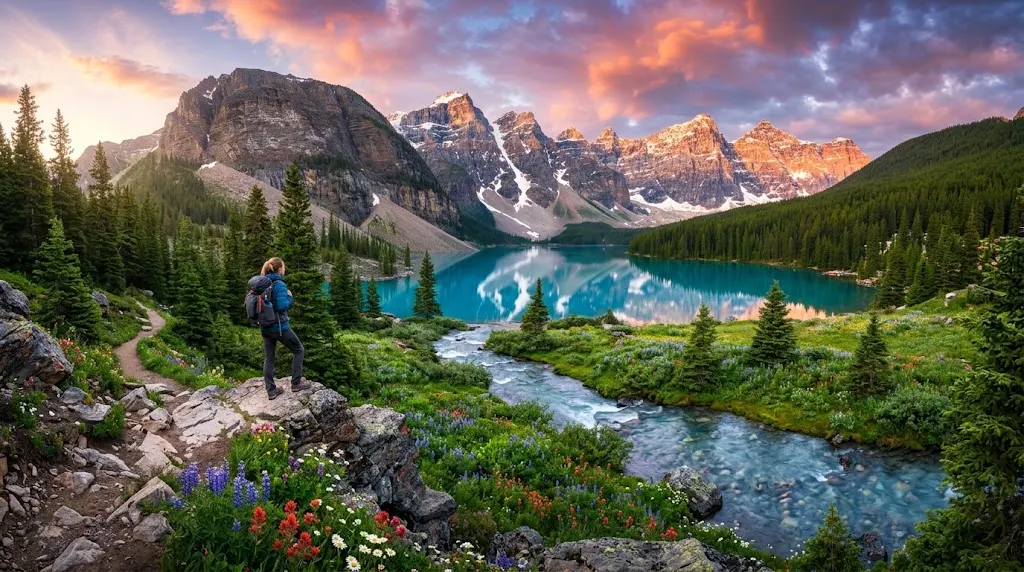
The Canadian Rockies offer a remarkable combination of dramatic mountain landscapes and relatively accessible outdoor experiences. Banff, Jasper, and surrounding areas contain snow-covered peaks, glaciers, forests, waterfalls, turquoise lakes, wildlife, and scenic roads. Travelers can choose demanding backcountry hikes or enjoy spectacular views through short walks and established viewpoints. This range makes the region attractive to families, couples, solo travelers, photographers, and experienced hikers alike. The infrastructure is convenient, but the surrounding environment remains genuinely wild. Nature lovers should therefore balance accessibility with respect for mountain conditions and wildlife.
Lakes such as Louise and Moraine are famous for intense blue and turquoise colors influenced by fine glacial sediment. Popularity means access may require shuttle systems or other visitor-management arrangements, so current official information should be checked before travel. Once there, avoid stopping only for the standard photograph. Walking along shorelines or hiking above the lakes reveals completely different perspectives. Morning and evening light can also transform colors and reflections. Spending more time in fewer locations creates a deeper experience than racing among every lake featured online.
The Icefields Parkway offers one of North America’s great scenic drives, linking dramatic valleys, glaciers, rivers, and viewpoints. Allow far more time than a basic navigation estimate because stopping is part of the purpose. Fuel, food, and weather should be considered carefully, particularly outside peak summer. Wildlife may appear near roads, making slow and attentive driving important. Never stop unsafely or block traffic for animals. A scenic highway becomes dangerous when drivers treat every wildlife sighting as permission to abandon ordinary road rules.
Hiking can take travelers well beyond the busiest viewpoints. Trails range from forest walks to high mountain routes, with changing difficulty and wildlife considerations. Bear awareness is particularly important, and visitors should follow current local guidance regarding group size, food, deterrents, and trail closures. Weather can shift quickly at elevation even when valley conditions seem warm. Carrying layers, water, navigation, and basic emergency supplies is good practice. Beginners can choose shorter established routes without sacrificing scenery. Nature exploration should match skill rather than social pressure.
The Canadian Rockies are particularly rewarding because the same destination changes radically across seasons. Summer offers open trails and vivid lakes, autumn can bring changing vegetation, and winter transforms valleys into snowy environments suited to skiing and snowshoeing. Shoulder periods may provide quieter conditions but also greater uncertainty around trails and weather. Choose the season according to the experience you care about most. You cannot optimize summer hiking and deep winter scenery on one visit. The possibility of returning to an entirely different version of the landscape is part of the region’s appeal.
9. How to Choose the Right Nature Destination
Start by identifying the kind of nature experience that excites you most. Someone fascinated by wildlife may prefer the Serengeti or Galápagos, while a hiker could feel more fulfilled in Patagonia, New Zealand, or the Canadian Rockies. Yellowstone suits travelers who want wildlife alongside unusual geology, whereas Norway is ideal for people drawn to mountains and water. Costa Rica works particularly well for tropical biodiversity. There is no universally best nature destination because landscape preferences are personal. The most famous place in the world may disappoint you if its main activity is something you do not enjoy.
Think carefully about the physical effort required. Certain experiences involve high altitude, long hikes, remote roads, rough seas, intense heat, or cold weather. Research what is necessary to reach the scenery rather than looking only at the final photograph. Many nature destinations provide accessible alternatives through boats, scenic drives, boardwalks, short trails, or guided excursions. Choosing an easier option does not make the experience less legitimate. A beautiful destination should be enjoyed in a way that suits your body and confidence. Adventure is rewarding only when challenge remains manageable.
Season should influence the decision significantly. Wildlife migration, rainfall, snow, water temperature, flowering plants, road access, and daylight can all alter a destination dramatically. Serengeti wildlife movement follows ecological conditions, while mountain trails may remain inaccessible under snow. Tropical regions can experience wet seasons that actually enhance certain landscapes but make other activities difficult. Rather than asking for a generic “best time to visit,” identify the exact experience you want and research when it is most likely. Nature works according to seasons rather than travel advertising.
Budget should include more than transportation and hotels. Safari destinations may require guides and park fees, islands can involve internal flights or boats, and remote mountain regions may need rental cars or specialized transfers. Conversely, some expensive-to-reach destinations provide many free activities once you arrive. Hiking, wildlife viewing, scenic drives, and beaches may cost little compared with urban attractions. Calculate the entire journey before deciding a destination is affordable or expensive. Spending longer in fewer places can sometimes improve both value and environmental impact by reducing constant transportation.
Finally, choose places where you are prepared to follow conservation rules even when they limit convenience. Protected environments may restrict trails, vehicles, wildlife access, drones, boats, or visitor numbers. These rules exist because fragile ecosystems can be damaged quickly when travelers prioritize photographs over preservation. Respect them without treating conservation as an obstacle to your vacation. Stay on marked routes, carry waste out, reduce unnecessary plastics, and choose operators with credible environmental practices. Nature travel remains worthwhile only when the landscapes and species attracting visitors are protected for the future.
Final Thoughts on the Best Places for Nature Lovers
The best places to visit for nature lovers reveal just how different natural beauty can be around the world. Yellowstone combines wildlife and geothermal phenomena, while the Galápagos make evolution and marine ecology unusually visible. The Serengeti offers vast wildlife systems and seasonal movement on an extraordinary scale, whereas Patagonia emphasizes mountains, wind, glaciers, and wilderness. Costa Rica provides tropical biodiversity, New Zealand’s South Island brings several landscape types into one journey, and Norway’s fjords show how dramatically water can shape mountain environments. The Canadian Rockies provide another accessible route into large-scale mountain scenery.
Scientific and conservation importance can deepen the experience beyond beautiful views. UNESCO describes Yellowstone as containing more than half of the world’s known geothermal features and a remarkably intact temperate ecosystem, while the Galápagos are recognized for unusual evolutionary processes and marine biodiversity. The Serengeti’s immense migration similarly demonstrates how rainfall, grazing, predators, and geography connect across a functioning ecosystem. Learning a little before visiting can transform sightseeing into understanding. A mountain, animal, or hot spring becomes more meaningful when you understand why it exists there.
Slow travel usually improves nature-focused vacations. Changing accommodation every night may allow you to see more names on a map, but it reduces opportunities to watch landscapes under different weather and light. Stay several nights in strong bases, revisit favorite trails, wake early for wildlife, and leave some afternoons completely open. Nature often produces unexpected highlights outside the itinerary. A sudden animal sighting, clearing storm, or extraordinary sunset cannot be booked months in advance. Flexibility gives those moments room to happen.
Responsible tourism should remain central throughout the trip. Keep distance from wildlife, never feed animals, stay on designated trails, avoid touching marine ecosystems, and respect limits placed on sensitive areas. Choose guides and operators who value conservation rather than promising unnaturally close wildlife encounters. Use water and energy thoughtfully in remote destinations and support locally owned businesses where practical. The most beautiful natural places often face pressure precisely because millions of people want to experience them. Visitors share responsibility for ensuring tourism does not destroy the qualities they traveled to see.
Ultimately, nature travel is rewarding because it changes attention. You begin noticing weather, animal movement, water, light, sound, altitude, vegetation, and the scale of landscapes in ways ordinary daily routines rarely encourage. You do not need to conquer mountains or visit every famous national park to call yourself a nature traveler. Choose environments that make you genuinely curious, experience them at a comfortable pace, and give them more attention than your camera. The best nature destination is the one that makes you want to stay outside a little longer simply to see what happens next.
Frequently Asked Questions
What are the best destinations for nature lovers?
Yellowstone, the Galápagos Islands, Serengeti National Park, Patagonia, Costa Rica, New Zealand’s South Island, the Norwegian fjords, and the Canadian Rockies are excellent choices because they offer distinctive combinations of wildlife and landscapes.
Where should wildlife lovers travel?
The Serengeti is ideal for large African wildlife and migration experiences, while the Galápagos offer unusually distinctive island and marine species. Yellowstone and Costa Rica also provide rewarding wildlife opportunities in very different ecosystems.
What are the best nature destinations for hiking?
Patagonia, New Zealand’s South Island, the Canadian Rockies, Norway, and many parts of Costa Rica offer excellent hiking. Choose routes according to your fitness, local weather, wildlife conditions, and experience rather than popularity alone.
How can I travel responsibly in natural areas?
Stay on designated trails, maintain appropriate wildlife distances, avoid feeding or touching animals, reduce waste, respect protected-area rules, and choose tour operators that demonstrate credible environmental and conservation practices.
What should I consider before booking a nature vacation?
Think about season, weather, physical difficulty, wildlife timing, total budget, transportation, permits, accommodation, and how remote the destination is. Leave enough flexibility for nature and weather to change your original plans.