


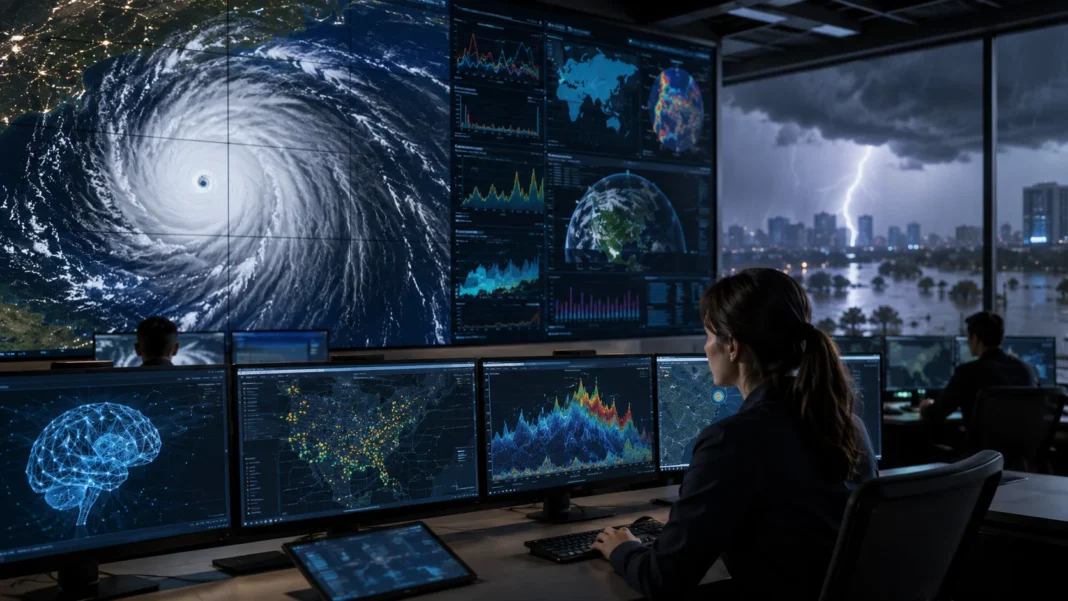
Can Artificial Intelligence Predict Natural Disasters?
Natural disasters can develop with little warning and affect entire communities within hours or even minutes. That has made one question increasingly important: Can artificial intelligence predict natural disasters? The short answer is that AI can significantly improve forecasting, hazard detection, and early warning for some disasters, but it cannot reliably predict every natural event with an exact time, location, and magnitude. Its effectiveness depends heavily on the type of hazard and the quality of available data.
Artificial intelligence works particularly well when scientists have large volumes of historical and real-time information to analyze. Machine learning models can process satellite imagery, radar observations, weather measurements, river levels, seismic signals, ocean data, and other environmental information much faster than people could examine manually. By identifying patterns within those datasets, AI can help estimate where hazardous conditions are developing and how they may change.
The technology is already moving beyond experimental research. Meteorological and geological agencies are incorporating AI into forecasting and monitoring workflows, while newer AI weather models can produce sophisticated predictions rapidly. The World Meteorological Organization says AI can strengthen forecasting and early-warning systems by quickly combining diverse information and recognizing complex patterns, while emphasizing that it should complement rather than replace established forecasting systems and expert judgment.
However, forecasting risk is different from predicting a disaster with absolute certainty. AI might identify a high probability of extreme rainfall, dangerous wildfire conditions, flooding, or drought, but nature remains complex and sometimes unpredictable. Understanding this distinction helps separate realistic scientific progress from exaggerated claims that AI will soon tell us exactly when every earthquake, hurricane, or volcanic eruption will occur.
How Does AI Predict Natural Disasters?
AI-based disaster prediction begins with data. Environmental agencies continuously collect information from weather satellites, radar, seismometers, ocean buoys, river gauges, weather stations, aircraft, ground sensors, and remote-sensing systems. Machine learning algorithms can analyze enormous quantities of these observations and search for relationships that might signal developing hazards or help forecast how environmental conditions will evolve.
Traditional forecasting models are generally built around mathematical equations describing physical processes. AI models approach some problems differently by learning patterns from historical observations or simulations. After being trained on large datasets, a model can examine new conditions and estimate what is likely to happen next. Researchers increasingly combine data-driven AI with physical science rather than treating the two approaches as competitors.
Deep learning is particularly useful when the input contains complicated spatial or visual patterns. Satellite images, radar sequences, wildfire imagery, and weather maps contain enormous amounts of information that would be difficult to process manually in real time. AI systems can repeatedly scan these data streams, identify unusual changes, and bring potentially dangerous situations to the attention of scientists and emergency managers.
The result is not necessarily a statement that a disaster “will happen.” More commonly, AI produces forecasts, probabilities, classifications, detected anomalies, or estimates of where hazards may develop. These outputs can then support meteorologists, geologists, hydrologists, emergency managers, and public authorities when deciding whether warnings should be issued or additional monitoring is required.
Why AI Is Becoming Important for Disaster Forecasting
The amount of environmental data available today is enormous. Modern satellites repeatedly observe Earth’s atmosphere, oceans, land surface, vegetation, fires, and storms, while ground-based instruments generate continuous streams of measurements. AI helps scientists process this information quickly enough for it to become useful during fast-changing emergencies.
Speed is particularly important when a hazard evolves rapidly. A severe storm, flash flood, or wildfire can change significantly while analysts are examining incoming observations. Machine learning systems can automate part of that analysis, helping experts recognize changing conditions earlier and allowing valuable time for emergency decisions.
AI can also discover statistical relationships that are difficult to recognize using simpler methods. A disaster may result from interactions among dozens or hundreds of variables rather than one obvious warning signal. Machine learning algorithms are designed to identify complex patterns across many factors and can therefore provide additional insight into developing environmental risks.
However, AI’s growing importance does not eliminate the need for scientific expertise. Data can contain errors, models can encounter conditions unlike anything in their training sets, and technically accurate forecasts still need to be translated into useful public warnings. Successful disaster forecasting therefore depends on a combination of advanced technology, reliable observations, physical science, experienced forecasters, and effective communication.
Can AI Predict Hurricanes and Severe Storms?
Weather forecasting is one of the areas where artificial intelligence has shown particularly rapid progress. AI weather models can analyze atmospheric conditions and generate forecasts much faster than many traditional numerical simulations. Advanced systems can help forecast temperature, wind, atmospheric pressure, precipitation, and other variables that contribute to hazardous weather.
Machine-learning weather models are also increasingly capable of probabilistic forecasting. Rather than producing only one possible future, probabilistic models generate multiple plausible outcomes, helping forecasters understand uncertainty. GenCast, for example, is a machine-learning weather model designed for probabilistic forecasting and was reported to outperform a leading operational ensemble system across many evaluated forecasting targets.
For tropical cyclones, AI can contribute to forecasting storm tracks, atmospheric conditions, rainfall, and other factors associated with hurricane impacts. Satellite imagery combined with machine learning can also help identify rapidly changing storm structures. These capabilities may give forecasters additional tools for understanding where dangerous weather is heading and which areas require closer attention.
Even advanced AI cannot guarantee the exact path or intensity of every storm days beforehand. Earth’s atmosphere is chaotic, meaning small uncertainties in current conditions can grow over time. AI therefore improves the forecasting process rather than removing uncertainty entirely, which is why official weather warnings and expert interpretation remain essential.
Can Artificial Intelligence Predict Floods?
Flood prediction is another promising application because flooding is influenced by measurable factors such as rainfall, soil moisture, river levels, snowmelt, terrain, drainage, and upstream water conditions. AI models can combine these variables to estimate when rivers may rise or where flooding is becoming increasingly likely.
Machine learning can be especially useful when processing large networks of river gauges and rainfall measurements. Models can learn relationships between rainfall patterns and resulting river responses, potentially improving forecasts for watersheds where sufficient historical information exists. Similar techniques can help identify areas vulnerable to flash flooding after intense rainfall.
AI-powered flood forecasting is already being explored internationally. WMO-supported pilot projects in several countries have used AI-based approaches to detect early flood signals that might otherwise have been missed, illustrating how machine learning can complement conventional hydrological forecasting, particularly where forecasting resources are limited.
Flood forecasting still carries significant uncertainty. Unexpected rainfall intensity, blocked drainage systems, dam failures, changing land use, and local terrain can affect what actually happens on the ground. The best systems therefore combine AI predictions with weather forecasts, hydrological models, physical observations, and local expertise rather than depending on one algorithm alone.
How AI Helps Predict Drought
Drought develops differently from sudden disasters because conditions can build over weeks, months, or even years. Scientists monitor precipitation, soil moisture, groundwater, streamflow, temperature, vegetation, and other indicators to understand whether an area is becoming unusually dry. AI can process these interconnected variables and help identify patterns that indicate worsening drought.
Machine learning is particularly well suited to recognizing gradual changes across large geographical areas. By learning from historical drought episodes, algorithms can estimate how current conditions compare with previous events and determine whether water shortages may develop. Earlier warning can help agricultural producers, water managers, communities, and environmental agencies prepare before conditions become severe.
A notable recent example came in March 2026, when the U.S. Geological Survey announced River DroughtCast, a machine-learning system designed to forecast streamflow drought conditions across the United States as far as 90 days ahead. The tool demonstrates how AI is moving from theoretical research toward practical environmental decision support.
AI drought forecasting is not perfect because future rainfall, temperature, water consumption, and other variables remain uncertain. Nevertheless, even probabilistic information can be valuable. Knowing that drought risk is increasing several weeks ahead can support decisions involving irrigation, reservoirs, municipal water supplies, ecosystems, and agricultural planning.
Can AI Predict Wildfires?
Wildfire prediction involves several different challenges. Scientists may want to estimate where fires are likely to start, detect newly ignited fires, predict how flames will spread, or identify communities most at risk. AI can contribute to all of these tasks by combining weather, vegetation, satellite, topographic, and historical fire data.
Machine learning models can evaluate factors such as temperature, humidity, wind, vegetation dryness, and previous fire activity to estimate wildfire risk. This does not mean the system knows exactly where someone will accidentally start a fire. Instead, it can identify environments where fires would be more likely to ignite or spread rapidly.
AI is especially powerful for early fire detection. NOAA’s Next Generation Fire System uses artificial intelligence to examine geostationary satellite imagery and detect potential fires rapidly while also helping track their growth and intensity. The system demonstrates how AI can reduce the time required to recognize developing wildfire threats from massive streams of satellite observations.
Predicting wildfire behavior remains challenging because wind shifts, terrain, changing fuel conditions, firefighting activity, and human behavior can quickly influence a fire. AI therefore works best as part of a larger decision-support system that combines satellite observations, weather forecasting, fire-behavior modeling, ground reports, and experienced emergency personnel.
Can Artificial Intelligence Predict Earthquakes?
Earthquake prediction is where claims about artificial intelligence require particular caution. Scientists currently cannot reliably predict a major earthquake by giving its precise location, magnitude, and time in advance. The U.S. Geological Survey states that scientists have not found a successful method for predicting earthquakes in this way.
AI nevertheless has important applications in earthquake science. Machine learning can detect small earthquakes hidden within noisy seismic data, classify seismic signals, estimate earthquake characteristics, and process enormous numbers of recordings. These capabilities help scientists develop more complete earthquake catalogs and understand patterns of seismic activity that conventional analysis might overlook.
Researchers are also investigating probabilistic earthquake forecasting. Instead of saying that a specific earthquake will occur at a particular time, such systems may estimate how earthquake rates, locations, or sizes could change over a defined period. Machine learning can support this research by finding statistical relationships across very large seismic datasets.
Earthquake early warning should also not be confused with earthquake prediction. Early-warning systems detect an earthquake after rupture has already begun and rapidly estimate where damaging shaking is heading. Depending on a person’s distance from the epicenter, this may provide seconds of warning before strong shaking arrives, but it does not predict the earthquake before it starts.
Can AI Predict Volcanic Eruptions?
Volcanoes often show measurable changes before eruptions, although those warning signs vary dramatically from one volcano to another. Scientists monitor seismic activity, gas emissions, ground deformation, temperature, magma movement, and other indicators that can reveal changes inside a volcanic system.
AI can help by analyzing continuous monitoring data and identifying patterns that deserve closer investigation. Machine learning may detect subtle combinations of seismic signals or deformation that would be difficult for people to recognize consistently across massive datasets. This can support volcanologists as they evaluate whether unrest is increasing.
The challenge is that volcanic unrest does not always lead to an eruption. Earthquake swarms, gas changes, or ground deformation may occur without magma ultimately reaching the surface. Different volcanoes also behave differently, making it difficult to create one universal algorithm that accurately forecasts every eruption.
AI should therefore be viewed as an additional monitoring tool rather than an automatic eruption predictor. Its greatest value may come from identifying unusual patterns quickly, prioritizing observations, and helping scientists integrate multiple streams of monitoring information before issuing hazard assessments.
Can AI Help Predict Tsunamis?
Tsunamis commonly result from large undersea earthquakes, although volcanic eruptions, landslides, and other disturbances can also generate them. Warning systems therefore rely on rapid earthquake detection, ocean observations, numerical models, and measurements of actual wave behavior.
AI can contribute by accelerating the processing of seismic and ocean data. Machine-learning techniques may help classify earthquake characteristics, improve estimates of their potential to generate tsunamis, or speed up interpretation of large sensor networks. Faster analysis can be extremely valuable when coastal communities may have only a limited period to respond.
AI can also support modeling by helping approximate complicated physical calculations more efficiently. If a model can rapidly estimate possible wave propagation and coastal impacts, emergency managers may gain additional information about which communities are likely to experience dangerous conditions.
However, tsunami warnings cannot rely solely on AI predictions. Direct observations remain extremely important because not every underwater earthquake creates a destructive tsunami. Combining seismic detection, sea-level measurements, physical models, AI tools, and established warning procedures provides a much stronger basis for public safety decisions.
Can AI Forecast Landslides?
Landslides are influenced by terrain, soil and rock properties, rainfall, vegetation, earthquakes, erosion, and human modification of slopes. Because these factors can be mapped and measured, machine learning offers useful possibilities for identifying areas where landslides are more likely.
Researchers can train models using locations of previous landslides together with information about slope, geology, rainfall, drainage, and land cover. The resulting models can produce landslide susceptibility maps showing which areas have conditions similar to places where failures occurred previously.
Real-time forecasting is more difficult. Intense rainfall may rapidly change soil conditions, and small geological differences can determine whether one hillside fails while another nearby remains stable. AI predictions therefore need accurate rainfall observations, detailed terrain information, and local geological knowledge.
Even when the exact timing of a landslide cannot be predicted, improved susceptibility mapping has practical value. Communities can use hazard information when planning roads, settlements, evacuation routes, drainage projects, or emergency monitoring, making AI useful for both disaster preparedness and land-use planning.
What Data Does AI Use to Predict Natural Hazards?
Satellite data are among the most important inputs because satellites can repeatedly monitor large areas that would be impossible to observe from the ground alone. They provide information about cloud systems, precipitation, vegetation, fires, temperature, snow cover, ocean conditions, and changes to Earth’s surface.
Ground sensors provide another critical layer of information. Seismometers record ground motion, weather stations monitor atmospheric conditions, river gauges measure water levels, and GPS instruments can detect subtle movement of Earth’s surface. These observations give AI models detailed information about changing environmental conditions.
Historical records are equally valuable during machine-learning training. Algorithms need examples of previous hurricanes, floods, fires, earthquakes, droughts, and other events so they can learn which patterns tend to occur before, during, or after hazardous conditions. The quality of those records directly affects what a model can learn.
Increasingly, disaster forecasting systems combine multiple information sources rather than depending on one dataset. Satellite observations, sensors, radar, physical simulations, maps, historical events, and real-time measurements can all contribute to a more complete understanding of risk. Combining diverse data is one of AI’s strongest potential advantages.
How Machine Learning Finds Warning Signs Humans Might Miss
Natural systems often involve relationships among numerous variables operating simultaneously. A meteorologist might examine rainfall, atmospheric pressure, wind direction, humidity, and temperature, while a machine-learning system can evaluate thousands of measurements across enormous geographical areas at once.
This ability makes AI useful for pattern recognition. A model may discover that a particular combination of environmental conditions has repeatedly appeared before specific types of hazardous events. It can then recognize similar patterns in new observations and calculate whether risk is increasing.
Deep-learning models can also process unstructured information such as satellite images and radar sequences. Instead of requiring every feature to be manually measured beforehand, the system can learn useful visual characteristics during training. This approach has contributed to rapid advances in weather forecasting and remote sensing.
However, finding a statistical pattern does not automatically prove what physically causes an event. Researchers must evaluate AI outputs carefully to determine whether the relationships are scientifically meaningful and whether the model performs reliably outside its training data. Interpretation remains an essential part of responsible AI forecasting.
AI Prediction vs. Early Warning: What Is the Difference?
Prediction generally means estimating an event before it occurs. A weather forecast predicting severe storms tomorrow is a straightforward example. The forecast provides information before the hazardous weather actually develops at a particular location.
Early warning can work differently. An earthquake warning system, for example, detects an earthquake immediately after it begins and then warns locations that have not yet experienced the strongest shaking. The event is already happening, but technology provides a short window for protective action.
Detection is another distinct concept. AI satellite systems may identify a wildfire shortly after ignition rather than predicting beforehand that the fire would start at that specific location. Faster detection can still save valuable time because authorities can respond before the event grows larger.
These distinctions matter when discussing whether AI can “predict natural disasters.” AI’s real-world value includes forecasting, risk estimation, detection, monitoring, impact modeling, and early warning. Measuring its usefulness only by whether it can perfectly predict an event would overlook many applications that can reduce disaster impacts.
What Are the Biggest Limitations of AI Disaster Prediction?
AI models depend heavily on the data used to train them. If observations are incomplete, inaccurate, geographically uneven, or biased toward certain types of events, predictions may become less reliable. Areas with limited weather stations or disaster records may therefore face additional challenges when building localized models.
Rare extreme events present another problem. Machine learning typically performs best when it has enough relevant examples from which to learn. Truly unprecedented disasters may involve combinations of conditions the model has never encountered, increasing uncertainty precisely when accurate forecasting is most important.
Environmental systems also change over time. Climate conditions, vegetation, urban development, coastlines, water use, and infrastructure can all evolve, meaning historical relationships may not remain perfectly stable. AI systems require continuous evaluation and updating as the world they are forecasting changes.
Finally, algorithms do not make emergency decisions in isolation. A model could produce technically accurate information that fails to protect anyone if warnings are unclear, people cannot access them, or emergency plans are inadequate. Disaster resilience therefore depends on communication, infrastructure, public trust, preparedness, and governance alongside forecasting technology.
Can AI Ever Predict Natural Disasters With 100% Accuracy?
It is extremely unlikely that AI will make every natural-hazard forecast perfectly accurate. Many Earth systems contain uncertainty that cannot simply be removed by using a more powerful computer. Atmospheric chaos, incomplete observations, geological complexity, and unpredictable human activity all place limits on forecasting.
Instead of expecting certainty, modern forecasting often uses probability. A system may estimate a 70% chance of a particular weather condition or identify a region with unusually high wildfire risk. Emergency managers can then use that information alongside other evidence to make decisions under uncertainty.
False alarms and missed events will remain important challenges. A system that issues too many unnecessary warnings may cause people to lose trust, while a system that rarely warns could fail during a dangerous event. Developers therefore need to evaluate both accuracy and the real-world consequences of model errors.
The goal of AI disaster forecasting should not be perfect prediction. A more realistic goal is to provide reliable information earlier, quantify uncertainty better, detect dangerous changes faster, and help people make more informed decisions. Even modest improvements in warning time can be valuable during rapidly developing hazards.
How AI Can Improve Emergency Response After a Disaster
AI’s role does not end when a disaster occurs. Satellite and aerial images collected afterward can be analyzed to identify damaged buildings, flooded neighborhoods, blocked roads, burned areas, and isolated communities. Automated analysis can help emergency teams understand the scale of an event more quickly.
Machine learning can also assist in prioritizing resources. When authorities receive thousands of reports, images, sensor readings, and infrastructure updates simultaneously, AI tools can help organize information and highlight areas that may require urgent attention.
Predictive models may estimate where secondary hazards could develop. Heavy rainfall after a wildfire can increase debris-flow risk, while damaged infrastructure after an earthquake may create additional safety concerns. Combining changing conditions with hazard models can support continuing emergency decisions.
Human oversight remains crucial because disaster environments contain incomplete and rapidly changing information. AI should help emergency professionals process evidence, not automatically determine who receives assistance. Local knowledge, direct observations, and experienced decision-makers remain essential.
How AI Could Change Disaster Forecasting in the Future
One major direction is faster weather modeling. Traditional global forecasting systems require substantial computing resources, whereas newer machine-learning models can generate forecasts more efficiently. NOAA is already developing pathways for integrating AI-driven global forecasting models into operational weather-prediction environments.
Another direction is multimodal forecasting, where systems analyze several forms of information simultaneously. Future disaster models may combine satellite images, sensor measurements, weather forecasts, geographic information, physical simulations, and historical data in increasingly integrated systems.
Localized forecasting could also improve. Global models provide essential broad-scale information, but communities often need neighborhood-level answers about flooding, wildfire spread, heat, or storm impacts. Improvements in sensors, computational efficiency, and machine learning may allow increasingly detailed risk estimates.
The most effective future systems will probably combine AI with established science rather than replacing traditional models entirely. WMO’s current approach similarly emphasizes that AI forecasting should complement existing numerical prediction, observations, and professional meteorological expertise. Such hybrid systems can take advantage of AI’s speed while retaining scientific knowledge developed over decades.
Will AI Replace Meteorologists and Disaster Scientists?
AI can automate many tasks, but forecasting involves much more than generating model output. Meteorologists and other scientists compare multiple models, recognize unusual situations, interpret uncertainty, understand local conditions, and communicate risks to decision-makers and the public.
Human expertise becomes particularly important when models disagree or encounter rare conditions. An algorithm trained primarily on historical patterns may struggle with an unprecedented event, whereas experienced scientists can incorporate physical reasoning and observations that fall outside the model’s normal assumptions.
Scientists also evaluate whether AI tools themselves are trustworthy. They test models across different regions and weather situations, identify systematic errors, determine when forecasts become unreliable, and decide how outputs should be incorporated into operational systems.
The more realistic future is therefore collaboration between humans and AI. Algorithms can handle massive datasets and repetitive calculations rapidly, while experts provide scientific interpretation, contextual judgment, communication, and accountability. Together, those strengths can potentially produce more useful warnings than either approach alone.
How AI Early Warnings Could Save Lives
The greatest benefit of AI for natural disaster prediction may be additional preparation time. Even a relatively small improvement in warning time can allow authorities to close roads, evacuate vulnerable locations, position emergency personnel, secure infrastructure, or communicate safety information.
For individuals, earlier warnings can provide time to reach safer locations, protect family members, move away from flood zones, or follow official emergency instructions. The usefulness of that warning depends on whether it reaches people quickly and whether they know how to respond.
AI can also help places with limited forecasting infrastructure by making advanced prediction techniques computationally more accessible. International initiatives are exploring how AI weather forecasting and early-warning tools can support countries that have fewer conventional forecasting resources.
Technology alone cannot guarantee safety, however. Warnings must be understandable, trusted, accessible, and linked to practical emergency plans. The strongest disaster-protection systems connect accurate science with effective communication and community preparedness.
Is AI the Future of Natural Disaster Prediction?
Artificial intelligence is likely to become an increasingly important part of disaster forecasting, but the phrase “prediction” needs to be interpreted carefully. AI already helps identify developing hazards, generate weather forecasts, detect wildfires, estimate drought risk, process seismic data, and support flood forecasting.
Its capabilities differ substantially by hazard. Weather-related disasters provide relatively rich datasets and measurable atmospheric conditions, making forecasting more achievable. Exact earthquake prediction remains beyond current scientific capability, while volcanoes, landslides, and tsunamis present different combinations of monitoring and forecasting challenges.
AI’s most significant contribution may therefore be reducing uncertainty rather than eliminating it. Better probabilities, faster calculations, earlier detection, and more efficient analysis can give scientists and authorities clearer information before and during dangerous events.
As models improve, the question may gradually shift from “Can AI predict disasters?” to “How effectively can AI help communities act before disaster impacts become severe?” That distinction keeps attention where it matters most: using technology to support earlier decisions, stronger preparedness, and safer communities.
Final Thoughts: Can Artificial Intelligence Predict Natural Disasters?
So, can artificial intelligence predict natural disasters? In certain situations, AI can forecast hazardous conditions and estimate disaster risk remarkably well, particularly for weather, floods, drought, and wildfire-related hazards. In other situations, it is better suited to rapid detection, monitoring, or probabilistic forecasting rather than precise prediction.
Artificial intelligence is powerful because it can process huge amounts of environmental data rapidly. Satellite observations, weather records, seismic signals, river measurements, and other information can be examined together, allowing algorithms to identify developing patterns that may deserve immediate attention.
However, AI does not eliminate uncertainty from nature. Earthquakes cannot currently be predicted precisely, extreme events can behave unexpectedly, and every model has limitations. Predictions therefore need expert interpretation and should be combined with physical science, reliable monitoring networks, and established warning systems.
The real promise of AI is not a perfect machine that knows exactly where and when every disaster will happen. Its value is helping humanity recognize danger earlier, understand possible outcomes more clearly, and make faster decisions. Used responsibly alongside scientific expertise, AI can become an increasingly valuable tool for reducing the human and economic impacts of natural hazards.
Frequently Asked Questions
Can AI predict earthquakes before they happen?
AI can analyze seismic patterns and improve earthquake monitoring, but it cannot currently predict the exact time, location, and magnitude of a major earthquake before it begins. Earthquake early-warning systems instead detect earthquakes rapidly after rupture starts.
Can AI predict floods?
AI can help forecast floods by analyzing rainfall, river levels, soil moisture, terrain, and historical flooding patterns. Its predictions are probabilistic, so they are generally combined with hydrological models and real-time observations.
How is AI used to predict natural disasters?
AI analyzes large environmental datasets from satellites, sensors, radar, weather stations, river gauges, and historical records. Machine learning then identifies patterns that can support hazard forecasting, detection, risk mapping, and early warnings.
Which natural disasters can AI predict best?
AI currently has particularly strong applications in weather forecasting, flood prediction, drought monitoring, and wildfire detection. Its effectiveness varies because different natural hazards have different causes, warning signals, and available datasets.
Will AI ever predict every natural disaster accurately?
Probably not with complete certainty because many natural systems are inherently complex and contain unavoidable uncertainty. The more realistic goal is better forecasting, faster detection, longer warning times, and more reliable estimates of risk.