


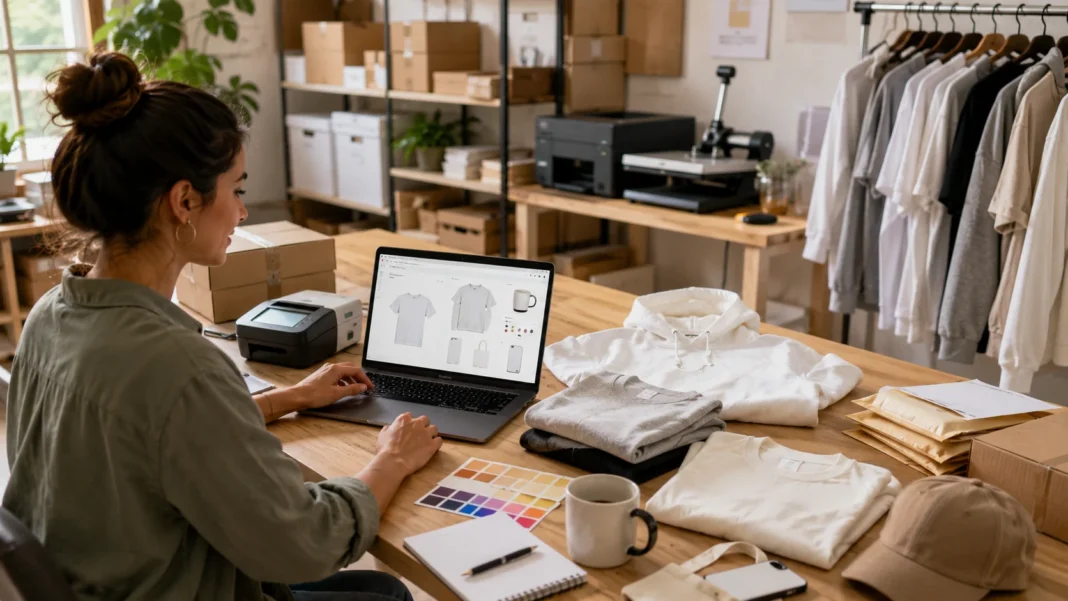
How to Start a Print on Demand Business: A Beginner’s Guide
Starting an online business no longer requires filling your garage with inventory or investing thousands of dollars in products before making your first sale. Print on demand has created a simpler path for entrepreneurs who want to sell customized products without managing manufacturing, warehousing, or traditional order fulfillment. It is especially attractive to designers, creators, niche website owners, and beginners looking for a relatively low-cost ecommerce business model.
A print on demand business allows you to create designs and place them on products such as T-shirts, hoodies, mugs, posters, tote bags, phone cases, notebooks, and home décor items. Products are normally manufactured only after a customer places an order. Your print on demand supplier then produces the item and ships it directly to the customer, meaning you do not need to purchase large quantities beforehand.
However, low barriers to entry do not mean instant success. Competition can be strong, and simply uploading random designs is unlikely to build a profitable business. Successful sellers generally focus on a clearly defined audience, distinctive designs, reliable suppliers, competitive pricing, strong branding, and consistent marketing. Treating print on demand like a real ecommerce company rather than a quick-money scheme can make a significant difference.
If you are wondering how to start a print on demand business, this guide walks you through the process from niche research and product selection to store creation, pricing, marketing, and scaling. Whether you want to create a side business or develop a larger online brand, these practical steps can help you build a stronger foundation from the beginning.
What Is a Print on Demand Business?
Print on demand, commonly shortened to POD, is an ecommerce fulfillment model in which products are created after customers order them. Instead of purchasing hundreds of printed shirts or mugs before knowing whether they will sell, you upload your designs to products offered by a print provider. When someone buys an item, the provider prints, packages, and ships it on your behalf.
The process is often automated through an ecommerce platform or online marketplace. A customer places an order through your store, the order details are sent to your print on demand supplier, and the supplier handles production. You generally pay the supplier’s base product and fulfillment cost while keeping the difference between your selling price and your overall expenses.
One major advantage is that you can test different products and designs without maintaining large amounts of physical inventory. If one design receives little attention, you can remove it without being stuck with unsold boxes of merchandise. This flexibility makes POD particularly useful for experimenting with niche products, seasonal collections, creator merchandise, and personalized designs.
The model also has limitations. Because products are generally produced individually rather than through large bulk manufacturing runs, your cost per item may be higher. You also have less direct control over production and shipping because another company handles those operations. Choosing dependable suppliers and building healthy profit margins are therefore essential parts of creating a sustainable POD business.
How Does Print on Demand Work?
The print on demand process begins when you create an original design or artwork that can be printed on physical merchandise. You then choose appropriate products from a supplier’s catalog and create mockups showing customers how the finished item should look. These products are published on your ecommerce store or marketplace along with descriptions, pricing, images, and other product information.
When a customer purchases something, the payment normally comes through your selling platform. The supplier receives the order information and charges you for the base product, printing, and fulfillment costs. Production begins only after the order has been submitted, which removes the traditional requirement to buy stock before customers actually want it.
After printing, the supplier packages the item and ships it to the customer’s address. Depending on the provider and service level, packaging may be generic or may offer certain branding options. Tracking information can usually be passed back to your store so customers can follow their orders without you personally handling every parcel.
Your responsibility is largely focused on everything surrounding production. You select profitable niches, create designs, develop the brand, build product pages, attract visitors, communicate with customers, and manage the financial side of the business. The supplier handles much of the physical fulfillment, but the customer usually sees you as the seller and expects you to resolve any problems.
Why Start a Print on Demand Business?
One of the strongest reasons people choose print on demand is the relatively low upfront financial commitment. Traditional ecommerce businesses may require large inventory purchases before selling anything. POD allows entrepreneurs to list products without first ordering dozens or hundreds of units, making it easier to test a business idea while keeping initial financial risk relatively manageable.
Print on demand can also be operated remotely. You do not normally need a warehouse, printing equipment, packaging station, or employees to prepare orders manually. Most administrative work can be completed from a laptop, including design creation, product listings, marketing, customer support, analytics, and supplier management.
The model is also flexible when it comes to product testing. You might launch five T-shirt designs, discover that customers strongly prefer one specific theme, and then expand that winning idea into sweatshirts, mugs, posters, and tote bags. Instead of predicting demand months in advance, you can respond to actual customer behavior.
Another advantage is the ability to build around a highly specific community. Instead of competing with enormous general fashion brands, you might develop products specifically for gardeners, nurses, dog owners, programmers, teachers, cyclists, book lovers, or another recognizable audience. Strong niche positioning can make your products feel more relevant and memorable than generic merchandise.
Step 1: Choose a Profitable Print on Demand Niche
Your niche is the specific group of people you intend to serve. Rather than creating products for everyone, successful POD businesses often focus on audiences with shared interests, professions, hobbies, lifestyles, identities, or passions. Examples could include camping enthusiasts, coffee lovers, mechanics, runners, new parents, pet owners, gamers, or people interested in particular hobbies.
A strong niche should provide enough potential customers while still being specific enough for targeted marketing. Extremely broad markets such as “funny shirts” can be difficult because thousands of sellers compete for similar buyers. A more focused category such as humorous gifts for RV travelers gives you clearer ideas for designs, keywords, messaging, and advertising.
Research what potential customers already purchase and discuss. Look at search suggestions, ecommerce marketplaces, social platforms, communities, trend tools, and competitor stores. Pay attention to repeated phrases, frustrations, inside jokes, hobbies, gift occasions, seasonal interests, and identity-based buying behavior. These insights can inspire products that feel created specifically for the target audience.
Do not select a niche only because it appears popular. Ideally, you should understand the audience well enough to create authentic designs and marketing. Consider whether the niche gives you enough product ideas for months of content and new releases. A business built around a sustainable theme generally has more room to grow than one based entirely on a short-lived trend.
Step 2: Research Your Competitors Before Creating Products
Competitor research helps you understand what already exists and where opportunities may remain. Search marketplaces, independent ecommerce stores, Google results, Pinterest, Instagram, TikTok, and other places where your target customers might discover products. Look for businesses selling similar themes rather than copying only the largest generic POD stores.
Study their product selection, prices, customer reviews, visual branding, descriptions, social content, and promotional strategies. Notice which products appear repeatedly and which designs receive high engagement. Customer reviews are especially useful because they can reveal what buyers appreciate and where existing sellers are disappointing them.
You should also identify gaps. Perhaps competitors have attractive designs but poor product descriptions. Maybe they focus almost entirely on shirts while customers appear interested in posters or embroidered hats. You might notice that most stores use similar humor and visual styles, creating an opportunity for more premium, minimalist, personalized, or emotionally meaningful products.
Competitor research should inspire strategic decisions rather than imitation. Copying another seller’s artwork, slogans, photographs, or branding can create ethical and legal problems while preventing you from developing a recognizable business. Your objective should be to understand the market and then create something customers can distinguish from existing alternatives.
Step 3: Decide What Print on Demand Products to Sell
T-shirts are one of the most familiar POD products, but you do not have to build your entire store around apparel. Depending on your audience and supplier, you may be able to sell hoodies, sweatshirts, tank tops, hats, mugs, posters, canvas prints, blankets, phone cases, tote bags, notebooks, stickers, pillows, or other customized merchandise.
Start with products that make sense for your niche instead of uploading every item available in a supplier’s catalog. A business targeting interior design enthusiasts might focus on wall art and home accessories, while a fitness-oriented brand might prioritize shirts, hoodies, bottles, and gym-related products. Product relevance usually matters more than offering an enormous catalog.
Think carefully about the balance between demand, quality, production cost, shipping cost, and potential selling price. A product may look attractive but leave little profit after supplier fees, platform fees, advertising, taxes, discounts, and customer service expenses. Calculate your approximate margin before committing large amounts of time to designing an entire collection.
Ordering samples is one of the most useful steps you can take. Mockups cannot fully show fabric quality, print accuracy, color appearance, sizing, packaging, or the experience of receiving the order. Seeing your products personally allows you to identify potential issues before customers experience them and gives you material for original photographs and marketing content.
Step 4: Choose a Reliable Print on Demand Supplier
Your supplier plays a major role in the customer experience because it creates and ships the physical product. Research potential print providers based on product quality, production locations, printing methods, fulfillment speed, shipping options, pricing, product variety, integrations, customer support, return procedures, and branding capabilities.
Different suppliers may be better suited to different businesses. Some offer enormous product catalogs and international fulfillment networks, while others focus on premium apparel, specialty products, sustainability, personalized merchandise, or particular geographic markets. The cheapest provider is not automatically the best choice if inconsistent quality creates complaints and refunds.
Consider where your customers are located. If most buyers are in the United States but every order is produced far away, longer delivery times and international shipping expenses can reduce conversions. Providers with production facilities closer to your target customers can sometimes make fulfillment faster and provide a smoother customer experience.
Before launching heavily, test the supplier yourself. Order multiple product samples if possible and evaluate printing, product construction, packaging, delivery communication, and shipping speed. A customer does not usually care that another company produced the item. If something goes wrong, your brand is likely to receive the complaint.
Step 5: Create Designs People Actually Want to Buy
Your designs are one of the strongest ways to differentiate a print on demand business. Attractive designs do not necessarily need to be complicated. Typography, illustrations, minimalist graphics, patterns, humorous phrases, personalized names, or niche-specific artwork can all perform well when they connect with the right audience.
Begin with the customer rather than designing only according to personal taste. Ask what someone in your niche would proudly wear, display, give as a gift, or share with friends. Designs connected to an emotion, community, occasion, profession, hobby, or personal identity can often feel more meaningful than generic decorative graphics.
You can create designs yourself using appropriate graphic design software or work with freelance designers and professional illustrators. AI-assisted creative tools may also support ideation and certain workflows, but sellers should carefully understand usage rights, platform policies, and intellectual property concerns before commercially using generated or third-party assets.
Always create original work or use assets that include appropriate commercial licensing. Do not assume that an image, quote, character, logo, celebrity name, or design found online is free to print and sell. Intellectual property mistakes can lead to listings being removed, marketplace account problems, complaints, or potentially more serious legal consequences.
Step 6: Build a Strong Print on Demand Brand
A brand is more than your logo. It includes the personality, visual appearance, positioning, values, product style, messaging, and overall experience customers associate with your business. Strong branding makes a POD store feel like a legitimate company rather than a collection of unrelated designs uploaded to an ecommerce website.
Choose a memorable business name that suits your niche and leaves room for future growth. Develop a consistent visual identity using complementary fonts, imagery, design styles, and packaging elements where possible. Your social media profiles, website, product mockups, emails, and advertisements should feel as though they belong to the same business.
Your brand also needs a recognizable promise or point of view. Perhaps you create witty products specifically for healthcare professionals, premium minimalist clothing for hikers, sentimental gifts for pet owners, or colorful home accessories for book lovers. Clear positioning helps customers quickly understand why your store is relevant to them.
Consistency becomes even more important as the catalog grows. If every product looks like it came from a different company, customers may struggle to remember your business. Establishing a distinct aesthetic and voice can increase recognition and make future product launches more valuable because existing customers already understand what your brand represents.
Step 7: Decide Where You Will Sell Your Products
You can sell print on demand products through your own ecommerce website, online marketplaces, social commerce channels, or a combination of different platforms. Each approach provides different advantages related to traffic, branding, control, costs, customer relationships, competition, and ease of setup.
Marketplaces can provide access to shoppers who are already searching for products. However, sellers usually compete closely with other listings and must follow the marketplace’s policies and fee structure. Your ability to control branding and customer relationships may also be more limited than when selling through an independent website.
An ecommerce website gives you greater control over design, branding, pricing, customer experience, and marketing. However, you are responsible for generating your own traffic through methods such as SEO, content marketing, email, social media, influencer partnerships, and paid advertising. Building traffic can require patience, particularly for a completely new brand.
Many businesses eventually use multiple channels. A marketplace can provide early product validation while an independent store becomes the long-term home of the brand. Avoid spreading yourself across too many platforms at the beginning, though. Mastering one or two sales channels is often more manageable than poorly maintaining five different storefronts.
Step 8: Create an Ecommerce Store That Builds Trust
Your store should make customers feel comfortable purchasing from a business they may never have encountered before. Use a clean layout, easy navigation, high-quality mockups or photographs, clear pricing, readable fonts, and simple product categories. Avoid making visitors search unnecessarily for basic information about products or ordering.
Product pages deserve particular attention. Include accurate descriptions, sizing information where appropriate, materials, care instructions, expected production details, shipping information, and helpful product images. Instead of writing generic descriptions, explain why the product would appeal to your specific audience and what makes the design meaningful.
Trust-related pages are also important. Depending on your business and location, customers may expect clear shipping information, return or refund policies, privacy information, contact details, and terms of service. Policies should accurately reflect how your supplier and store actually operate rather than being copied blindly from another website.
Mobile usability should be a priority because many shoppers discover products through mobile search and social platforms. Test product pages, checkout, menus, images, buttons, and forms from a phone before launching. A beautiful desktop store can still lose potential customers if shopping becomes frustrating on smaller screens.
Step 9: Price Your Print on Demand Products for Profit
Pricing should begin with your true costs rather than simply copying competitors. Your expenses can include the supplier’s base product price, printing, fulfillment, shipping subsidies, marketplace fees, payment processing, software subscriptions, advertising, refunds, taxes, discounts, and other operating expenses.
Suppose your total cost for fulfilling a product is significantly higher than the price customers expect to pay. Even strong sales could leave you with little profit. Calculate an estimated contribution margin for each product and decide how much room remains for marketing, unexpected expenses, and business growth.
Do not automatically compete by being the cheapest seller. Customers may pay more for strong designs, premium products, personalization, superior branding, compelling photography, faster delivery, or products that closely match their identity. A well-positioned niche brand can often compete on perceived value rather than price alone.
Review your pricing regularly. Supplier costs, shipping rates, platform charges, advertising expenses, and customer expectations may change over time. Track profitability at the product level so you know which items actually contribute to the business rather than judging performance only by total revenue.
Step 10: Optimize Product Pages for SEO
Search engine optimization can help people discover your products without requiring you to pay for every website visit. Begin with keyword research to understand how potential customers describe the products you sell. Focus particularly on specific phrases that indicate someone may be interested in purchasing rather than purely informational searches.
Use important keywords naturally in product titles, descriptions, category pages, image information, URLs, headings, and supporting content where appropriate. Avoid repeating the same phrase unnaturally simply to increase keyword frequency. Modern SEO depends heavily on satisfying search intent and providing useful information rather than keyword stuffing.
Long-tail keywords can be especially valuable for niche POD businesses. Ranking for an extremely broad term such as “T-shirt” may be unrealistic, while a more specific phrase related to your audience, style, occasion, or product could attract visitors with clearer purchasing intent. Specific search terms can also inspire new product collections.
Content marketing can strengthen ecommerce SEO beyond product pages. Publish useful gift guides, niche-specific articles, style guides, buying advice, seasonal content, or educational resources connected to your products. Internal links between relevant articles, collections, and products can help visitors discover more of your store while strengthening site structure.
Step 11: Market Your Print on Demand Business
A store cannot generate consistent sales if the right customers never discover it. Marketing should therefore begin alongside product development rather than after the store is finished. Your most effective marketing channels will depend on where your target audience spends time and how they normally discover products.
Visual platforms can work particularly well for print on demand because the products themselves provide content opportunities. Show products in real environments, demonstrate different styles, share behind-the-scenes design processes, publish customer photos, create niche-related videos, and develop content people would want to save or share even if they are not immediately purchasing.
Email marketing provides another valuable channel because it allows you to communicate repeatedly with people who have already shown interest. You can use email to announce new collections, send abandoned-cart reminders where appropriate, share promotions, recommend products, provide useful niche content, and encourage previous customers to return.
Paid advertising can accelerate testing, but it should be approached carefully. Advertising an untested product with weak margins can quickly consume your budget. Start with manageable experiments, track conversions and customer acquisition costs, and increase spending only when the economics make sense rather than assuming additional ad spend automatically creates profit.
Step 12: Use Social Media to Build an Audience
Social media works best when your account provides something beyond constant product promotion. People generally follow accounts because they find the content entertaining, educational, relatable, inspiring, or useful. Build content around the interests of your niche and naturally incorporate your products into that wider conversation.
For example, a print on demand brand for teachers might create funny classroom content, relatable teaching experiences, gift ideas, inspirational posts, and product videos. A hiking brand could publish trail-related humor, outdoor tips, adventure content, and customer stories. Your audience becomes interested in the community rather than seeing every post as an advertisement.
Short-form video can help demonstrate personality and product appearance more effectively than static mockups alone. Record samples being worn, unpacked, styled, given as gifts, or placed in real settings. Original content can also increase credibility by proving that you have actually seen the products you are selling.
Avoid chasing every social platform simultaneously. Choose one or two platforms where your audience is active and develop consistent content before expanding. Study which posts generate profile visits, saves, shares, comments, website clicks, and sales, then produce more content around formats and themes that demonstrate meaningful engagement.
Step 13: Deliver Excellent Customer Service
Even though your supplier fulfills orders, customer service remains your responsibility. Buyers interact with your store and associate the purchase with your brand. When an item arrives late, has a printing defect, or appears different from expectations, customers will generally contact you rather than the printing company.
Create a clear process for handling common issues. Understand your supplier’s policies regarding damaged products, incorrect items, lost packages, address problems, and reprints. Respond to customers professionally and avoid forcing them to communicate directly with suppliers when you are the merchant they purchased from.
Set realistic expectations from the beginning. Print on demand products often require production time before shipping, so customers should understand that the item may not leave a facility immediately after ordering. Clear shipping information can reduce unnecessary support requests and prevent disappointment around birthdays, holidays, or gift deadlines.
Customer feedback can also improve the business. If several buyers mention confusing sizing, weak packaging, slow production, or a particular design problem, investigate it rather than treating every complaint as an isolated incident. Solving recurring problems can improve reviews, reduce refunds, and increase the likelihood of repeat purchases.
Step 14: Track the Right Print on Demand Metrics
Revenue alone does not tell you whether your business is healthy. A store can generate substantial sales while losing money if product costs, advertising, platform fees, and refunds are too high. Track financial and marketing metrics so you understand where profit actually comes from.
Important metrics may include conversion rate, average order value, gross margin, customer acquisition cost, refund rate, repeat purchase rate, traffic sources, advertising return, and profit per product. These measurements can help you identify which products and channels deserve additional investment.
Also evaluate design-level performance. If one design receives many product views but few purchases, the price, mockup, product type, or design itself may need improvement. If another item consistently converts well, consider creating complementary products or variations based on the same customer interest.
Data should guide decisions without eliminating creativity. Print on demand involves testing ideas, and not every design will succeed. Instead of becoming attached to unsuccessful products, use sales and customer behavior to determine what deserves additional promotion and what should be redesigned, repositioned, or removed.
How Much Does It Cost to Start a Print on Demand Business?
One reason POD attracts beginners is that you can start without purchasing bulk inventory or expensive printing machinery. However, calling it completely free can be misleading. You may still spend money on an ecommerce platform, domain name, samples, graphic design tools, professional artwork, marketplace fees, marketing, and other business expenses.
Your startup budget depends heavily on the approach you choose. Selling through a marketplace may reduce some website-related expenses, while creating a standalone branded store typically involves additional software and domain costs. Paid advertising can also become one of the largest expenses if you use it aggressively during product testing.
You should budget for product samples even when trying to keep expenses low. Seeing the product yourself can help you verify quality and create more authentic marketing materials. Spending a modest amount to discover a serious product-quality problem before dozens of customers order it can save considerably more money later.
Begin with the smallest realistic setup that allows you to validate demand. You do not need dozens of premium tools, hundreds of designs, or a large advertising budget on day one. Build a professional foundation, test carefully, reinvest a portion of successful sales, and increase spending when results justify additional investment.
Is Print on Demand Profitable?
Print on demand can be profitable, but the business model does not guarantee profit. Your results depend on product pricing, supplier expenses, platform fees, marketing costs, conversion rates, customer demand, product quality, and the strength of your designs. Two stores selling similar products can have dramatically different financial outcomes.
Margins can be tighter than in bulk manufacturing because suppliers handle production individually and provide fulfillment services. That convenience has a cost. Successful sellers therefore pay close attention to average order value, premium positioning, upsells, repeat purchases, organic traffic, and other strategies that improve unit economics.
Niche selection also influences profitability. A distinctive product created for a passionate audience may face less direct price competition than generic designs available from hundreds of sellers. Strong branding can further increase perceived value and reduce the pressure to become the cheapest option in the market.
Think about profitability over time rather than judging the business from the first few weeks. Early stages may involve spending on samples, design, store development, and marketing while you learn what customers want. The objective is to identify repeatable products and acquisition channels that can eventually generate sustainable margins.
Common Print on Demand Mistakes to Avoid
One major mistake is launching too many random products without clear positioning. A store selling nurse shirts, gaming mugs, wedding posters, dog pillows, and motivational notebooks may struggle to create a recognizable audience. A focused niche usually makes branding, content, advertising, and product development easier.
Another common mistake is choosing suppliers based entirely on price. Saving a small amount per product can become expensive if poor printing, long shipping delays, or inconsistent quality creates refunds and negative reviews. Product quality influences customer satisfaction, repeat purchases, and the reputation of your brand.
Ignoring intellectual property is equally dangerous. Finding popular designs online and recreating them does not make them safe for commercial use. Avoid copyrighted artwork, protected characters, trademarks, brand logos, and other intellectual property unless you have appropriate rights or licensing to use them.
Finally, many beginners expect immediate passive income. Print on demand automates manufacturing and fulfillment, but it does not automate customer acquisition, branding, design strategy, support, SEO, product research, or financial management. Building a dependable business generally requires repeated testing, learning, optimization, and consistent marketing.
How to Scale a Print on Demand Business
Once you discover products that consistently sell, expand strategically rather than adding random designs. Develop variations, complementary products, seasonal versions, bundles, or personalized options connected to proven customer interests. Successful designs can become the foundation of larger collections.
Increase marketing around products with demonstrated demand. Improve their product pages, create more social content, build SEO resources around relevant searches, collect customer-generated content, and test advertising. It is often more efficient to strengthen a winner than continually search for completely new ideas.
You can also increase average order value through bundles, complementary recommendations, quantity incentives, and strategic free-shipping thresholds when financially appropriate. Encourage existing customers to purchase again with new collections, email campaigns, loyalty offers, and products related to previous purchases.
As order volume grows, review whether print on demand remains the best production method for every product. Some successful brands eventually move particular bestsellers to bulk manufacturing while continuing to use POD for testing and lower-volume designs. Print on demand can therefore be both a long-term fulfillment model and a useful product-validation strategy.
Is Print on Demand Worth Starting?
Print on demand can be worthwhile for entrepreneurs who value low inventory risk, creative flexibility, and the ability to test products relatively quickly. It is particularly suitable for niche brands, artists, content creators, community-based businesses, and beginners who want ecommerce experience without managing a warehouse.
However, POD is not an automatic source of passive income. Competition exists, margins require careful management, and customers still expect professional service. The strongest businesses combine useful market research, distinctive products, reliable fulfillment, compelling branding, and consistent traffic generation.
You should also consider your own strengths. Someone who enjoys design may need to improve marketing, while a strong marketer might need help producing professional artwork. Understanding your weaknesses early allows you to develop skills, use appropriate tools, or outsource specific tasks instead of expecting to manage everything perfectly alone.
Approach the business as an ongoing testing process. Your first niche, product, or design does not have to become your permanent direction. Use real customer data to improve decisions, keep your expenses controlled, and gradually build around the products and messages that generate genuine demand.
Final Thoughts on How to Start a Print on Demand Business
Learning how to start a print on demand business begins with understanding that POD is a fulfillment method, not a complete business strategy. The supplier may produce and ship your products, but you are still responsible for choosing the market, creating valuable products, attracting customers, building trust, and managing profitability.
Start by selecting a specific niche and researching what that audience genuinely cares about. Choose relevant products, work with a reliable print on demand supplier, create original designs, and build consistent branding. Order samples before aggressively marketing the store so you understand exactly what your customers will receive.
Next, focus on visibility. Optimize your store for search engines, publish useful content, develop social media channels, build an email audience, and test advertising carefully when your margins allow it. Track product performance and profitability rather than assuming that high traffic or revenue automatically means the company is successful.
Most importantly, remain patient and willing to test. Some designs will fail while others may reveal opportunities you never expected. By listening to customers, analyzing your data, improving your products, and consistently building your brand, you can transform print on demand from a simple product experiment into a sustainable ecommerce business.
Frequently Asked Questions
Can I start a print on demand business with no money?
You can begin researching niches and creating ideas with little money, but a professional launch usually involves some expenses. Samples, store fees, domains, design tools, marketing, or marketplace charges may require a modest startup budget.
Do I need an LLC to start a print on demand business?
Not necessarily. Business structure requirements vary by location and circumstances. You may be able to start under another structure, but consider taxation, liability, registration requirements, and professional advice when deciding how to organize your business.
What are the best products for print on demand beginners?
T-shirts, sweatshirts, mugs, posters, tote bags, and other familiar products can be beginner-friendly. The best choice ultimately depends on your niche, supplier quality, customer demand, shipping costs, and available profit margin.
How much can you make with print on demand?
Income varies widely between sellers. Profit depends on sales volume, margins, product costs, marketing expenses, niche demand, conversion rates, and repeat customers, so there is no guaranteed monthly income from print on demand.
Is print on demand good for beginners?
Yes, POD can be an accessible ecommerce model because you typically do not need to purchase bulk inventory. Beginners still need to learn niche research, design, pricing, SEO, marketing, customer service, and financial management to succeed.